DeFi Asset Tokenization: Uses, Benefits and Challenges
Tokenized assets can be lent, traded and used as collateral inside DeFi protocols. Here is how that works, where it helps, and what can go wrong.
On this page
Short answer
DeFi asset tokenization turns real-world assets such as bonds, property shares and fund units into tokens that lending pools, exchanges and vaults can use. The benefits are smaller minimums, faster settlement and income plus liquidity from one asset, while the challenges are regulation, thin markets and the strength of the claim behind the token.
What is DeFi asset tokenization?
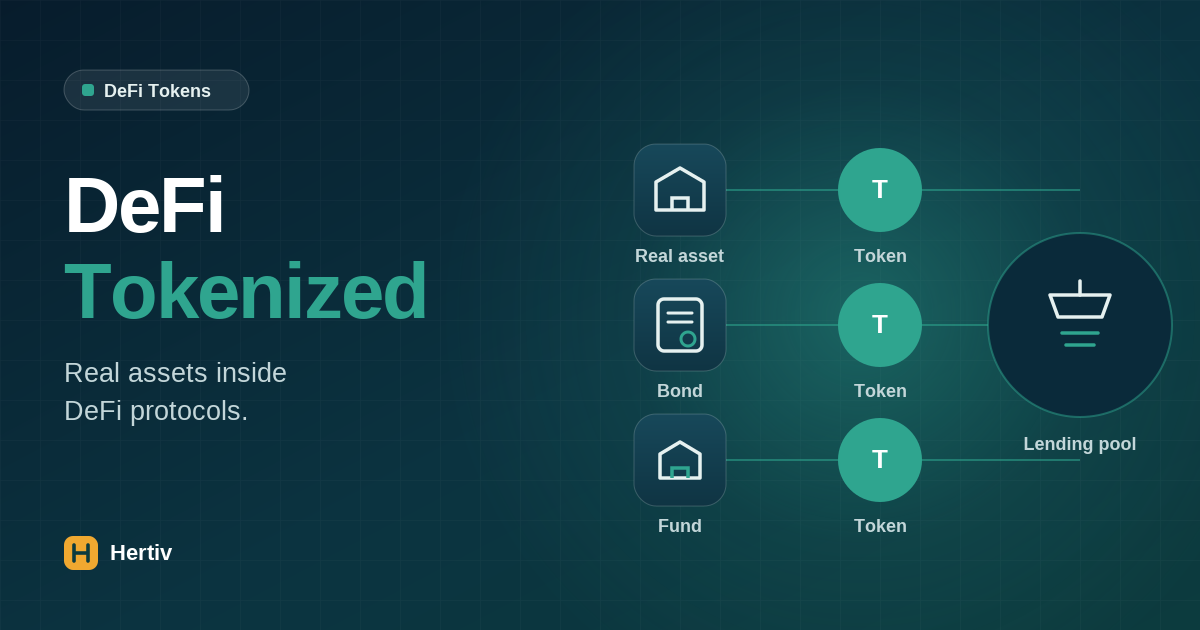
DeFi asset tokenization is the process of turning a real-world asset, such as a bond, a property share or a fund unit, into a token that can be used inside decentralised finance protocols. The token stands for a claim on the asset, and the protocol treats it like any other token: it can be lent, traded or locked as collateral.
The idea connects two worlds. Off chain, a legal structure holds the asset and issues tokens against it. On chain, those tokens move through lending pools, exchanges and vaults without a bank in the middle. The link between the two is the part that needs the most care, because the token is only as good as the claim behind it.
Tokenized assets are not the same as crypto-native tokens. A crypto-native token is created on chain, while a tokenized asset starts off chain and is brought on chain by an issuer. That difference shapes the risks, the rules and who can hold the token. For the asset-class view, see real-world asset tokenization use cases.
How do tokenized assets enter DeFi?
Tokenized assets enter DeFi in five steps, and each step adds a check that the token is what it claims to be. Skipping a step does not stop the token from trading, but it leaves the holders with less protection if something goes wrong.
- The asset is held. A legal entity holds the bond, property or fund, and records who owns what.
- Tokens are issued. The issuer mints tokens on a blockchain, each one standing for a share of the asset.
- Rules are set. The token contract limits who can hold or transfer it, so it stays within the law.
- The token is listed. A lending pool or exchange accepts the token, usually after checking the issuer and the asset.
- It is used. Holders lend it, borrow against it, or trade it, and the yield or income flows back to them.
The issuer and the protocol both matter. A strong issuer with a weak protocol still leaves holders exposed to a smart contract bug, and a strong protocol with a weak issuer leaves them exposed to an asset that is not really there.
What are the main use cases?
The main use cases for DeFi asset tokenization are lending, trading and yield, all built on tokens that represent something real. Each use case works because the token can move inside a protocol, while the asset itself stays where it is.
| Use case | How it works | Who it suits |
|---|---|---|
| Lending against tokens | Lock a tokenized bond as collateral and borrow stablecoins | Holders who need cash without selling |
| Tokenized fund units | Buy and sell fund units on chain, in small amounts | Investors who want smaller minimums |
| On-chain trading | Trade tokenized assets on a decentralised exchange | Traders who want round-the-clock markets |
| Yield vaults | Deposit tokens in a vault that earns income from the asset | Holders seeking regular income |
| Cross-border settlement | Settle a trade in minutes instead of days | Firms moving money between countries |
Lending is the most common use case today, because it is the simplest to explain: a token that is worth something can back a loan. The other uses grow as more assets are tokenized and more protocols accept them. For the property angle, see what real estate tokenization is.
What are the benefits?
The benefits of DeFi asset tokenization are smaller minimums, faster settlement and markets that do not close. A bond that once needed a large minimum can be split into tokens that many more people can buy, and a trade that took days to settle can finish in minutes.
A second benefit is that the token can be used while it is held. A tokenized bond sitting in a wallet earns its coupon, and the same token can be locked as collateral for a loan, so the holder gets income and liquidity from one asset instead of choosing between them.
A third benefit is transparency. The token, its supply and its movements are visible on the chain, so anyone can check how many tokens exist and where they have gone. That does not remove the need to trust the issuer, but it makes the on-chain part easy to verify.
What are the challenges?
The challenges of DeFi asset tokenization start with the law. A token that stands for a security is usually regulated, and the rules differ by country, so an issuer must limit who can hold it and where it can trade. A protocol that ignores those limits puts its users at risk.
Liquidity is the next challenge. A token that few people want to buy is hard to sell, and a lending pool that accepts it as collateral can be left holding an asset nobody will take. Thin markets also mean prices can move sharply on a single trade.
The third challenge is the link between the token and the asset. If the issuer fails, the token may still trade while the claim behind it is worth nothing. Smart contract bugs add a further risk: a flaw in the lending pool can drain the collateral even when the underlying asset is sound. For how tokens are created, see how to create a cryptocurrency.
Example (hypothetical): a tokenized property fund in a lending pool
Example (hypothetical): a fund holds a commercial property worth $10 million and issues 10,000 tokens, so each token stands for $1,000 of the property. An investor buys 100 tokens for $100,000, which is 1% of the fund. The property pays 6% a year in rent, so the investor's share of the income is 6% of $100,000, or $6,000 a year.
The investor then locks the 100 tokens in a lending pool as collateral and borrows $50,000 in stablecoins, which is half the value of the tokens. The loan costs 5% a year, which is $2,500, while the rent income is $6,000, so the investor keeps $3,500 after interest, before fees.
If the property value falls 20%, the tokens are worth $80,000, and the loan of $50,000 is now 62.5% of the collateral value. If the pool requires the loan to stay below 70% of the collateral, the position is still safe, but a further fall would trigger a sale of the tokens. The numbers show why the loan size matters more than the yield.
What are the common mistakes?
The most common mistakes in DeFi asset tokenization are trusting the token without checking the issuer, borrowing too much against it, and assuming a thin market will stay liquid. Each one turns a useful tool into a loss when conditions change.
- Ignoring the issuer. A token is only as good as the legal claim behind it, so read the issuer's documents.
- Borrowing to the limit. A loan at the maximum ratio leaves no room for a price fall.
- Trusting a thin market. A token with few buyers can be hard to sell when you need to exit.
- Skipping the audit. A lending pool holding real value should have a public security review.
- Forgetting the rules. Holding a regulated token in the wrong place can create legal trouble.
Key takeaways
- A tokenized asset is a claim on a real asset that DeFi protocols can use
- Lending against tokenized assets is the most common use case
- Smaller minimums and faster settlement are the main benefits
- Regulation, thin markets and issuer risk are the main challenges
- Borrow well below the limit so a price fall does not trigger a sale
Frequently asked questions
What is DeFi asset tokenization?
It is the process of turning a real-world asset, such as a bond or a fund unit, into a token that decentralised finance protocols can lend, trade or hold as collateral. The token stands for a claim on the asset, which is held off chain by an issuer.
How is it different from RWA tokenization?
RWA tokenization is the wider idea of putting real-world assets on a blockchain. DeFi asset tokenization is the narrower step of using those tokens inside DeFi protocols, such as lending pools and vaults, rather than simply holding or trading them.
Can I borrow against a tokenized asset?
Yes, if a lending pool accepts the token as collateral. You lock the token and borrow stablecoins against it, usually up to a set share of its value. Borrowing well below the limit is safer, because a price fall can trigger a forced sale.
What assets can be tokenized for DeFi?
Bonds, fund units, property shares and invoices are the most common, because they produce income and can be valued. Any asset needs a legal structure that holds it and a token that clearly records the claim on it.
Is DeFi asset tokenization regulated?
Often, yes. A token that stands for a security is usually regulated, and the rules differ by country. Issuers limit who can hold and transfer the token, and users should check the rules that apply to them before buying.
What is the biggest risk?
The biggest risk is the gap between the token and the asset. If the issuer fails or the claim is weak, the token can lose its value even while it keeps trading. Smart contract bugs in the protocol add a second risk that has nothing to do with the asset.


