How Much Does Decentraland Development Cost?
Building on Decentraland means paying for land, 3D scenes, smart contracts and upkeep. Here is what each part costs and how to budget for a build.
On this page
Short answer
Decentraland development cost is the total of land, 3D scene design, smart contracts and ongoing upkeep, and the range is wide because each part scales with scope. A small scene on rented land can be built for a modest budget, while a large branded world with custom contracts and live events costs far more.
What is Decentraland?
Decentraland is a virtual world built on the Ethereum blockchain where users explore 3D spaces, attend events and trade digital land as NFTs. Land is divided into parcels, and each parcel is a token that its owner can build on, rent out or sell.
The world is run by a community organisation, and token holders vote on rules and spending. A build in Decentraland usually means a 3D scene on one or more parcels: a store, a gallery, an event space or a game.
Scenes are made with a software development kit and can include 3D models, animation, sound and links to smart contracts. Anyone can visit a scene without an account, but the land owner pays for the land and the work to create the scene.
That split between land cost and build cost is the starting point for any budget. Renting land for a short event is often cheaper than buying, and it lets a team test an idea before committing money to a parcel.
What does it cost to build on Decentraland?
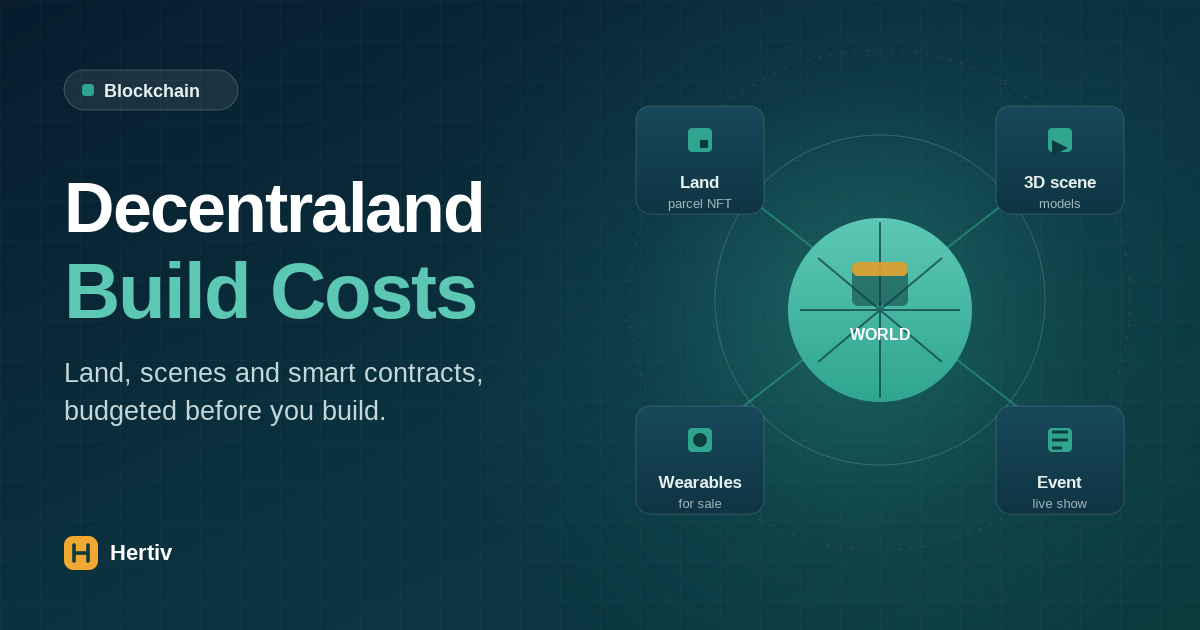
The cost of a Decentraland build comes from five parts, and each one can be small or large depending on the scope. Land is usually the most visible cost, but the 3D work and the upkeep often matter more over time.
| Cost part | What it covers | What drives the price |
|---|---|---|
| Land parcel | The plot your scene sits on | Size, location and market price |
| 3D scene design | Models, textures and animation | Scene size and level of detail |
| Smart contracts | Payments, tickets and wearables | Number of on-chain actions |
| Hosting and upkeep | Updates, fixes and events | How often the scene changes |
| Team and tools | Designers, developers and testing | In-house team or hired specialists |
Land prices change with the market, so check the Decentraland marketplace before you budget; see vendor site for current prices. The build itself is priced like any software project, by the hours of design and development it needs.
What affects the price most?
The size of the land is the first price driver, because a scene that spans several parcels needs more models, more testing and more upkeep than a single-parcel scene. A small, focused scene is usually the cheapest way to start.
The level of 3D detail is the second driver. Custom models, animated characters and interactive objects take far longer to make than a scene built from ready-made assets. Each custom model adds design hours and testing time.
Smart contracts are the third driver. A scene that only shows products is cheap to build, while one that sells wearables, runs ticketed events or pays out rewards needs contracts that must be written, tested and audited. Live events add a fourth cost, since staff, streaming and moderation all need paying for.
What is included in a typical build?
A typical build starts with a plan: the goal of the scene, the audience, the land size and the features it must have. The plan sets the budget, because it decides how much 3D work and how many smart contracts are needed.
The build itself usually includes the 3D scene, any wearables or collectibles, the smart contracts for payments or tickets, and a test pass on the live world. A launch plan covers the opening event, announcements and a way to measure visits.
Good builds also include documentation and a handover, so the owner can change text, images or prices without calling the developer each time. If you are comparing builders, ask what is included in the price and what is charged as an extra, since quotes vary widely. Teams that already build metaverse experiences can usually give a firmer quote once they see the plan.
Decentraland vs building your own metaverse
Decentraland gives you an existing audience and a ready-made world, while building your own metaverse gives you full control at a much higher cost. The right choice depends on whether you need reach or control.
| Factor | Decentraland | Your own metaverse |
|---|---|---|
| Audience | Visitors already use the world | You must attract every visitor |
| Land cost | Buy or rent parcels | No land cost, but hosting instead |
| Control | Rules set by the community | Full control over rules and design |
| Upkeep | Scene updates only | Platform, servers and security too |
| Time to launch | Weeks for a small scene | Months for a working platform |
For most brands, Decentraland is the cheaper test: a small scene shows whether visitors care, before any money goes into a custom platform. A custom world makes sense when the experience needs rules or data handling that a shared world cannot provide.
Example: a virtual store in Decentraland
Example (hypothetical): a fashion brand wants a virtual store on two parcels, with a 3D showroom, six wearable items and a launch event. The team plans the work and prices each part before starting.
The 3D scene takes 120 hours at $60 an hour, which is $7,200. The smart contracts for the wearables cost $3,000 to write and test, and the launch event costs $1,500 for staffing and streaming. The build total is $7,200 + $3,000 + $1,500 = $11,700.
The team adds a 15% reserve for fixes after launch, which is $1,755, so the full budget is $11,700 + $1,755 = $13,455. Land is rented separately, so it is not in this total. The reserve matters, because the first visitors always find problems that testing missed.
What are the common mistakes?
The most common Decentraland mistakes are buying land before having a plan, overbuilding the scene, and forgetting the upkeep budget. Each one wastes money that a small test would have saved.
- Buying land first. Land without a plan for the scene is a cost with no return. Decide the experience, then buy the land it needs.
- Over-detailed scenes. Heavy models load slowly and push visitors away. Keep the scene light and test it on an ordinary laptop.
- Skipping the contract audit. A contract that handles payments or tickets should be reviewed by a second party before launch.
- No upkeep budget. Scenes need updates, fixes and fresh content, or visits fall away within weeks.
- No clear goal. A scene with no measure of success, such as visits, sales or sign-ups, cannot show whether it was worth the cost.
Key takeaways
- Decentraland cost is land plus 3D scene, smart contracts and upkeep
- Land prices change with the market, so check the marketplace before budgeting
- Custom models, smart contracts and live events drive the price up most
- A small scene on one parcel is the cheapest way to test the idea
- Budget a reserve of about 15% for fixes after launch
Frequently asked questions
Is Decentraland free to use?
Visiting Decentraland is free, but building on it is not. Land must be bought or rented, and the 3D scene, smart contracts and upkeep are paid work. A visitor pays nothing, while the owner pays for the land and the build.
Do you need to own land to build in Decentraland?
Yes, you need land to place a scene, but you can rent a parcel instead of buying one. Renting suits a short event or a test, while buying suits a scene that will run for a long time.
What is a Decentraland wearable?
A wearable is a digital item, such as clothing or an accessory, that an avatar can wear in the world. Wearables are tokens, so they can be sold or traded, and they are often used as a way to earn from a scene.
How long does a Decentraland build take?
A small scene with ready-made assets can take a few weeks, while a large custom world with smart contracts and events can take several months. The timeline depends on the size of the scene and the number of custom features.
Can you make money from a Decentraland scene?
Yes, scenes can earn from wearable sales, ticketed events, advertising and renting out land. Earnings are not guaranteed, and most scenes earn little at first, so treat income as a bonus rather than a budget line.
Is Decentraland the same as the metaverse?
No. Decentraland is one virtual world inside the wider idea of the metaverse, which covers many worlds and platforms. The metaverse is the general concept, while Decentraland is a specific world with its own land, currency and rules.


