What Does Custom Software Cost to Build in the Netherlands?
Custom software in the Netherlands is usually priced by team, hours and scope, with Dutch rates above offshore rates. Here is what drives the bill and how to budget.
On this page
Short answer
Custom software development in the Netherlands is the design and build of software made for one company, by a Dutch or mixed team, and priced by the hours the work takes. The cost depends on the scope, the seniority of the team, and whether the team is based in the Netherlands or partly abroad. A first version is a five- or six-figure project; get a written quote for your scope.
What is custom software development in the Netherlands?
Custom software development in the Netherlands is software designed and built for one company, by a team based in the Netherlands or working with one. It covers web apps, internal tools, integrations and mobile apps, built to fit the way that company works instead of forcing the company to fit a ready-made product.
Most Dutch projects are priced by time: the team works in weeks, and each week has a rate that covers the developers, the design, the testing and the project management. Some firms quote a fixed price for a fixed scope, but most work on a time-and-materials basis, which means the bill follows the hours actually worked.
The Netherlands has a large software market, with firms in Amsterdam, Rotterdam, Utrecht and Eindhoven, and many Dutch companies also work with teams abroad. The choice between a Dutch team and a mixed team is the biggest cost decision, and it changes the price more than any feature choice.
What drives the cost of custom software in the Netherlands?
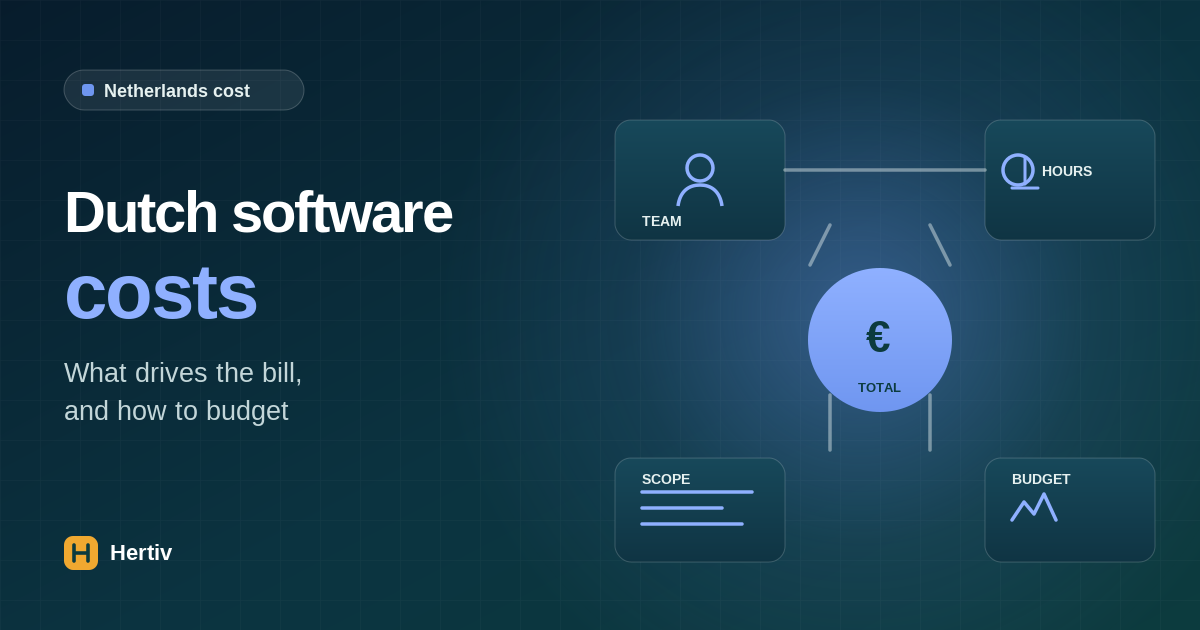
Five factors drive the cost, and the table below shows how each one moves the bill.
| Cost driver | What it means | How it moves the price |
|---|---|---|
| Scope | Number of features and screens | More features, more hours, higher bill |
| Team location | Dutch team, mixed team or offshore | Dutch rates are higher than offshore rates |
| Seniority | Junior, mid-level or senior developers | Senior teams cost more per hour |
| Integrations | Links to payment, accounting or other systems | Each integration adds build and test time |
| Rules and data | Privacy, security and compliance needs | Stricter rules add design and test work |
Scope is the driver teams control most. Cutting the first version to one user journey can halve the hours, while adding a second journey late in the project costs more than building it first time round. For the company side of the same decision, custom software development companies explains how to compare Dutch firms.
Dutch team, mixed team or offshore: what changes?
A Dutch team works in your time zone, speaks Dutch and English, and knows Dutch rules such as privacy law and invoicing. That makes communication fast and misunderstandings rare, which matters on a project where the scope changes as the work goes on.
A mixed team keeps the design and the project lead in the Netherlands and puts part of the build abroad. The hourly rate falls, but the project needs more written briefs and more review time, because the developers are not in the room. Many Dutch firms work this way, and it suits projects with a clear scope and a steady pace.
A fully offshore team is the cheapest per hour and the hardest to manage. It works best when the scope is fixed and the client has someone technical on their side to check the work. For most Dutch companies buying their first custom software, a Dutch or mixed team is the safer choice.
What does a first version usually include?
A first version usually includes one user journey that works end to end, a login and roles, the core data the business needs, and one or two integrations. It does not include every feature on the wish list, and that is the point: the first version proves the idea with real users before more money goes in.
The build usually runs in two-week cycles, with a working version to look at after each cycle. That rhythm lets the client change direction early, when changes are cheap, instead of at the end, when they are not. Testing runs through the build, not at the end, so problems are found while the code is still fresh.
After launch, the team stays on for fixes and small changes. A first version that nobody maintains will break within months as browsers, libraries and connected systems change, so budget for a few hours a week after launch. For the cost of the same work in another market, software development cost in Canada shows how rates compare.
Example (hypothetical): a first version for a Dutch wholesaler
Picture a Dutch wholesaler that wants a first version of an ordering portal: customers log in, see their prices, place orders and track deliveries. The team is two developers, one designer and a part-time project lead, working for twelve weeks.
The build takes 1,200 hours at a hypothetical rate of 90 euros an hour, which is 108,000 euros. Design adds 10,000 euros and testing adds 12,000 euros, so the first version costs 130,000 euros in total. That figure is a worked example, not a quote: the real price depends on the scope and the team.
If the same scope were built by a mixed team at a lower average rate, the hours would stay near 1,200 but the total would fall, while the review time would rise. That is the trade-off to price before choosing a team, not after the build starts.
How to budget for custom software in the Netherlands
A budget that survives contact with the build has five parts, and each one needs its own number.
- Fix the scope in writing. List the features the first version must have, and mark the rest as later. Get the list signed off before the build starts.
- Get three written quotes. Ask three firms for a quote on the same scope, and compare the hours and the rate, not just the total.
- Hold back a change budget. Keep 15 to 20 percent of the budget for changes you will want once you see the working software.
- Price the running costs. Hosting, licences, support and small changes after launch are a monthly cost, not a one-off.
- Plan the decision points. Agree in advance when the client reviews the work and who can approve changes, so the build does not stall waiting for a decision.
The quote is only as good as the scope behind it. A firm that quotes without a written scope is guessing, and the bill will grow when the scope becomes clear. For the scoping side, what is an MVP explains how to cut a first version to what matters.
What are the common mistakes?
The most common mistakes when buying custom software in the Netherlands are starting without a written scope, choosing on hourly rate alone, and forgetting the running costs.
- No written scope. A scope that lives in someone's head changes every week, and each change costs hours. Write it down and sign it off.
- Choosing on rate alone. The cheapest hourly rate is not the cheapest project. A slow team at a low rate costs more than a fast team at a higher rate.
- Forgetting running costs. Hosting, support and small changes continue after launch. A budget that ends at launch is a budget that runs out.
- Skipping the change budget. Every project changes once the client sees working software. Without a change budget, each change becomes a fight.
- No one to decide. A project with no single decision-maker stalls. Name one person who can approve changes before the build starts.
Before hiring, software development companies shows what to check in a Dutch firm, from references to how they handle changes.
Key takeaways
- Custom software in the Netherlands is priced by hours, scope and team location
- A Dutch team costs more per hour but needs less review time than a mixed team
- Cut the first version to one user journey that works end to end
- Get three written quotes on the same scope and compare hours, not just totals
- Hold back 15 to 20 percent for changes and budget for running costs after launch
Frequently asked questions
How much does custom software cost in the Netherlands?
It depends on scope, team and seniority, and there is no fixed price. A small first version with a Dutch team is a five- or six-figure project, and the only reliable number is a written quote for your scope, from a firm that has seen it in writing.
Is a Dutch team worth the higher rate?
Often, yes, for a first project or a project where the scope will change. A Dutch team works in your time zone, knows Dutch rules and needs less written briefing. A mixed team suits a fixed scope with a steady pace.
How long does a first version take?
A small first version usually takes eight to sixteen weeks with a team of two or three developers. The time depends on the scope and on how fast the client reviews the work, which is why decision points should be agreed before the build starts.
Should I pay fixed price or by the hour?
A fixed price suits a fixed scope that will not change, while time and materials suits a project where the scope will grow as the client sees the software. Most Dutch firms prefer time and materials, because it fits the way software is actually built.
What costs continue after launch?
Hosting, licences, support, small changes and security updates. Budget for a few hours a week of team time after launch, because browsers, libraries and connected systems change, and software that nobody maintains breaks.
Do I own the code?
Usually yes, if the contract says so. Check before signing that the code, the designs and the documentation transfer to you, and that you can move to another team without losing the work.


