Crypto Bank Software: 3 Modules Every Platform Needs
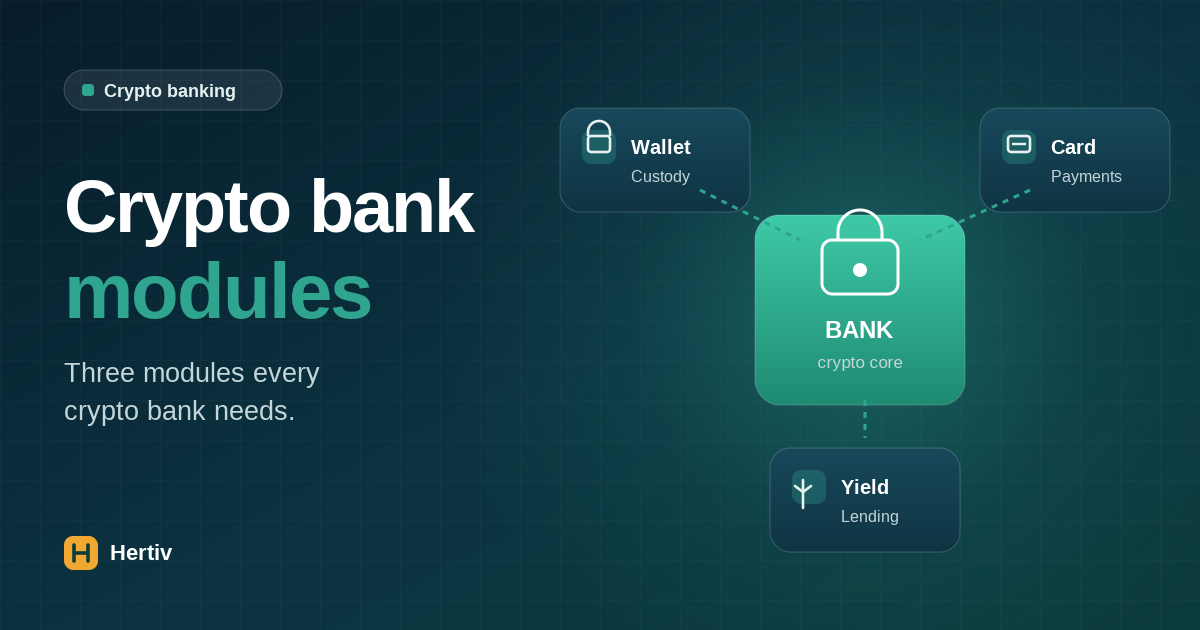
Crypto bank software usually ships as three modules: custody, payments and cards, and lending and yield. Compare each one and which to build first.
On this page
Short answer
The three most popular modules in crypto bank software are digital wallets and custody, payments and card issuing, and lending, staking and yield. Custody holds customer funds safely, payments let customers spend them, and lending and yield put idle balances to work. Most platforms start with custody, then add the module their customers ask for next.
Which modules does crypto bank software offer?
The three most popular modules in crypto bank software are digital wallets and custody, payments and card issuing, and lending, staking and yield. Together they cover holding funds, spending them and putting balances to work, which is why most crypto banking platforms start with these three.
A module is a self-contained part of the platform that handles one job, such as storing keys or moving money. You can buy or build them one at a time, which matters because each one carries its own rules, partners and risks.
| Module | What it does | Who needs it first | Main risk |
|---|---|---|---|
| Wallets and custody | Stores keys and customer funds safely | Every crypto bank | Key loss or theft |
| Payments and cards | Moves money and lets customers spend | Retail-focused platforms | Failed settlements |
| Lending, staking and yield | Earns returns on idle balances | Platforms with large deposits | Borrower default |
Start with custody. If customer funds are not safe, nothing else on the platform matters, and regulators will look at custody before they look at your lending book or your card programme.
Digital wallets and custody: best for holding customer funds
1. Digital wallets and custody: best for holding customer funds
The wallet and custody module stores private keys and customer balances, and it signs transactions when a customer asks to move funds. It is the foundation of a crypto bank: every deposit, withdrawal and payment passes through it.
Most platforms split keys between hot wallets for daily withdrawals and cold storage for the bulk of funds. Hot wallets stay online and move fast, while cold storage stays offline and moves slowly, so a breach of one side does not empty the whole bank.
Pros
- Customers trust a bank that can show how funds are protected
- Works for many coins and tokens from one place
- Supports limits, approvals and multi-signature signing
Cons
- Key management is hard to get right and costly to fix
- Cold storage slows down large withdrawals
- Insurance and audits add running cost
For the wallet side of the build, see what is a hot wallet and how it differs from cold storage.
Payments and card issuing: best for everyday spending
2. Payments and card issuing: best for everyday spending
The payments module moves money between accounts, converts crypto to local currency when needed, and settles card purchases at the point of sale. It turns a crypto balance into something a customer can spend at a shop or online.
Behind the scenes it needs banking partners, card schemes and liquidity so that a payment clears in seconds and the merchant gets paid in the currency it expects. Settlement speed and fees decide whether customers keep the card in their wallet or leave it at home.
Pros
- Customers can spend crypto without converting it by hand
- Recurring payments and payroll become possible
- Transaction fees create steady revenue
Cons
- Needs licensed partners in each market you serve
- Chargebacks and fraud checks add friction
- Conversion spreads can eat into margins
Stablecoins often sit at the centre of this module, so read stablecoin payments for business before choosing which coins to support.
Lending, staking and yield: best for putting balances to work
3. Lending, staking and yield: best for putting balances to work
The lending and yield module lets customers earn returns on idle balances by lending crypto, staking it to secure a network, or placing it in a yield product. It turns a deposit account into an income account, which is a strong reason for customers to keep funds with you.
The module must track collateral, interest, lock-up periods and risk limits in real time. If a loan is under-collateralised or a staking validator fails, the platform needs rules that act fast, or losses land on the bank and its customers.
Pros
- Higher returns keep deposits on the platform longer
- Lending spreads add revenue beyond fees
- Staking rewards can be shared with customers
Cons
- Borrower default can wipe out months of yield
- Lock-up periods frustrate customers who need funds fast
- Rules differ by country and change often
For the background on how these products work, see what is DeFi and the lending models it describes.
How to choose crypto bank software modules
Choose modules by the customers you serve first, not by the longest feature list. A platform for savers needs custody and yield, while one for spenders needs payments and cards.
- List the jobs your customers need done. Holding, spending and earning are the three usual jobs; rank them by how often customers ask.
- Check the rules in each market. Custody, lending and card issuing each need different licences, so confirm what you can legally offer before you build.
- Pick your partners early. Banking partners, card schemes and custody providers set your timeline, so shortlist them before you write code.
- Test with a small group. Run one module with a few hundred users, watch where they get stuck, and fix those points before adding the next module.
- Plan for the worst case. Key loss, a failed settlement and a borrower default should each have a written response before launch.
Build in the order your customers feel the pain. Custody first, then the module that solves their next biggest problem, and only then the rest.
What are the common mistakes?
The most common mistakes are launching all three modules at once, treating custody as a solved problem, and promising yields that the platform cannot sustain.
- Launching everything at once. Three modules mean three sets of partners, rules and failure modes, so delays in one hold back the other two.
- Treating custody as solved. Key management looks simple until a key is lost or stolen, and by then the damage is done.
- Promising fixed yields. Yields move with markets, so a fixed promise becomes a liability when rates fall.
- Skipping the audit. An unaudited custody or lending module is a risk that regulators and partners will find quickly.
- Ignoring support load. Failed payments and stuck withdrawals create support tickets fast, so staff the team before launch.
Each module can be bought, built or partnered on, but the responsibility for customer funds stays with you, whatever the vendor promises. Crypto exchange development covers related build choices if your platform also needs trading.
Key takeaways
- Custody comes first: without safe key and fund storage, nothing else matters
- Payments turn a crypto balance into money customers can spend every day
- Lending and yield earn returns on idle balances but carry default risk
- Each module needs its own partners, licences and failure plan
- Launch one module at a time and add the next only when the first runs clean
Frequently asked questions
What is crypto bank software?
Crypto bank software is the set of systems that lets a platform hold customer crypto, move money, issue cards and offer lending or yield products. It is usually built as separate modules for custody, payments and lending, so a team can launch one part at a time and add the rest later.
Do crypto banks need a licence?
In most markets, yes. Custody, lending and card issuing each sit under different rules, and the exact licence depends on the country and the services offered. Check the rules in each market before launch, since operating without the right licence can shut a platform down.
What is the difference between hot and cold wallets?
A hot wallet stays connected to the internet and moves funds fast, which suits daily withdrawals. Cold storage stays offline and moves slowly, which suits the bulk of funds. Most crypto banks use both: hot wallets for what customers need now, cold storage for the rest.
How do crypto banks make money?
They earn from transaction fees, card interchange, conversion spreads and lending margins. Yield products share part of the return with customers and keep part for the platform. Fees and spreads should be clear to customers before they deposit.
Can a crypto bank offer cards?
Yes, with a card scheme and a banking partner in each market it serves. The card converts crypto to local currency at the point of sale so merchants get paid as usual. Card programmes need fraud checks and settlement partners, which take time to arrange.
Is staking the same as lending?
No. Staking locks tokens to help secure a blockchain network and earns rewards from the network. Lending gives tokens to a borrower who pays interest. Both earn returns on idle balances, but staking risk sits with the network and validators, while lending risk sits with the borrower.


