What Does It Cost to Train an AI Model?
Training an AI model costs for data, compute, people and testing. A small fine-tune costs far less than training a large model from scratch.
On this page
Short answer
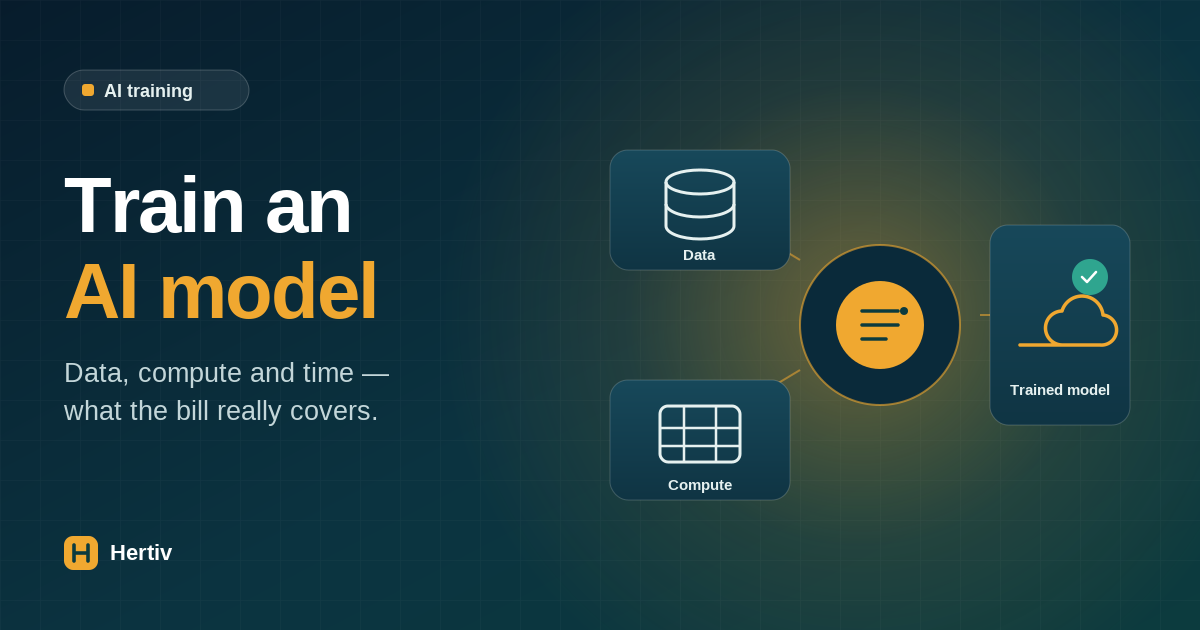
Training an AI model is the process of teaching a model from data, and its cost depends on how much data must be prepared, how much computing is needed, and how many people work on it. A small fine-tune of an existing model costs far less than training a large model from scratch, because the base model already knows the general patterns.
What is the cost of training an AI model?
The cost of training an AI model is the total spend to prepare data, run the training, test the result and keep it running, and it depends on the size of the model, the amount of data and the quality bar you set. Training is not one bill; it is data work, compute time, engineering time and testing, added together.
A fine-tune of an existing model is the cheapest route: you start from a model that already understands language or images, and you train it further on your own data. Training from scratch is the most expensive route, because you pay for all the learning yourself, and only a few teams need it.
The same logic applies to the team. A small fine-tune can be done by one or two engineers with a cloud GPU; a large training run needs data engineers, ML engineers and someone to watch the run around the clock. For teams scoping the work, LLM development usually starts with the smallest model that can do the job.
What does the training cost usually cover?
The cost usually covers six parts, and each one can be small or large depending on the model. A fine-tune rarely needs all six at full depth; teams pick the parts that matter for the model they are training.
| Part | What it includes | When it costs most |
|---|---|---|
| Data preparation | Collecting, cleaning and labelling data | Large or messy datasets |
| Compute | GPU time for training runs | Large models, long runs |
| Engineering | Training code, pipelines, debugging | Custom architecture, new data types |
| Evaluation | Test sets, human review, benchmarks | High accuracy bar, safety checks |
| Failed runs | Runs that crash or give poor results | New methods, unstable training |
| Running costs | Hosting, monitoring, retraining | High traffic, fast-changing data |
Start with the two or three parts that matter for your model. A fine-tune that reuses a base model and a small, clean dataset needs far less compute and data work than a model trained from scratch.
What drives the cost up or down?
The cost is driven by model size, data size and the number of training runs. Each doubling of model size or data roughly multiplies the compute bill, and each failed run adds to the total, so the teams that spend least are the ones that test small first.
Data quality matters more than data size. A clean dataset of ten thousand good examples often beats a messy dataset of a million, and it costs less to prepare. Labelling is the hidden cost: someone must check that each example teaches the right thing, and that work is slow and hard to automate well.
The choice between fine-tuning and training from scratch matters most. A fine-tune reuses years of work already in the base model, so it needs less data and less compute. Training from scratch needs both in large amounts, and it only pays off when no existing model fits the task at all. A guide to AI model training explains how the two routes differ in practice.
What should the first training run include?
The first training run should be small: a fine-tune on a few thousand examples, a clear test set, and a measure of success written down before the run starts. A small run that works beats a large run that fails and leaves no lesson behind.
A sensible first run includes a clean training set, a separate test set the model has never seen, a base model chosen for the task, and a simple evaluation that a person can read in five minutes. Leave large datasets, custom architectures and long runs for later, once the small run shows the approach works.
Define what success looks like before training: a target accuracy on the test set, a response time, or a rate of wrong answers that staff can live with. If the team cannot name the measure, the training run is probably too wide. A fine-tuning guide built this way gives the team real data to decide what to train next.
How to estimate the cost in five steps
Estimate the cost by listing the data work, pricing the compute, counting the engineering time and adding a reserve for failed runs. A rough estimate that lists its assumptions is more useful than a precise number with none.
- Count the data. List the examples you have, the ones you must create, and the ones you must label by hand.
- Pick the base model. Name the model you will fine-tune, and check its licence and size.
- Price the compute. Estimate the GPU hours for one run, then multiply by the number of runs you expect.
- Count the engineering time. Add data work, training code, evaluation and the review of results.
- Add a reserve. Hold back 10 to 15 percent for failed runs and extra data work found during testing.
Run a tiny training job first, on a fraction of the data, to check that the pipeline works before you pay for the full run. A small test that fails early is cheap; a large run that fails late is not.
Example (hypothetical): a small fine-tune for a retailer
Example (hypothetical): an online retailer wants a model that classifies support tickets into 20 categories, and it has 8,000 labelled tickets. The team fine-tunes a small base model instead of training one from scratch.
The estimate is 200 hours of data preparation at $55 an hour, which is $11,000. Compute for the training runs costs $6,000, and 300 hours of engineering at $60 an hour costs $18,000. The subtotal is $35,000. A 10 percent reserve adds $3,500, giving a total of $38,500 for the first trained model.
Running costs after launch include hosting the model, monitoring its accuracy and retraining when new ticket types appear. Budget a monthly amount for the person who owns the model, or its accuracy will drift as products and policies change.
What are the common mistakes?
The most common mistakes are training on dirty data, picking a model that is too large, and skipping the test set. Each one turns a promising model into a cost that never pays back.
- Dirty training data. A model trained on wrong labels learns the wrong thing, and no amount of compute fixes it.
- A model too large for the job. A large model costs more to train and to run, while a small one would have done the job.
- No separate test set. Testing on the training data hides real errors until customers find them.
- No reserve for failed runs. Training runs fail; a budget without a reserve runs out before the model works.
- Ignoring running costs. Hosting, monitoring and retraining cost money every month after the training ends.
Training cost follows the data and the model size, and the cheapest model that passes the test is usually the right one, which is why training a domain-specific model starts small and grows only on evidence.
Key takeaways
- Training cost follows data, compute, people and testing — not just GPU time
- A fine-tune of an existing model costs far less than training from scratch
- Clean, labelled data matters more than the size of the dataset
- Estimate per data, compute and engineering hour, and keep a 10 to 15 percent reserve
- A separate test set and a written success measure stop the run from drifting
Frequently asked questions
How much does it cost to train a small AI model?
A small fine-tune on a few thousand examples costs far less than training from scratch, because the base model already knows the general patterns. The main costs are data preparation, a modest amount of GPU time and engineering time. Get a quote against a written data and model scope.
Is it cheaper to fine-tune or to train from scratch?
Fine-tuning is almost always cheaper. It reuses a base model that already understands language or images, so it needs less data and less compute. Training from scratch only pays off when no existing model fits the task at all, which is rare for most business use cases.
What is the biggest cost in training an AI model?
It depends on the route. For a fine-tune, data preparation and engineering time are often the biggest costs. For training from scratch, compute dominates, because the run needs many GPU hours. Failed runs add to both, which is why a small test run first saves money.
Do I need my own GPUs to train a model?
No. Most teams rent cloud GPUs by the hour, which suits fine-tunes and occasional training runs. Buying GPUs only pays off when the team trains often and at large scale, and it adds maintenance and power costs that renting avoids.
How long does it take to train a model?
A small fine-tune can finish in hours or days, including data preparation and testing. A large training run from scratch can take weeks or months of compute time. The data work and the evaluation usually take longer than the training run itself.
What happens after the model is trained?
It needs hosting, monitoring and regular retraining as data changes. Accuracy drifts as products, policies and customer language change, so budget a monthly amount for the person who owns the model and for the retraining runs.


