How Much Does It Cost to Tokenize Real Estate?
Tokenizing a property usually costs $50,000 to $150,000 to launch, with legal work costing more than the code. Here is what each part costs and how to budget it.
On this page
Short answer
Tokenizing a property usually costs $50,000 to $150,000 to launch, covering legal setup, smart contracts, a security audit, the platform and compliance, plus about $2,000 a month to run. Legal work usually costs more than the code, and the total only makes sense when the rental income covers the running cost.
What does it cost to tokenize a property?
Tokenizing a property costs the owner for legal setup, smart contract development, a security audit, the tokenization platform and ongoing compliance, and a first project usually lands between $50,000 and $150,000 before marketing. The exact figure depends on the property value, the jurisdiction, the token structure and how much of the work is done in-house.
Tokenization turns ownership of a building into digital tokens on a blockchain, so many small investors can buy a share instead of one buyer taking the whole property. The technology is the smaller part of the bill. Legal work and compliance usually cost more than the code, because the tokens are often treated as securities and need proper paperwork.
| Cost area | What it covers | Typical range |
|---|---|---|
| Legal and entity setup | SPV, offering documents, counsel | $15,000 - $40,000 |
| Smart contract development | Token contract, transfer rules, testing | $15,000 - $40,000 |
| Security audit | Independent review of the contracts | $10,000 - $25,000 |
| Platform and issuance | Investor portal, onboarding, payments | $10,000 - $30,000 |
| Custody and compliance | KYC checks, token custody, reporting | $5,000 - $15,000 |
These ranges are planning figures, not quotes. Ask each provider for a written quote for your property and jurisdiction before you commit, and check the vendor's own pricing page where one exists. Real estate tokenization services can give you a scoped estimate once the property and token structure are clear.
What drives the legal and setup cost?
Legal cost is driven by the jurisdiction, the token structure and the investor base, because those three choices decide which rules apply. A single-property SPV for local investors in one country is the simplest setup. A cross-border offering with several investor types needs more counsel, more documents and often a licensed partner.
The main legal items are the special purpose vehicle that holds the property, the offering documents that describe the investment, and the checks on who may buy the tokens. Some jurisdictions treat the tokens as securities from the start, which means a prospectus or an exemption, while others have a lighter path for small private offers. Your lawyer should confirm the classification before any code is written.
One way to control this cost is to keep the first offer small and local. Fewer jurisdictions, fewer investor types and one property mean fewer documents and fewer hours. Teams that try to tokenize five properties in three countries at once usually pay several times more in legal fees than teams that start with one property at home.
What does the technology cost?
Technology cost covers the smart contracts, the investor portal and the connections to payment and identity services. A standard token contract with transfer restrictions is the cheapest part, because the pattern is well known and the code is short. The portal, where investors register, pass KYC checks and buy tokens, usually costs more than the contracts themselves.
The choice between a white-label platform and a custom build changes the price a lot. A white-label platform charges a setup fee and a share of each sale, which keeps the upfront cost low but adds cost on every transaction. A custom build costs more upfront and gives you full control of the branding, the rules and the data.
The security audit is a separate line and should never be skipped. An audit of a token contract typically takes one to three weeks and costs $10,000 to $25,000, depending on the size of the codebase.
A failed audit that finds a serious flaw is cheaper than a live contract with the same flaw, so budget for fixes after the audit as well. Tokenization platform costs vary widely, so compare a platform fee against a custom build for your volume.
What are the ongoing costs after launch?
Ongoing costs after launch include platform hosting, KYC and compliance checks, token holder reporting and the running of the SPV. These are smaller than the launch cost but they never stop, so they belong in the budget from day one. A common mistake is to budget only for the launch and then find the yearly running cost eats the rental income.
Investor reporting is the largest recurring item for many projects. Token holders expect regular updates on rental income, expenses and the property value, and someone has to prepare them. If the property pays rent monthly, the distribution run, the accounting and the tax documents for each holder all take time or a service fee.
Compliance checks also repeat. New investors must pass KYC and accreditation checks, and some jurisdictions ask for periodic filings. A small project with twenty holders can handle this with a part-time administrator, while a project with hundreds of holders usually needs a platform that automates onboarding and reporting. Ask for the monthly running cost in writing before you choose a platform.
How to budget for a first tokenization
You budget for a first tokenization by pricing each cost area separately, adding a reserve for fixes and delays, and checking the total against the income the property can pay out.
- Fix the token structure first. Decide the property, the number of tokens, the minimum investment and who may buy, because every quote depends on these choices.
- Get a legal quote in writing. Ask a lawyer in your jurisdiction for a fixed fee for the SPV and offering documents.
- Price the technology two ways. Get a quote for a white-label platform and one for a custom build, including the audit.
- Add the first year of running costs. Include hosting, KYC, reporting and SPV administration for twelve months.
- Add a 15% reserve. Audits find issues, documents take longer than planned, and a reserve keeps the project moving.
- Check the total against the rent. If the launch cost is more than two years of net rental income, the project may not make sense.
A written budget with these six lines is also what a partner, a lender or an investor will ask to see. How to tokenize real estate walks through the process step by step, which helps you price each stage.
Example (hypothetical): tokenizing a $2M building
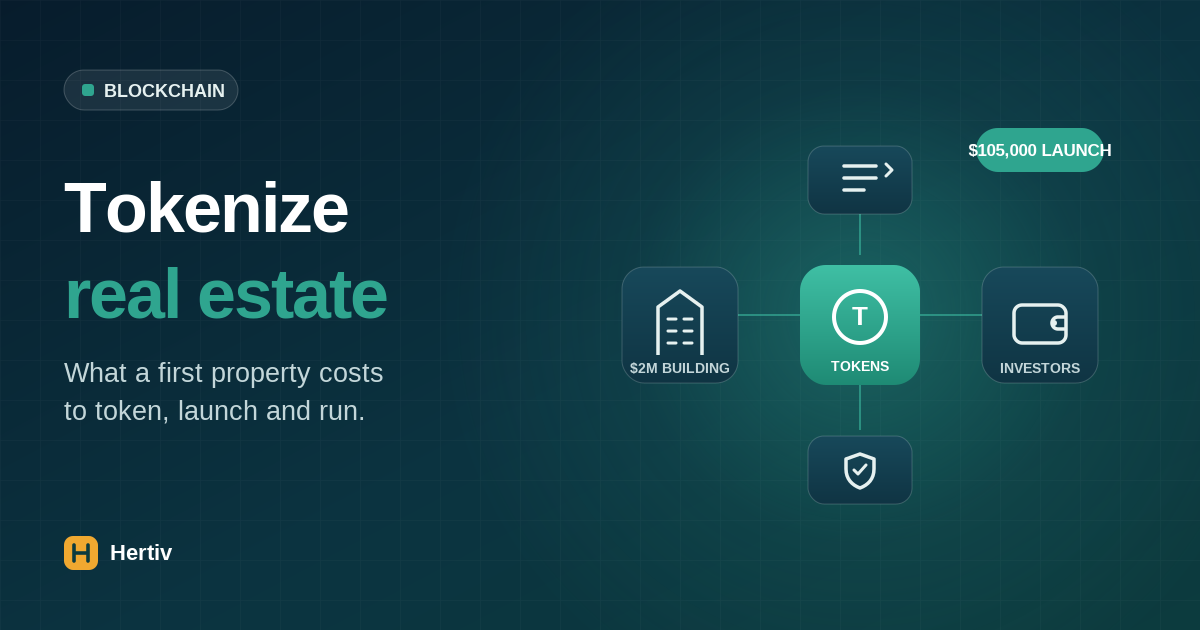
Example (hypothetical): an owner wants to tokenize a commercial building worth $2,000,000 and sell 40% of it to investors. The building earns $120,000 a year in net rent, and the owner plans to issue tokens worth $800,000 in total.
The launch budget is $105,000. Legal and SPV setup costs $25,000, smart contract development costs $30,000, the security audit costs $15,000, the platform setup costs $20,000, custody setup costs $5,000, and compliance and marketing setup costs $10,000. Added together, $25,000 plus $30,000 plus $15,000 plus $20,000 plus $5,000 plus $10,000 equals $105,000.
Running costs are $2,000 a month, or $24,000 a year, for hosting, KYC, reporting and SPV administration. The token holders receive 40% of the $120,000 net rent, which is $48,000 a year, so the running cost takes half of the first payout. The owner decides the project still works because the $800,000 raised is used to buy a second property, but the numbers show why the running cost must be in the budget before launch.
What are the common mistakes?
The most common mistakes are starting the code before the legal structure is settled, skipping the audit, and forgetting the running costs. Each of these is easy to avoid with a written budget and a fixed order of work.
- Building before the legal structure is set. A contract written for the wrong token structure has to be rewritten, which costs more than waiting for the lawyer.
- Skipping the security audit. A token contract that holds real value needs an independent review, whatever the size of the project.
- Budgeting only for launch. Running costs, reporting and compliance continue for as long as the tokens exist.
- Choosing a platform on setup fee alone. A cheap setup fee with a high share of each sale can cost more than a higher setup fee with no revenue share.
- Promising a return. Rental income varies, and token holders should see the real figures, not a promised yield.
- Ignoring secondary trading. If holders cannot sell, they may not buy, so decide the transfer rules before the sale opens.
A realistic budget is what makes a tokenization project fundable. Real-world tokenization examples show how other owners structured their first projects and what they spent.
Key takeaways
- A first tokenization usually costs $50,000 to $150,000 to launch
- Legal and SPV setup is often the largest single cost, not the code
- A security audit is a separate line and should never be skipped
- Running costs of about $2,000 a month continue for the life of the tokens
- Price the platform two ways: white-label fees against a custom build
- If launch cost tops two years of net rent from the tokenized share, shrink the scope
Frequently asked questions
Is tokenizing real estate cheaper than a normal property sale?
Not usually. A normal sale has one buyer and one set of legal fees, while tokenization adds smart contracts, an audit, a platform and ongoing reporting. Tokenization makes sense when you want many small investors or a partial sale, not when you want the cheapest exit.
What is the cheapest way to tokenize a property?
Start with one property, one jurisdiction and a small local investor group, and use a white-label platform instead of a custom build. That keeps legal work simple and the upfront technology cost low, though the platform takes a fee on each sale.
Do I need a lawyer to tokenize real estate?
Yes. The tokens are often treated as securities, and the SPV, offering documents and investor checks need a lawyer in your jurisdiction. The legal classification should be confirmed before any code is written, because it shapes the whole structure.
How long does a first tokenization take?
A simple single-property project usually takes three to six months from the legal structure to the first sale. Legal work and the audit take the most time, while the smart contracts themselves are usually ready in a few weeks.
Can I tokenize only part of a building?
Yes. Most first projects tokenize 20% to 50% of a property and keep the rest with the owner. The token holders receive that share of the rental income, and the owner keeps control of the building and the management.
What happens to the tokens if the property is sold?
The sale proceeds are distributed to token holders in proportion to their tokens, after costs, and the tokens are then redeemed or cancelled. The offering documents should state this clearly before anyone buys.


