What Does a Marketplace App Cost to Build?
A marketplace app connects buyers and sellers in one place. Its cost depends on the features you launch with, the number of user types and the payments you support.
On this page
Short answer
A marketplace app is an app where buyers find sellers, sellers list goods or services, and the app handles search, chat, payments and reviews. The cost to build one depends on what you launch with: a simple listing app costs far less than a full marketplace with escrow, disputes and seller tools.
What is a marketplace app?
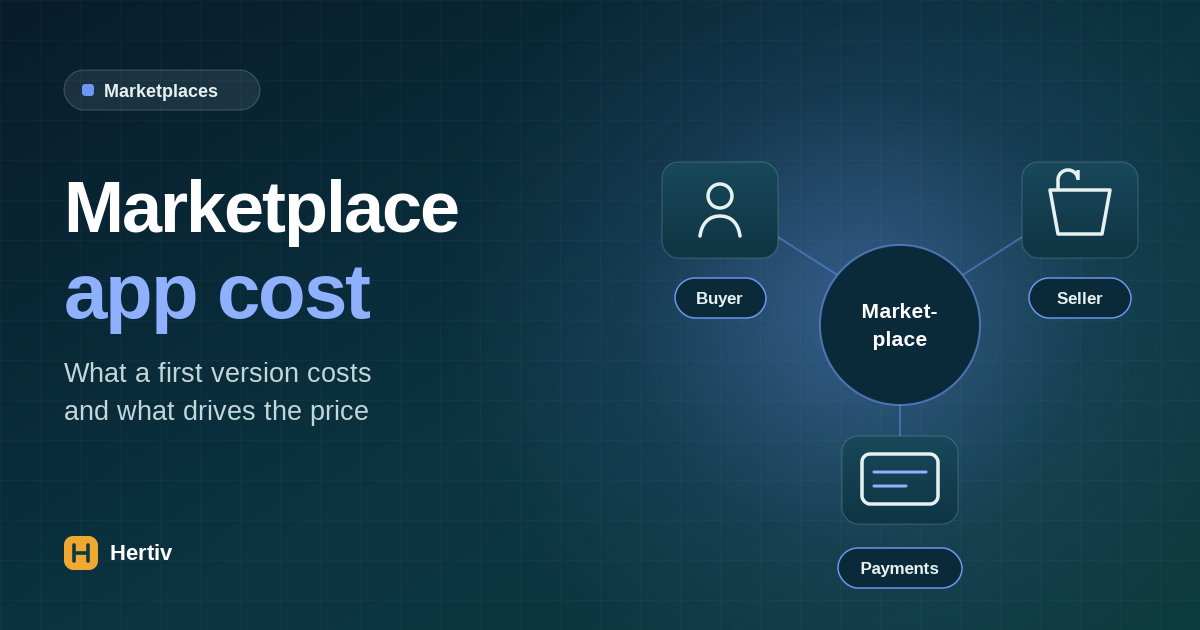
A marketplace app is a platform where buyers and sellers meet. The buyer searches, compares and pays. The seller lists items, manages orders and gets paid. The app sits in the middle: it holds the listings, runs the search, takes the payment and keeps a record of every order.
Marketplaces come in two kinds. A goods marketplace sells things, such as handmade goods or second-hand items. A services marketplace sells time and skill, such as home repairs or lessons. The kind you build changes the features you need: goods need stock and delivery, services need booking and calendars. To see how big apps are scoped, read what an MVP is.
| Part | What it does | Needed at launch? |
|---|---|---|
| Listings | Sellers add items or services | Yes |
| Search and filters | Buyers find what they want | Yes |
| Chat | Buyers ask sellers questions | Yes |
| Payments | Buyers pay, sellers get paid | Yes |
| Reviews | Buyers rate sellers | Soon after |
| Disputes | Sorts out bad orders | Later |
The table shows the launch set: listings, search, chat and payments. Reviews can wait a few weeks, and disputes can wait until you have real orders. Every extra feature adds build time and cost, so the first version should be the smallest set that still works.
What drives the cost up or down?
The biggest cost driver is the number of user types. A marketplace has at least two: buyers and sellers, and often a third: an admin who manages disputes and payouts. Each type needs its own screens, its own rules and its own testing, so three user types cost more than one.
Payments are the second driver. Taking a payment is simple, but splitting it between you and the seller, holding it until delivery, and paying out in different countries is not. Each payment rule adds work, and each country adds tax and payout rules. Keep payments simple at launch.
The third driver is trust. Reviews, identity checks and dispute handling all cost money to build, but without them buyers will not trust a new marketplace. A marketplace with no trust features is a listing site, not a business. For a lean launch, see how to build an MVP.
What should the first version include?
The first version should let a buyer find an item, ask the seller a question, pay for it, and leave a review. That is the whole loop, and if any step is missing, the marketplace does not work. Everything else can wait.
For sellers, the first version needs a way to list an item with photos and a price, see orders, and get paid. Keep the seller tools simple: a form, a list of orders and a payout page. Sellers will tell you what else they need once they start using it.
For the admin, the first version needs a way to see orders, refund a buyer and remove a bad listing. You do not need a full dashboard yet; a simple admin page with the key actions is enough. Add reports and tools only when the order count makes them necessary.
How to estimate the cost in five steps
Estimate the cost by breaking the app into parts and pricing each one. A rough number from a single guess is rarely right, but a sum of small parts is usually close.
- List the features. Write down every feature for buyers, sellers and admin, and mark each one as launch, soon after or later.
- Count the screens. Each screen is a unit of work; a marketplace first version usually has 25 to 40 screens across all user types.
- Price the hard parts. Payments, search and chat take longer than simple screens, so price them on their own.
- Add testing and launch. Testing, app store review and fixing the first bugs take real time, so add a share for them.
- Add a reserve. Add 10 percent on top for the things you forgot, because every build has some.
Ask two or three builders for a quote on the same feature list, and compare the parts, not just the total. A quote that is far below the others usually leaves something out. The full-stay cost of a first version is covered in MVP app development cost.
Example (hypothetical): a first version for a local services marketplace
Example (hypothetical): a team wants a marketplace where local tutors list lessons and parents book them. The first version has 30 screens: 12 for parents, 12 for tutors and 6 for admin. The team prices the build at 600 hours at 55 dollars an hour, which is 33,000 dollars.
Payments, search and chat are the hard parts, so the team adds 4,500 dollars for payment setup and 3,000 dollars for search and chat work, bringing the total to 40,500 dollars. A 10 percent reserve adds 4,050 dollars, so the full estimate is 44,550 dollars.
The team also counts the running costs. Hosting, payment fees and a part-time support person come to about 900 dollars a month. With 200 bookings a month at a 10 percent fee on an average booking of 40 dollars, the app earns 800 dollars a month in fees, so the team knows it needs more bookings or a higher fee to cover the running costs.
What does it cost to run after launch?
Running costs come from hosting, payment fees, support and keeping the app working. Hosting grows with the number of users and listings. Payment fees are a share of every sale, so they grow with revenue. Support grows with the number of orders and the number of problems.
The fee you take must cover these costs. If you take 10 percent of each sale, a marketplace with 1,000 dollars of sales a month earns 100 dollars, which will not cover hosting and support. Work out the sales you need at your fee before you launch, and check the number is realistic.
Also plan for the slow start. A new marketplace has few sellers and few buyers, so each side waits for the other. Many teams start in one city and one category, so buyers and sellers meet quickly, then grow from there.
What are the common mistakes?
The most common mistakes in marketplace apps are building too much, ignoring trust, and launching in too many places at once.
- Building too much. A first version with every feature costs too much and takes too long; launch the smallest loop that works.
- Ignoring trust. Without reviews, identity checks and clear refunds, buyers will not pay a stranger through a new app.
- Too many categories. A marketplace with ten empty categories looks dead; start with one category in one place.
- Forgetting the sellers. Buyers come for sellers, so make listing easy and pay sellers fast, or they will leave.
- No plan for disputes. Bad orders will happen, so decide in advance who refunds and how fast.
Key takeaways
- A marketplace app connects buyers and sellers with search, chat and payments
- The first version needs listings, search, chat and payments, nothing more
- Payments and trust features are the biggest cost drivers
- Estimate by pricing each part, then add 10 percent for what you forgot
- Start in one city and one category so buyers and sellers meet quickly
Frequently asked questions
How long does it take to build a marketplace app?
A small first version usually takes a few months, depending on the features and the team. Listings, search, chat and payments are the core, and each one takes real time. A full marketplace with escrow, disputes and seller tools takes longer. Get a quote on a written feature list, not on a guess.
Do I need an app or a website first?
A website is usually the cheaper first step, because it works on every device and is easier to update. An app makes sense once you have regular buyers who want alerts and quick repeat orders. Many marketplaces start on the web and add an app later.
How do marketplaces make money?
Most take a fee on each sale, often a share of the price, and some charge sellers a monthly listing fee. A few earn from promoted listings or from extra services. Pick a fee that covers your running costs at a realistic number of sales.
What is the hardest part of a marketplace?
The hardest part is getting both sides at once: buyers want sellers, and sellers want buyers. Starting in one city and one category helps, because a small group of buyers and sellers can meet quickly. Marketing to one side alone rarely works.
Should I build payments myself?
No, use a payment provider that handles cards, payouts and refunds. Building payments yourself is slow, risky and hard to keep secure. A provider takes a fee on each sale, but it saves months of work and handles the rules for you.
Can I start a marketplace with no sellers?
You can, but you need a plan to find the first sellers before you open to buyers. Invite sellers by hand, list their items yourself, or start with a small group you already know. An empty marketplace will not attract buyers.


