What Does an App Like MyWe Cost to Build?
An app like MyWe costs what its parts cost: profiles, groups, feeds, chat and moderation, built in stages over 10 to 16 weeks.
On this page
Short answer
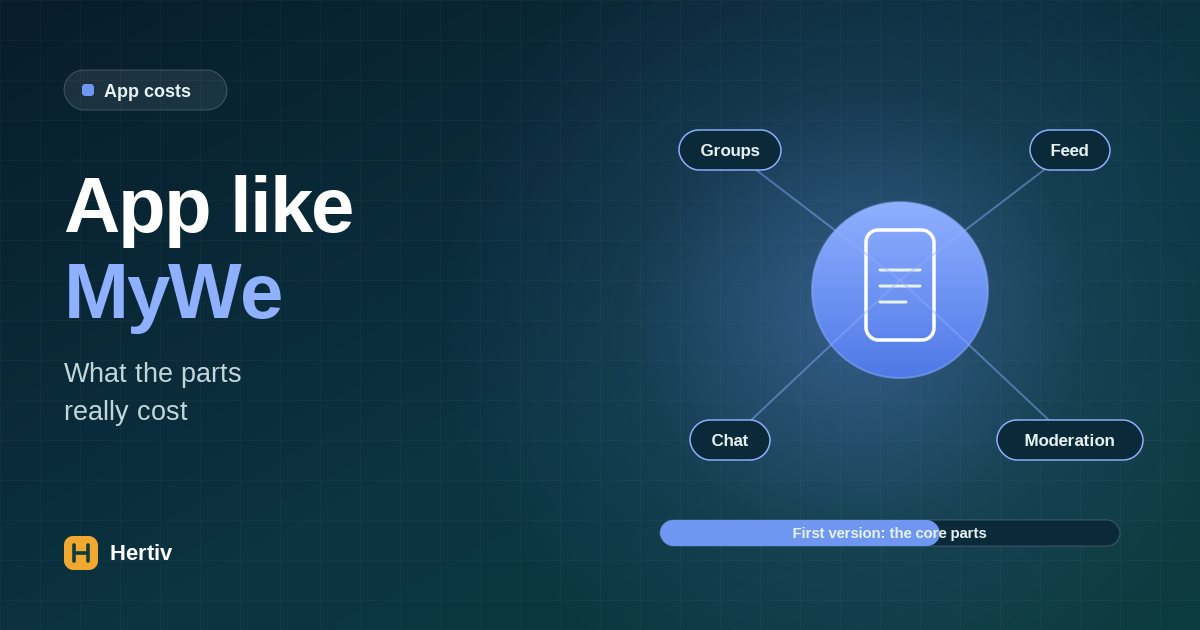
An app like MyWe, a social app where people join groups, share posts and chat, costs what its parts cost: accounts and profiles, groups, a feed, messaging, and moderation. A small first version takes roughly 10 to 16 weeks of work, and the total depends on how much of that scope you build first.
What is an app like MyWe?
An app like MyWe is a social app built around groups: people create a profile, join groups they care about, share posts and photos, and chat with other members. The core is simple on the surface, but each part needs its own work: accounts, a feed that stays fast as it grows, and tools that keep the community safe.
The cost comes from scope, not from the name on the app. A first version with profiles, groups, a feed and chat costs far less than a full social network with video, live events and payments. The sections below break the cost into parts so you can see where the money goes.
| Part | What it includes | Share of the build |
|---|---|---|
| Accounts and profiles | Sign-up, profiles, settings | Small |
| Groups | Create, join, manage, invite | Medium |
| Feed | Posts, photos, likes, comments | Large |
| Chat | One-to-one and group messages | Medium |
| Moderation and safety | Reports, blocks, admin tools | Medium |
What drives the cost up or down?
Scope is the biggest driver. Each feature adds design, build and testing time, and social apps have many small features that add up fast: notifications, search, media uploads and settings all look small alone and cost real time together. A first version with five features costs far less than one with fifteen.
Platform choice matters too. One platform, iOS or Android, costs less than both, and a web version adds more. Media is another driver: photos are cheap to handle, while video needs storage, processing and a player that works on weak connections. The team should decide these three things before estimating anything.
Team size is the third driver. A small team of two or three people costs less per week but takes longer, while a larger team costs more per week and finishes sooner. The total cost is similar either way, so the choice is really about speed: how fast the app needs to reach users.
What should the first version include?
The first version should do one thing well: let people join a group and talk. That means accounts, groups, a feed with text and photos, and simple chat. Everything else, such as video, events and payments, can wait for the second version, when real users tell you what they want.
Moderation cannot wait, though. A social app without reporting, blocking and admin tools will be abused quickly, and fixing that after launch costs more than building it first. Keep moderation simple at first: report, block, and an admin screen to review reports. For the planning basics, read what an MVP is before you scope the build.
Notifications are worth including in the first version too, because they bring people back. A member who gets a short message when someone replies to their post will open the app again, while a member who hears nothing will forget it. Keep notifications simple: replies, mentions and group invites are enough to start.
How do you estimate the cost, step by step?
Estimate by parts, not by guessing a total. List every feature, estimate the hours for each, and add design, testing and launch work on top. A part-by-part estimate shows where the money goes and what you can cut if the total is too high.
- List the features for the first version only, and cut anything that is not needed on day one.
- Estimate the hours for each feature, including design and testing.
- Add the hours for accounts, moderation and launch work.
- Add a reserve of about 10% for surprises, because social apps always have some.
- Compare the total with the budget, and cut features before cutting quality.
Check the running costs too: hosting, storage, messages and moderation all cost money every month after launch. A cheap build with high running costs is not a cheap app.
Example (hypothetical): a first version for a community app
Example (hypothetical): a team plans a first version with accounts, groups, a feed, chat and basic moderation. They estimate 520 hours of build work at $60 an hour, which is $31,200, plus $4,000 for design and $3,000 for testing and launch.
The parts add up to $38,200. They add a 10% reserve of $3,820 for surprises, giving a total of $42,020. The build takes about 13 weeks with a small team, and the monthly running cost afterwards is a few hundred dollars for hosting and storage, growing as members join.
If the budget were smaller, the team would cut chat first and keep the feed, because the feed is where the community lives. Cutting moderation is not an option, because a social app without it will be abused fast.
What does it cost to run after launch?
Running costs start small and grow with members. Hosting and storage grow as posts and photos pile up, messaging costs grow with chat volume, and moderation grows with reports. A small community costs a few hundred dollars a month to run, while a large one costs far more.
The team should plan for moderation as a running cost, not a one-off build. Someone must read reports, handle disputes and keep the community safe, and that work grows with the member count. Read how to build an MVP for keeping the first version small.
Also check what an MVP costs to compare the estimate with a typical first build.
Support is another running cost that teams forget. Members will ask how to change a setting, recover an account or report a problem, and someone must answer. A simple help page and an email address are enough at first, but the team should budget a few hours a week for support from day one.
Common mistakes
The most common mistake is building every feature at once. Social apps have endless feature ideas, and a first version that tries to include them all takes too long and costs too much. Build the core, launch it, and let real users tell you what to add.
Another mistake is skipping moderation. A social app without reporting and blocking will be abused, and the abuse will drive good members away. Build simple moderation from the start, even if it feels like a cost with no visible return.
A third mistake is ignoring the feed's speed. A feed that loads slowly will not be used, no matter how good the features are. Test the feed with a large amount of test data before launch, not with ten posts.
Finally, do not forget the running costs. A build that fits the budget can still fail if hosting and moderation cost more than the team planned. Estimate the monthly cost for the first year, not just the build.
Key takeaways
- Cost comes from scope, not from the app's name
- First version: accounts, groups, feed, chat and moderation
- Estimate by parts, then add a 10% reserve
- Moderation cannot wait, even in a first version
- Running costs grow with members, so plan for year one
Frequently asked questions
How much does an app like MyWe cost to build?
It depends on scope. A small first version with accounts, groups, a feed, chat and moderation takes roughly 10 to 16 weeks of work. The total is the sum of the parts, plus design, testing and a reserve of about 10%.
What is the most expensive part?
The feed is usually the largest part, because it must stay fast as posts pile up. Chat and moderation are the next largest, while accounts and profiles are the smallest part of the build.
Should I build for iOS and Android at once?
No, if the budget is tight. One platform costs less and lets you learn what users want. Add the second platform once the first version works and real users ask for it.
Can I cut moderation to save money?
No. A social app without reporting, blocking and admin tools will be abused quickly, and the abuse drives good members away. Keep moderation simple, but build it from the start.
What are the running costs after launch?
Hosting, storage, messaging and moderation, all of which grow with members. A small community costs a few hundred dollars a month, while a large one costs far more, so estimate the first year, not just the build.
How do I keep the cost down?
Cut features, not quality. Build the core first, launch it, and add features when real users ask for them. A small first version that works beats a big one that never ships.


