Cost to Build a Tokenization Platform in Saudi Arabia
Building a tokenization platform in Saudi Arabia adds regulatory, localisation and custody costs to the usual build. Here is what drives the price.
On this page
Short answer
Building a tokenization platform in Saudi Arabia typically costs from around $60,000 for a basic pilot to $400,000 or more for a regulated, production-grade platform, with the Saudi route adding legal, compliance and localisation costs on top. The final price depends on the asset type, whether the offering is a security, the custody model, and whether the platform runs under a CMA FinTech Lab permit or a SAMA sandbox.
What is a tokenization platform?
A tokenization platform is software that turns rights in a real-world asset, such as shares, sukuk, fund units or property income, into digital tokens on a blockchain, and manages their issuance, transfer and settlement. It includes the token contracts, investor onboarding, compliance checks, custody connections and the marketplace or registry where tokens change hands.
For the issuer, the platform replaces paper certificates and manual registries with a single record of who owns what. For the investor, it offers fractional ownership, faster settlement and a clearer record of their holding. The platform itself does not make an asset legal to sell; the legal character of the token decides which rules apply.
In Saudi Arabia that distinction matters more than in most markets, because the Kingdom has no general licensing regime for virtual asset service providers. Tokenized securities fall under the Capital Market Authority, while payment and banking activity falls under the Saudi Central Bank, known as SAMA, so the platform must be built for the right regulator from the start.
What does the Saudi route change?
The Saudi route changes a tokenization build in three ways: the regulatory path, the asset scope, and the localisation work. Each one adds cost and time compared with building the same platform for a market with a settled licensing regime.
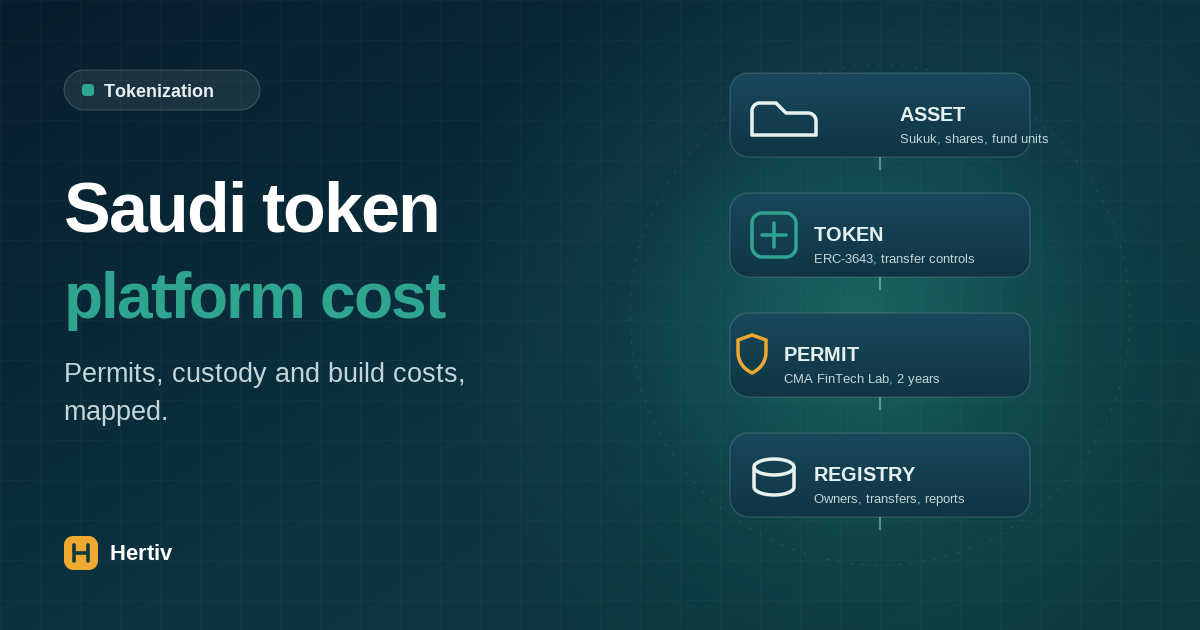
On regulation, tokenized securities in Saudi Arabia are tested inside the CMA FinTech Lab under an experimental permit, which lasts up to two years, rather than under a general licence.
Security token models have been accepted in the Lab since 2022, and the test is limited to securities with the features of traditional ones, such as transferable shares, sukuk and fund units. SAMA runs its own sandbox for payment and banking innovation, and admission to one route does not give permission from the other.
On asset scope, the token must match a traditional security type to fit the Lab test. A direct revenue right with no security behind it has no established route of its own, so income from an asset is usually channelled through a fund. That shapes the platform design, because the token model, the investor flow and the custody setup all follow the asset type.
On localisation, the platform needs Arabic as a first-class language, Saudi identity verification, and payment rails that fit local practice. These are not cosmetic changes: onboarding, disclosure and reporting all need to work in Arabic, and the investor checks must connect to local identity and banking systems. For the general cost picture, see how much a tokenization platform costs.
What drives the cost of a Saudi tokenization platform?
The cost of a tokenization platform in Saudi Arabia is driven by the asset type, the regulatory route, the custody model and the integration load. The table below shows the main drivers and how each one moves the price.
| Cost driver | What it covers | Cost effect |
|---|---|---|
| Asset and token model | Shares, sukuk, fund units, property | Complex assets need more contract and legal work |
| Regulatory route | CMA FinTech Lab permit or SAMA sandbox | Application, legal advice and testing add months |
| Custody model | Self-custody, MPC, third-party custodian | Institutional custody is the largest single add-on |
| Investor onboarding | KYC, AML screening, Arabic flows | Local identity checks add integration cost |
| Integrations | Banks, payments, registries, oracles | Each live integration adds build and testing time |
| Security and audit | Contract audit, penetration testing | Required for any regulated route |
The regulatory route is the driver teams underestimate most. The permit application, the legal opinions and the testing conditions are real project work, not paperwork, and they run in parallel with the build, so they need budget and a named owner from day one.
Cost tiers for a tokenization platform in Saudi Arabia
Costs vary with scope, but published 2026 agency guides put a tokenization platform build in three broad tiers, with the Saudi route adding a regulatory and localisation premium on top of each one. Treat these as indicative planning ranges, not quotes.
| Tier | What it includes | Indicative range |
|---|---|---|
| Pilot | One asset type, basic issuance, test users | $60,000 - $150,000 |
| Mid-level | Investor onboarding, custody, secondary transfer | $150,000 - $400,000 |
| Production-grade | Full compliance, institutional custody, reporting | $400,000 and above |
The Saudi premium sits on top of these ranges. Legal and regulatory advisory for a FinTech Lab permit, Arabic localisation of the full investor flow, and local identity and payment integrations typically add a meaningful share to the mid-level tier, and the exact amount depends on the asset and the testing conditions the CMA sets. Maintenance usually runs at around 15 to 25% of the build cost per year, covering monitoring, updates and support.
Teams should also budget for the audit. A smart contract audit and a security review are expected for any regulated route, and the audit alone can cost a significant share of a pilot budget. Skipping it is not an option when the platform will hold investor funds or issue securities.
How to plan the build
You plan a Saudi tokenization platform build by settling the legal position first, then the token model, then the technology, so the build never outruns the permission it needs.
- Define the asset and the token. Decide what is being tokenized, what rights the token carries, and whether it is a security under the Capital Market Law. That answer decides the regulator.
- Choose the regulatory route. Apply to the CMA FinTech Lab for a securities offering, or to the SAMA sandbox for payment-side innovation, and confirm the testing conditions before building.
- Pick the chain and token standard. Choose a chain and a standard that fits the asset, such as a permissioned token standard with transfer controls for securities, and confirm it works with the custody provider.
- Design onboarding and custody. Build the investor checks, the Arabic onboarding flow and the custody model together, since they share the same identity and signing rules.
- Build the platform. Develop issuance, transfer, settlement and reporting, with the compliance checks enforced in the contracts and the platform, not only in the interface.
- Audit and test. Run a smart contract audit and a security review, then test the full flow in the sandbox with real users before asking for live approval.
Expect the regulatory work to take as long as the engineering. A platform that is technically ready but has no permit cannot take live investors, so the permit timeline, not the build timeline, usually sets the launch date. A related build guide is how to build a tokenization platform on Solana.
Example (hypothetical): a mid-level sukuk platform
Example (hypothetical): a team plans a mid-level platform to tokenize sukuk for Saudi investors. The build costs $180,000, legal and regulatory advisory for the FinTech Lab permit costs $45,000, the smart contract audit costs $30,000, and bank and identity integrations cost $25,000.
Adding those together gives $180,000 plus $45,000 plus $30,000 plus $25,000, which is $280,000 for the first build. Annual maintenance at 20% of the build cost is $36,000 a year, so the first-year total is $280,000 plus $36,000, or $316,000.
The team also budgets for a second year of sandbox testing, since the permit lasts up to two years and the platform cannot take live investors until the CMA approves the move out of the Lab. That second year costs the $36,000 maintenance plus a further $20,000 for legal and reporting work, bringing the two-year total to $372,000 before any live revenue.
What are the common mistakes?
The most common mistakes are building before the regulatory route is settled, treating a token as a product instead of a security, and underestimating the Arabic and integration work.
- Building before the permit path is clear. A platform built for the wrong regulator has to be rebuilt. Confirm the route with legal advice before writing contracts.
- Ignoring the security test. If the token looks like a security, it is regulated as one. Designing around that fact is far cheaper than redesigning after the fact.
- Underestimating localisation. Arabic onboarding, disclosure and reporting are core features, not translations done at the end. Budget for them from the start.
- Skipping the audit. An unaudited contract that holds investor funds is a risk no regulator will accept. Plan the audit into the timeline and the budget.
- Forgetting the sandbox clock. A FinTech Lab permit lasts up to two years. If the build runs long, the testing window can close before the platform is ready.
If the platform is part of a wider real-world asset programme, RWA tokenization covers the platform and custody patterns that apply across markets.
Key takeaways
- A Saudi tokenization platform typically costs from around $60,000 for a pilot to $400,000 or more for a production-grade build
- Tokenized securities are tested in the CMA FinTech Lab under a permit of up to two years, not under a general licence
- The asset type decides the regulator, the token model and the custody setup, so settle it first
- Legal, Arabic localisation and local integrations add a real premium on top of the base build cost
- Budget for a smart contract audit and for a second year of sandbox testing before live revenue
Frequently asked questions
How much does it cost to build a tokenization platform in Saudi Arabia?
Published 2026 guides put a pilot at roughly $60,000 to $150,000, a mid-level platform at $150,000 to $400,000, and a production-grade build at $400,000 or more. The Saudi route adds legal, compliance and localisation costs on top, so treat these as planning ranges.
Can anyone launch a tokenized security in Saudi Arabia?
No. Tokenized securities are tested inside the CMA FinTech Lab under an experimental permit, and the test is limited to securities with traditional features, such as shares, sukuk and fund units. There is no general licence for virtual asset service providers in the Kingdom.
What is the CMA FinTech Lab?
The FinTech Lab is the Capital Market Authority's testing route for financial innovation in securities. It grants experimental permits of up to two years, during which a firm can test a model such as a tokenized offering under supervisory conditions.
What role does SAMA play in tokenization?
The Saudi Central Bank, SAMA, supervises banks, payment services and its own regulatory sandbox for financial innovation. A platform with payment or banking features may need SAMA's route as well as, or instead of, the CMA's.
Which assets can be tokenized in Saudi Arabia?
The FinTech Lab test accepts securities with traditional features, including transferable shares, sukuk and investment fund units. A direct revenue right with no security behind it has no established route, so income is usually channelled through a fund.
How long does a Saudi tokenization build take?
The engineering can take a few months, but the permit application, legal work and sandbox testing usually take as long again. Plan for the regulatory timeline to set the launch date, and budget for up to two years of testing under the permit.


