How to Build a Tokenization Platform on Solana
A tokenization platform on Solana turns real assets into tokens that trade on-chain. Here is the build process, the Solana pieces involved and what it costs.
On this page
Short answer
A tokenization platform on Solana is software that issues tokens backed by real assets, such as treasuries or funds, and lets investors hold, transfer and redeem them on the Solana blockchain. Building one means choosing a token program, writing the issuance and compliance logic, and connecting custody, payments and reporting, with costs driven mainly by the team and the legal work.
What is a tokenization platform on Solana?
A tokenization platform on Solana is a system that turns ownership of a real asset into tokens on the Solana blockchain. Each token stands for a share of the asset, and the platform handles issuance, transfers, redemptions and the records that prove who owns what.
The platform has three layers: the on-chain token and its rules, the off-chain services that hold the asset and check investors, and the interface where investors buy, hold and redeem. Solana suits this work because transactions settle in seconds and fees are low, which matters when a fund issues thousands of small positions.
Tokenization is not the same as launching a memecoin. A tokenized asset must track a real holding, pay the yield or value that holding produces, and let investors redeem, which means the off-chain legal and custody work is as large as the code. For the single-token version of this work, see how to create a token on Solana.
SPL Token or Token-2022: which program fits?
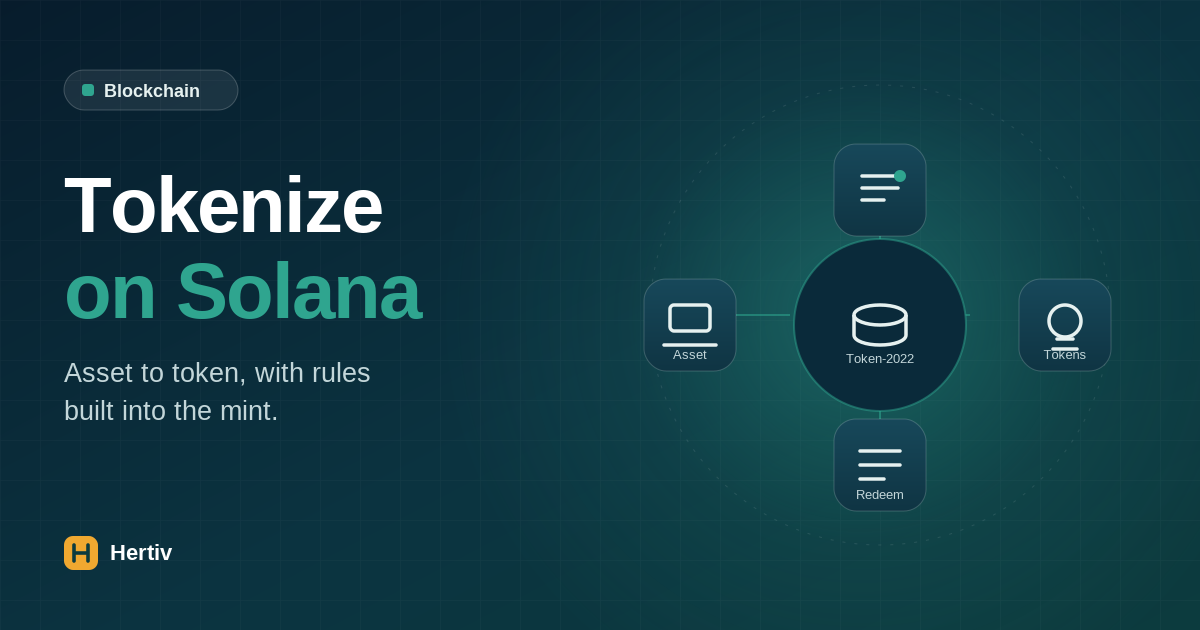
Solana has two token programs, and the choice shapes what the platform can do without extra code. The original SPL Token program is simple and widely supported by wallets and exchanges. Token-2022, also called the Token Extensions program, adds behaviour directly to the mint, such as transfer fees, on-chain metadata and transfer hooks.
For a regulated asset, Token-2022 is usually the better fit, because compliance rules such as transfer restrictions and fees can live in the token itself rather than in a server that watches every transfer. The trade-off is weaker support in older wallets and tools, so check that your custody and wallet partners support Token-2022 before you commit.
| Feature | SPL Token | Token-2022 |
|---|---|---|
| On-chain metadata | Needs Metaplex | Built into the mint |
| Transfer fees | Not built in | Built-in extension |
| Transfer restrictions | Needs extra program | Transfer hook extension |
| Wallet support | Widest | Growing, check each wallet |
| Best for | Simple tokens | Regulated tokenized assets |
Decide the program before you write the platform, because the mint's extensions are set at creation and cannot be added later. A wrong choice means reissuing the token and moving every holder.
How to build the platform, step by step
Build in the order that removes risk first: asset and legal structure, then token design, then the platform around it. Code written before the legal structure is settled often has to be rewritten.
- Define the asset and the structure. Pick the asset, the legal vehicle that holds it, and who may invest. This decides the jurisdiction and the rules the platform must enforce.
- Choose the token program and extensions. Pick SPL Token or Token-2022, set decimals, and choose extensions such as metadata, transfer fees and transfer hooks.
- Build issuance and redemption. Write the program that mints tokens when money arrives and burns them when an investor redeems, with checks on who may hold.
- Connect custody and payments. Link a custodian for the asset and a payment route for subscriptions and redemptions, in fiat or stablecoins.
- Add investor checks. Build KYC, accreditation checks and a transfer allowlist, so tokens cannot move to an unchecked wallet.
- Test on devnet, then audit. Run the full lifecycle on Solana devnet, then get the programs and the platform audited before mainnet.
Keep the on-chain code small. Put the rules that must never break, such as who may hold, on-chain, and keep pricing, reporting and investor communication off-chain where they are easier to change.
What does it cost to build?
Cost depends on the team, the asset and the legal work, so treat the ranges below as planning figures, not quotes. The build is usually the smaller share: legal, audit and running costs add up over the first year.
| Cost item | What it covers | Indicative range |
|---|---|---|
| Legal structure and opinions | Vehicle, offering documents, counsel | $50,000 to $200,000+ |
| Smart contract build | Token program, issuance, redemption | $60,000 to $250,000 |
| Platform and interface | Investor portal, admin, reporting | $50,000 to $200,000 |
| Audit | Program and platform security review | $30,000 to $150,000 |
| Custody and payments | Custodian, payment rails, banking | $20,000 to $100,000 a year |
| Running costs | Hosting, monitoring, compliance staff | $10,000 to $50,000 a month |
The cheapest way to cut cost is to narrow the scope: one asset, one investor type, one jurisdiction. Each extra asset class or country adds legal review, and the platform must enforce the rules of each one. For the market this platform would enter, see the Solana RWA tokenization market.
What about compliance and custody?
Compliance is part of the product, not a layer added at the end. A tokenized security must only move between investors who have passed checks, and the platform must be able to prove that. On Solana, that usually means a transfer hook or an allowlist that blocks transfers to unchecked wallets.
Custody splits in two: the asset itself sits with a regulated custodian or in a fund structure, and the tokens sit in investor wallets. The platform must reconcile the two every day, so the number of tokens in circulation always matches the asset held. If they drift apart, investors lose trust fast.
Redemption is the hardest part to get right. An investor who cannot redeem will treat the token as illiquid, however good the trading looks. Design the redemption flow before the issuance flow, and test it with real money on devnet first.
Example (hypothetical): a tokenized treasury fund
Example (hypothetical): a fund manager wants to tokenize a treasury fund on Solana. The fund holds $50 million of short-term government bills with a custodian, and the platform issues tokens at $100 each, so 500,000 tokens stand for the whole fund.
The build takes 16 weeks: 4 weeks on legal structure, 6 weeks on the token program and platform, 3 weeks on audit fixes and 3 weeks on investor testing. The first-year cost is $180,000 for legal work, $150,000 for the build, $60,000 for the audit and $120,000 for custody and running costs, a total of $510,000.
In the first year the fund takes in $10 million from 400 investors. At a 4% yield, the fund earns $400,000, and an investor holding 2,500 tokens, worth $250,000, earns $10,000. The lesson is that the platform only pays if the fund raises enough to cover the fixed legal and audit cost.
What are the common mistakes?
The most common mistakes with a Solana tokenization platform are picking the token program late, treating compliance as an afterthought, and under-budgeting the legal work.
- Late program choice. Token-2022 extensions cannot be added after the mint is created, so a late switch means reissuing.
- Compliance as an afterthought. A token that any wallet can hold is a problem for a regulated asset, not a feature.
- Ignoring redemption. If investors cannot redeem, the token trades at a discount and the platform loses trust.
- No reconciliation. Tokens in circulation must match the asset held, checked daily, not monthly.
- Too many assets at launch. Each asset class adds legal review and new rules for the platform to enforce.
- Skipping the audit. A token program that moves real money needs a security review before mainnet.
For the economics behind the token design, see what tokenomics is.
For a gold-backed version, see how to create a gold tokenization platform.
Key takeaways
- A tokenization platform turns a real asset into tokens and handles issuance, transfers and redemption
- Token-2022 fits regulated assets better, but its extensions must be set at mint creation
- Legal structure comes before code, and redemption design comes before issuance
- First-year cost is driven by legal work, audit and running costs, not only the build
- Tokens in circulation must match the asset held, checked daily
- Launch with one asset, one investor type and one jurisdiction
Frequently asked questions
How long does it take to build a tokenization platform on Solana?
A focused build usually takes three to six months, including legal structure, the token program, the investor platform and an audit. The legal work and the audit often take longer than the code, so start them first.
Is Token-2022 better than SPL Token for tokenization?
For regulated assets, usually yes, because transfer fees, on-chain metadata and transfer restrictions can live in the token itself. For simple tokens, SPL Token is simpler and has wider wallet support.
Can I change a token's rules after launch?
No, not the extensions. Token-2022 extensions are set when the mint is created and cannot be added later. That is why the token design must be settled before the platform is built.
How much does a Solana tokenization platform cost?
A focused first version typically costs $300,000 to $800,000 in the first year, including legal work, the build, an audit and running costs. The legal structure and the audit are often the largest single items.
Do investors need to pass checks to hold the tokens?
Yes, for tokenized securities. The platform must check each investor before they can hold, and it must block transfers to wallets that have not passed checks, usually with a transfer hook or an allowlist.
What assets work best for tokenization on Solana?
Treasuries, money market funds and other assets with a clear price and regular yield work best, because the token value is easy to track. Illiquid assets such as property are harder, since pricing and redemption are less clear.


