What Does It Cost to Build a Super App?
A super app costs more than a single-purpose app because it packs payments, chat, shopping and mini-apps into one product, and the bill depends on launch scope.
On this page
Short answer
A super app is one mobile app that packs many services, such as payments, chat, shopping, bookings and food delivery, into a single product with one login and one wallet. It costs more than a single-purpose app because each service needs its own screens, backend and rules, and the app has to keep them working together. The total depends on how many services launch on day one.
What is a super app?
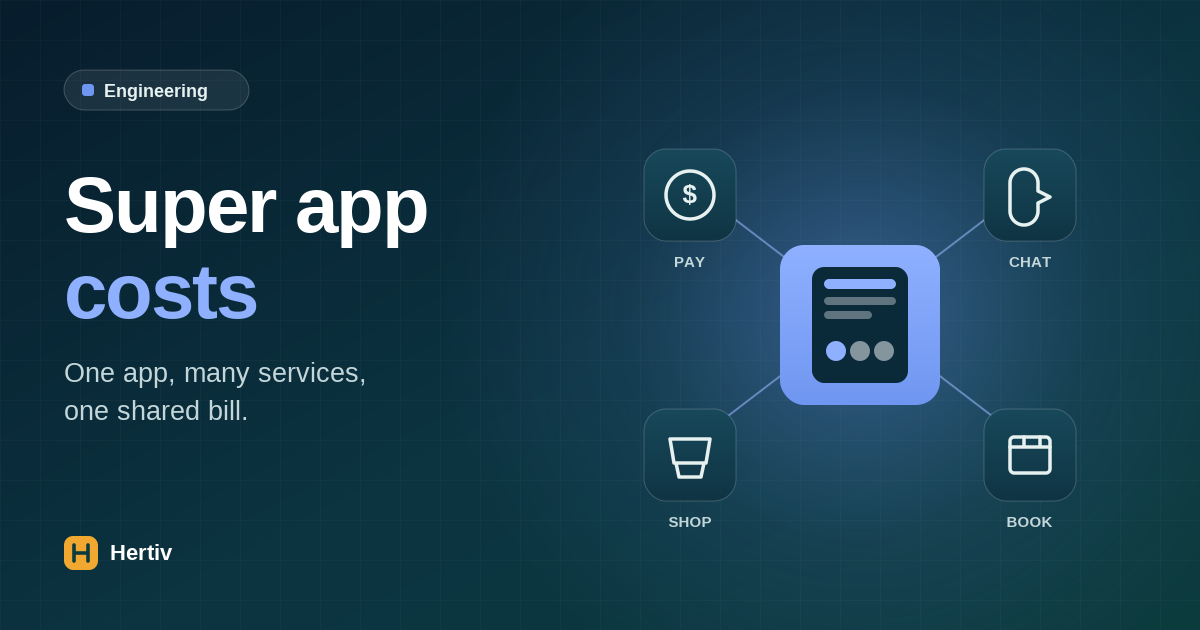
A super app is a single mobile app that packs many services into one product, such as payments, chat, shopping, bookings and food delivery, with one login and one wallet shared across them. Users open one app and switch between services without downloading anything else.
The idea is common in Asia, where apps such as WeChat and Grab grew from one service into many. In other markets, a super app is usually built by a retailer, a bank or a delivery company that already has customers and wants them to stay inside one product.
A super app is not just a big app. It has a mini-app system: small services built by outside teams that run inside the main app. That system is what makes a super app expensive, because the main app has to host, secure and update services it did not build itself.
The cost question is really a scope question. A super app with three services is a different project from one with twelve, and the difference shows up in the team, the timeline and the running cost.
What drives the cost of a super app?
The cost of a super app comes from four places: the services themselves, the shared platform underneath them, the mini-app system, and the running cost after launch. The table below sets out each driver and what pushes it up.
| Cost driver | What it covers | What pushes it up |
|---|---|---|
| Core services | Payments, chat, shopping, bookings | More services at launch |
| Shared platform | Login, wallet, search, notifications | One account across all services |
| Mini-app system | Hosting and rules for outside services | Outside teams building on it |
| Payments and compliance | Licences, fraud checks, refunds | Handling money in several countries |
| Team and timeline | Design, build, testing, launch | Longer build, larger team |
| Running cost | Servers, support, updates | More users and more services |
Payments are often the most expensive part. Handling money means licences, fraud checks, refunds and audits, and each country adds its own rules. A super app that takes payments in three countries costs far more than one that takes payments in one.
The shared platform is the second driver. One login, one wallet and one search box sound simple, but they have to work the same way across every service, and every new service has to fit the same rules. That shared work is invisible to users and easy to under-budget.
How much does each part cost to build?
Each part of a super app has its own build cost, and the parts do not scale in the same way. A chat service is mostly a screen and a message store, while a payment service needs licences, fraud checks and a ledger that never loses a cent.
The first version should carry the services that make money or keep users coming back, and little else. A retailer might launch with shopping, payments and delivery tracking, then add bookings and chat later. Each service added later costs less than one forced into the first launch, because the platform already exists.
Mini-apps are the part teams forget to price. The main app needs a way to load outside services, check that they are safe, and update them without breaking the app. That system takes real engineering time, and it only pays off once outside teams actually build on it.
Testing costs more than in a single-purpose app. A change to the wallet can break the shop, and a change to the login can lock users out of every service. Teams should plan for testing across services, not just inside one, and keep a minimum viable product mindset: launch small, then grow.
What does the team and timeline look like?
A super app team is larger than a normal app team, because the work splits across services. A typical first version needs product and design leads, mobile developers, backend developers, a payments specialist, a quality tester and someone running the launch. Small teams can build one or two services; a full super app needs a real team, which is why most founders talk to a custom software development partner before they commit.
Timelines run longer for the same reason. The shared platform has to be built before the services can use it, so the first months produce little that users can see. Teams that skip the platform and build services first usually pay for it later, when the services do not fit together.
A realistic first launch takes the better part of a year for a team of six to ten people, and the app keeps growing after that. The launch is a starting point, not a finish line: new services, new countries and new rules keep arriving.
Running costs also grow with the app. Servers, support, fraud monitoring and app-store updates all scale with users and services, so the monthly bill after launch is part of the budget, not an afterthought.
Should you build one app or several small apps?
One app is the right choice when users already move between your services and when one login and one wallet would save them real effort. A bank with accounts, cards and loans, or a retailer with shopping, delivery and loyalty, fits this pattern well.
Several small apps are better when the services have different users. A delivery app for riders and a shopping app for customers have little in common, and forcing them into one product makes both harder to use. A fintech super app shows the same trade-off: payments and lending fit together, but a stock-trading service may not.
A middle path is common: one app for customers, with services added over time, and separate tools for staff and partners. That keeps the customer product simple while the business still gets one login and one wallet.
The decision should follow the user, not the trend. If your customers already use two or three of your services in one week, one app will help them. If they use one service a month, a super app adds cost without adding value.
Example (hypothetical): a retailer plans a super app budget
Example (hypothetical): a retailer plans a super app with shopping, payments and delivery tracking. The team has six people, each working 160 hours a month at $70 an hour, so one month of team time costs $67,200. The build runs for nine months, so team time costs $604,800.
Design costs $40,000, testing across the three services costs $30,000, and the launch, including app-store work and the first marketing push, costs $20,000. The build total is $604,800 plus $40,000 plus $30,000 plus $20,000, which comes to $694,800.
The team adds a 15% reserve for surprises, which is $104,220, so the full budget is $799,020. Running costs after launch are about $8,000 a month for servers, support and fraud monitoring.
The retailer launches with three services and adds bookings in the second year, when the platform already exists. The numbers are planning figures, not quotes: real costs depend on the team, the country and the payment rules, so get a written quote before you commit.
What are the common mistakes?
The most common super app mistakes are launching with too many services, under-budgeting the shared platform, and treating payments as an afterthought. Each one adds cost after launch, when it is hardest to fix.
- Launching with too many services. Twelve services on day one means twelve things to test, support and fix. Launch with the three that earn money or keep users, then add the rest.
- Under-budgeting the platform. One login, one wallet and one search box take real work. If the platform is weak, every new service costs more than it should.
- Treating payments as an afterthought. Licences, fraud checks and refunds need planning from the start. Adding them late is slow and expensive.
- No mini-app rules. If outside teams build on your app, you need rules for safety, updates and revenue sharing before the first one ships.
- Ignoring running costs. Servers, support and fraud monitoring grow with users. Budget the monthly bill, not just the build.
Key takeaways
- A super app is one app with many services, one login and one wallet
- Payments and the shared platform are the biggest cost drivers
- Launch with three services, not twelve, and add the rest later
- A first version takes the better part of a year for a team of six to ten people
- Budget running costs after launch, not just the build
Frequently asked questions
What is a super app?
A super app is one mobile app that packs many services, such as payments, chat, shopping, bookings and delivery, into a single product with one login and one wallet. Users switch between services without downloading another app, and the business keeps them inside one product.
How much does a super app cost to build?
It depends on scope. A first version with three services and one country costs far less than one with twelve services and payments in several countries. The main drivers are the services, the shared platform, payments and compliance, and the team. Get a written quote for your scope.
How long does it take to build a super app?
A first version usually takes the better part of a year for a team of six to ten people, because the shared platform has to be built before the services can use it. The app keeps growing after launch, with new services and countries added over time.
What is the difference between a super app and a normal app?
A normal app does one job, such as shopping or chat. A super app does many jobs inside one product, with one login and one wallet, and it can host mini-apps built by outside teams. That shared platform is what makes it different and more expensive.
Do I need a super app, or several small apps?
One app fits when your users already move between your services in the same week. Several small apps fit when the services have different users, such as riders and shoppers. Follow the user, not the trend, and launch with the services that earn money.
What are the running costs of a super app?
Running costs cover servers, support, fraud monitoring, app-store updates and mini-app review, and they grow with users and services. A small launch might run at a few thousand dollars a month, while a large one costs far more. Budget the monthly bill before you build.


