How Much Does a Retail Delivery App Like Woolworths Cost?
A retail delivery app like Woolworths costs roughly $150,000 to $300,000 for a first version and $300,000 to $600,000 for a full product.
On this page
Short answer
A retail delivery app like Woolworths is a grocery shopping app that lets customers order food and household items for delivery, with live tracking, delivery slots and loyalty rewards. Building one costs roughly $150,000 to $300,000 for a first version and $300,000 to $600,000 for a full product, with the picking, slotting and delivery parts adding the most to the bill.
What does a Woolworths-style delivery app include?
A Woolworths-style delivery app is a grocery shopping app for ordering food and household items for delivery to the door. Woolworths is an Australian supermarket chain, and its app lets customers shop a full grocery range, choose a delivery window, earn Everyday Rewards points, and track the order on a live map. Its Delivery Now service delivers a full shop of up to 50 items in under two hours from over 700 stores.
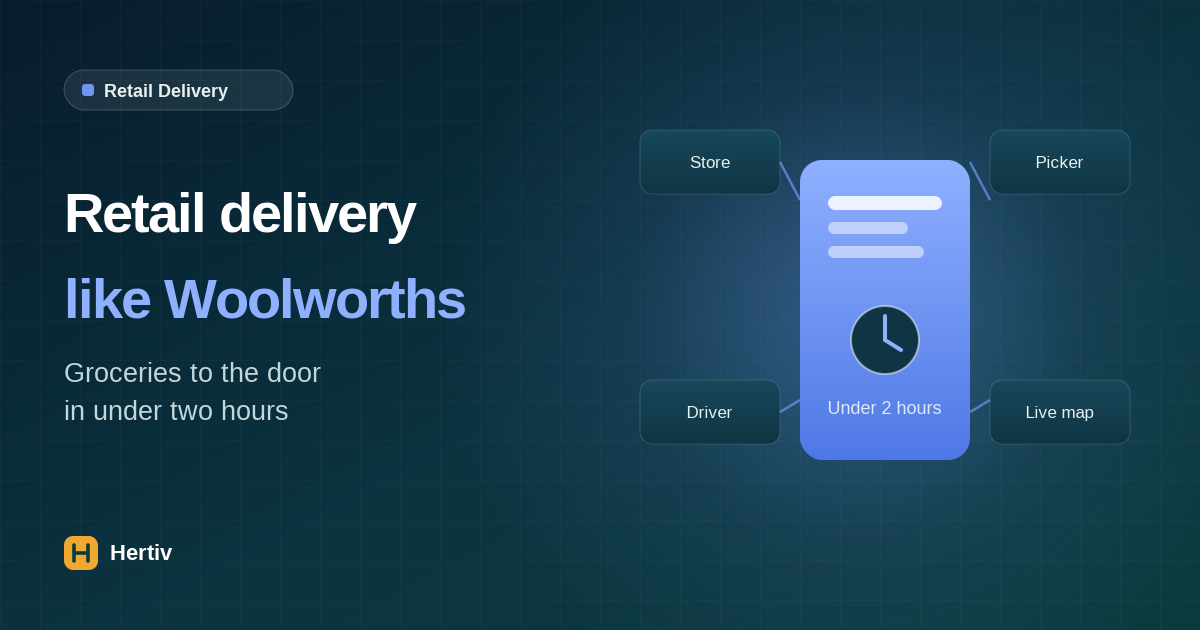
The app has three sides. Customers browse, order and track. Store staff pick and pack the order in the shop. Drivers collect the packed order and deliver it. Each side needs its own screens, and the three sides must agree on the order status at every step.
Delivery is the hard part. A grocery order has fresh food that must stay cold, a delivery window the customer chose, and a driver who must arrive on time. That needs live stock, timed slots, route planning and tracking, which a simple shop app does not have. For how another delivery app is priced, see how much an app like Grab costs to build.
Which features drive the cost?
The features that drive the cost are the ones that touch real orders: the catalogue, the picking flow, delivery slots and live tracking. A grocery catalogue is large, with thousands of items, prices that change often, and stock that differs by store, so the data work alone is a major part of the build.
| Feature | What it does | Cost driver |
|---|---|---|
| Catalogue and search | Browse, search, specials | Large catalogue, live prices |
| Delivery slots | Book a time window | Slot capacity per store |
| Picking and packing | Staff pick items in store | Picker app, substitutions |
| Live tracking | Map, driver location, ETA | Maps, GPS, real-time updates |
| Payments and loyalty | Pay, earn rewards points | Payment and loyalty links |
| Driver app | Jobs, routes, proof of delivery | Routing, offline mode |
Substitutions are a grocery-only problem. When an item is out of stock, the picker must offer a replacement and the customer must be able to accept or refuse it. That flow touches the catalogue, the order, the price and the refund, so it is easy to get wrong and costly to fix later.
How much does each version cost?
A first version with a catalogue, checkout, delivery slots and basic tracking costs roughly $150,000 to $300,000. A full product with a picker app, a driver app, live tracking, loyalty rewards and delivery in under two hours costs roughly $300,000 to $600,000. A large-scale product with many stores, same-day and on-demand delivery and heavy order volume costs $600,000 to $1,200,000 or more. All figures are indicative ranges, not quotes.
| Version | What is included | Indicative cost |
|---|---|---|
| First version | Catalogue, checkout, slots, basic tracking | $150,000–$300,000 |
| Full product | Picker app, driver app, loyalty, fast delivery | $300,000–$600,000 |
| Large scale | Many stores, on-demand, high volume | $600,000–$1,200,000+ |
The running costs sit outside these ranges. Delivery fees, driver pay, map licences and payment fees are paid per order, so they grow with volume. Woolworths charges a delivery fee from $15 in metropolitan areas on weekdays for its Delivery Now service, which shows how the fee model works in practice. See mobile apps for retail business for the wider retail picture.
What makes grocery delivery expensive to build?
Grocery delivery is expensive to build because every order is a race against time and temperature. Fresh food must stay cold from the shelf to the door, so the app must plan the pick, the pack and the route in one sequence, not as three separate jobs. If any step slips, the order arrives late or warm.
Delivery slots are the second cost. Each store can only handle a set number of orders per hour, because pickers and drivers are limited. The app must show only the slots the store can actually fill, and it must stop selling a slot when it fills up. That needs live capacity data from every store, updated as orders come in.
Live tracking is the third cost. Customers expect to see the driver on a map and get an accurate arrival time, which needs GPS, map licences and real-time updates. A tracking screen that shows a stale location is worse than no tracking at all, because it creates calls to support.
How to build it in seven steps
Build a Woolworths-style delivery app in seven steps, starting with one store and one delivery area, not with a whole city. The catalogue and checkout come first; the fast-delivery promise comes after the basics work.
- Pick one store and area. Start with a single store and a small delivery zone, so the team can learn the real order flow.
- Build the catalogue. Load the product range with live prices and stock, and make search and specials work well.
- Add checkout and slots. Payments, delivery windows and a minimum order, with slot capacity tied to the store.
- Build the picker app. A simple list for store staff, with substitutions and a way to flag out-of-stock items.
- Add the driver app. Jobs, routes and proof of delivery, with offline mode for poor signal areas.
- Add live tracking. Driver location on a map, an arrival estimate, and messages when the order is on its way.
- Add loyalty and fast delivery. Rewards points and an under-two-hours option, once the standard delivery works well.
Keep the first version to standard next-day or same-day delivery. An under-two-hours promise needs pickers, drivers and stock all ready at once, and it is the most expensive promise to keep. For a related retail build, see IoT in the retail industry.
Example (hypothetical): a one-store launch
Example (hypothetical): a team launches a Woolworths-style app for one store with 5,000 orders a week in the first year. Each order brings in $3 on average from delivery fees and margins, so weekly revenue is 5,000 x $3 = $15,000, or $60,000 a month.
Running costs are $40,000 a month, covering drivers, maps, servers, support and payment fees. That leaves $60,000 - $40,000 = $20,000 a month in net income. A first version that cost $200,000 to build pays for itself in $200,000 / $20,000 = 10 months, if order numbers and revenue hold steady.
The numbers change fast if delivery is faster than planned. If half the orders use an under-two-hours slot, driver costs rise and so does the fee income, but the margin per order can fall if drivers wait between jobs. Plan the budget around the slow case, and treat extra volume as a bonus, not as the plan.
What are the common mistakes?
The most common mistakes with retail delivery apps are promising fast delivery before the basics work, showing slots the store cannot fill, and forgetting substitutions.
- Fast delivery first. An under-two-hours promise needs pickers, drivers and stock ready at once.
- Slots without capacity. Selling a slot the store cannot fill means late orders and refunds.
- No substitution flow. Out-of-stock items without a replacement choice create complaints and refunds.
- Cold chain ignored. Fresh food that arrives warm is a refund and a lost customer.
- Stale tracking. A map that shows an old driver location creates more support calls than no map at all.
- Catalogue out of date. Prices and stock that differ from the shelf break trust at the checkout.
Key takeaways
- Grocery delivery is a race against time and temperature
- A first version costs roughly $150,000 to $300,000; a full product $300,000 to $600,000
- Slots must match real store capacity, or orders arrive late
- Substitutions and the cold chain decide whether customers come back
- Start with one store and standard delivery before promising two hours
Frequently asked questions
How much does an app like Woolworths cost to build?
A first version costs roughly $150,000 to $300,000, a full product roughly $300,000 to $600,000, and a large multi-store product $600,000 to $1,200,000 or more. These are indicative ranges. Delivery fees, driver pay, map licences and payment fees are running costs that sit outside them.
What is Woolworths Delivery Now?
Delivery Now is Woolworths' fastest grocery delivery service in Australia, delivering a full shop of up to 50 items in under two hours from over 700 stores. The delivery fee starts at $15 in metropolitan areas on weekdays, and customers can track the order on a live map.
Does a retail delivery app need a driver app?
Yes, if the business employs its own drivers. The driver app shows jobs, routes and proof of delivery, and it needs offline mode for areas with poor signal. If a third-party courier handles delivery, the app needs an integration with that courier instead.
How do delivery slots work in a grocery app?
Each store can only handle a set number of orders per hour, because pickers and drivers are limited. The app shows only the slots the store can actually fill and stops selling a slot when it fills up, which needs live capacity data from every store.
What is the hardest part of grocery delivery?
Keeping fresh food cold and on time. The pick, pack and route must be planned as one sequence, and any slip means a late or warm order. Substitutions for out-of-stock items are the other hard part, because they touch the catalogue, the price and the refund.
Can a small retailer build a Woolworths-style app?
Yes, starting with one store and a small delivery zone. A first version with a catalogue, checkout, delivery slots and basic tracking is enough to learn the real order flow. Fast delivery and loyalty rewards can wait until standard delivery works well.


