What Does an App Like Metrash2 Cost to Build?
An app like Metrash2 costs what its services, identity checks, payments and links to official systems cost. This guide breaks down the parts and estimation steps.
On this page
Short answer
An app like Metrash2 costs what its services, identity checks, payments and integrations cost, and the only reliable estimate is a breakdown of those parts plus a 10% reserve, never a single round number quoted.
What does an app like Metrash2 cost to build?
An app like Metrash2 is a government services app that lets residents handle official tasks on a phone, such as renewing documents, paying fines and booking appointments. Metrash2 is the app of Qatar's Ministry of Interior, and a similar app is a large, secure product with identity checks, payments and links to government systems.
There is no fixed price for such an app. A first version with the core services, login, payments and notifications typically needs several months of work from a small team, while a full version with many services, several languages and deep links to official systems takes far longer. The honest way to price it is to list the services you will ship first and cost each one separately.
| Part | What it includes | Cost driver |
|---|---|---|
| Accounts and identity | Login, verification, profiles | Security reviews and testing |
| Service flows | Renewals, payments, bookings | Number of services in version one |
| Payments | Cards, receipts, refunds | Payment provider and compliance |
| Notifications | Push, SMS, email reminders | Volume and delivery channels |
| Admin tools | Case handling, reports, content | Staff workflows behind the app |
| Security and testing | Encryption, audits, load tests | Data sensitivity and scale |
The table shows where the money goes. Identity and security are the parts you cannot cut, because the app handles official records and payments. For the general shape of a first release, what is an MVP explains how to scope a version that proves the idea before you build everything.
What is inside an app like Metrash2?
Inside an app like Metrash2 you will find a small set of services that residents use often, each one a short flow from request to confirmation. The app itself is the front door; the real work happens in the systems behind it.
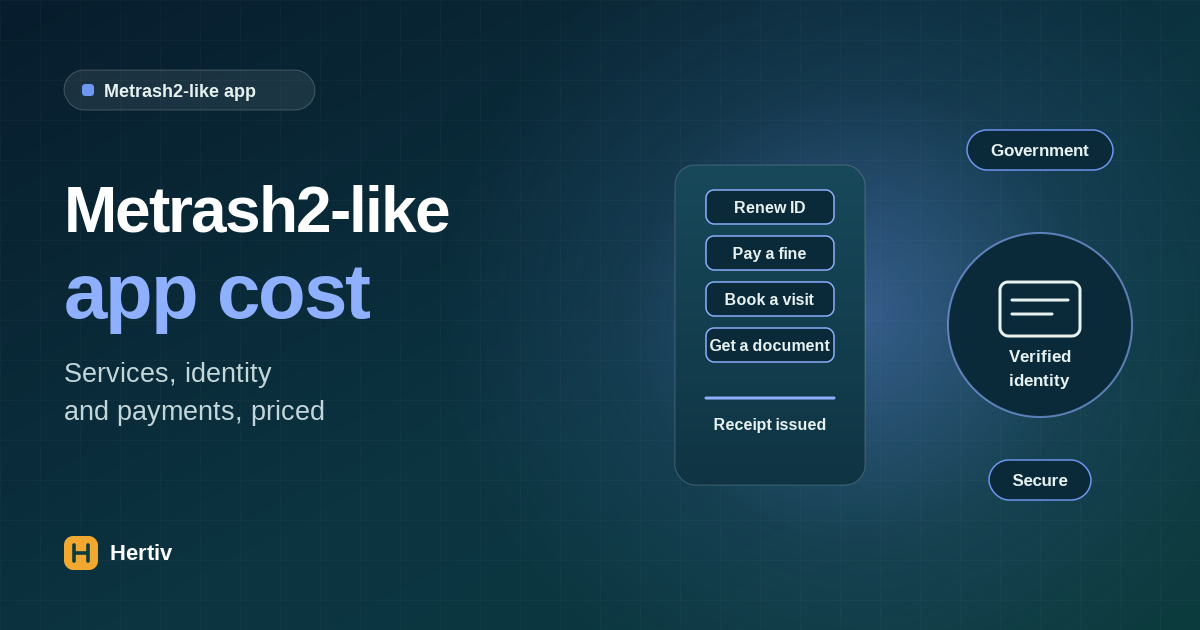
Typical services include renewing an ID or licence, paying a traffic fine, checking the status of an application, booking an appointment and downloading an official document. Each service needs the same building blocks: a verified login, a form that checks the input, a payment step where money changes hands, and a receipt or reference number the resident can show later.
Behind the app there is an admin side for staff, who review applications, answer questions and publish updates. There are also links to the official databases that hold the records, which is why this kind of app takes longer than a shop or booking app. The app must show the right record for the right person, every time, and it must keep a full audit trail of who did what.
What drives the cost up or down?
The cost of an app like Metrash2 is driven by the number of services, the strength of the identity checks, the payment setup and the links to official systems. Each of these can move the price by a large amount.
More services means more flows to design, build and test, and each service needs its own error handling and its own admin screen. Stronger identity checks, such as document verification and two-factor login, add security work and testing time. Payments add compliance work, because money handling needs receipts, refunds and reconciliation with the finance system.
The biggest driver is usually integration. If the official systems already offer clean interfaces, the app can connect to them quickly. If the records live in older systems, the team must build the connections first, and that work is hard to estimate until it starts.
A second driver is language: an app in two or three languages needs translation, layout checks and support in each language. Keep the first version to one language and the most-used services, then add the rest in later releases.
How do you estimate the budget in 5 steps?
You estimate the budget for an app like Metrash2 by listing the services, sizing each one in hours, and adding the costs that sit around the build. An estimate built this way can be checked, while a single round number cannot.
- List the services for version one. Pick the five to eight services residents use most, and write one sentence for each.
- Size each service. Break each service into design, build, testing and admin screens, and put an hour range on each part.
- Add identity and payments. Cost the login, verification and payment steps separately, because they carry the most risk.
- Add the running costs. Include hosting, notifications, payment fees and support for the first year.
- Add a reserve. Add 10% for the things you will discover during the build, and review the total before you commit.
Ask the team to show the hours behind the total. If the estimate is a single figure with no breakdown, you cannot tell which service is expensive or what happens if you cut one. For the shape of a first release, how to create a mobile app for business covers the same scoping discipline for a smaller app.
Example (hypothetical): a first version for one city
Example (hypothetical): a city wants a first version with six services: renew an ID, pay a fine, check an application, book an appointment, download a document and update contact details. The team estimates 600 hours of design and build work.
At $55 an hour, 600 hours is $33,000. Identity checks and payment setup add $4,500, and testing, security review and launch add $3,000. That gives $40,500. A 10% reserve of $4,050 brings the total to $44,550 for the first version.
Running the app for a year adds hosting, notifications and support, which the team budgets separately at a few thousand dollars a year, plus payment fees that depend on volume. The city ships the six services first, measures which ones residents use most, and only then adds the next set. Cutting the list from twelve services to six is what keeps the first version affordable and testable.
What are the common mistakes?
The most common mistakes when building an app like Metrash2 are trying to ship every service at once, underestimating the integration work, and treating security as a final step.
- Shipping every service at once. A long list of services means a long build and a late launch; start with the ones residents use most.
- Underestimating integration. Links to official records take longer than the screens, and the work is hard to estimate until it starts.
- Security last. Identity checks, encryption and audit trails must be designed in from the start, not added after launch.
- Skipping the admin side. Staff need tools to handle cases, or every exception becomes a phone call.
- No plan for updates. Rules and fees change, so the app needs a content and release process, not a one-off build.
- Ignoring low-end phones. Residents use a wide range of devices, so test on older phones and slow connections.
What does it cost to run after launch?
Running an app like Metrash2 after launch costs money every month for hosting, notifications, payment fees, support and updates. These costs are smaller than the build, but they never stop, so they belong in the budget from the start.
Hosting and monitoring scale with the number of users and the size of the records. Notifications are charged per message, so an app that sends reminders to thousands of residents pays for every one. Payment fees are a share of each transaction, and support costs grow with the number of services and languages.
Plan for one small release a month after launch, to fix problems and add services. A team that ships once and stops will watch the app fall behind as rules change and phones update. If you are comparing build options, MVP app development cost shows how a scoped first version keeps both the build and the running costs under control.
Key takeaways
- Metrash2 is Qatar's Ministry of Interior app; a similar app is a secure product, not a simple booking app
- Identity, payments and links to official systems drive most of the cost
- Ship the five to eight most-used services first, then add the rest
- Estimate in hours per service, add identity and payments separately, then a 10% reserve
- Budget for hosting, notifications, payment fees and monthly releases after launch
Frequently asked questions
Is Metrash2 a government app?
Yes. Metrash2 is the official app of Qatar's Ministry of Interior, used for services such as renewals, fines, appointments and document requests. A similar app needs the same identity checks and links to official records.
How long does an app like Metrash2 take to build?
A first version with a handful of services usually takes several months, while a full version with many services and deep integrations takes much longer. The timeline depends on the number of services and the state of the systems behind them.
Why is identity verification so expensive in these apps?
Because the app must prove who the user is before showing official records or taking payments. Document checks, secure login and audit trails need careful design and testing, and they cannot be skipped.
Can I build it in phases?
Yes, and you should. Ship the most-used services first, measure what residents actually use, and add the next set in later releases. Phasing keeps the first version affordable and gives you real usage data.
Do I need an admin panel?
Yes. Staff need tools to review applications, handle exceptions, publish updates and answer questions. Without an admin side, every exception becomes a phone call or a visit.
What are the ongoing costs?
Hosting, monitoring, notifications, payment fees, support and regular releases. These run every month and should be budgeted from the start, alongside the build cost.


