Cognitive Computing vs AI: What's the Difference?
Cognitive computing is a style of AI that mimics how people reason, learn and decide. Learn how it differs from AI in general and when each label fits.
On this page
Short answer
Cognitive computing is an approach to artificial intelligence that tries to mimic how people think: it learns from experience, reasons about uncertain information and explains its conclusions in plain language. Artificial intelligence is the wider field, covering every method that lets a computer do tasks needing judgement, including systems that never try to copy human thought at all.
What is cognitive computing?
Cognitive computing is a way of building AI systems that work the way people think: they take in messy information, weigh what they know, reason about what is missing, and give an answer a person can follow. The idea is not to replace human judgement but to support it with a system that learns from experience.
A cognitive system usually combines several techniques. Natural language processing lets it read documents and conversations. Machine learning lets it find patterns in past cases. A knowledge store, often a knowledge graph, holds the facts and the links between them, so the system can reason about relationships rather than only matching words.
The result is a system that can say why it reached an answer, not just what the answer is. That matters in fields where a wrong answer has a cost and a person must sign off, such as medical advice, legal research and financial checks. For background on the building blocks, see What Is Machine Learning, and How Does It Work?.
How does a cognitive system work?
A cognitive system works in a loop: it takes in information, understands it, reasons about it, and learns from the result. The loop is what makes it different from a fixed set of rules, which gives the same answer to the same input every time.
First, the system reads and organises the input, which may be documents, messages, images or sensor readings. Then it connects that input to what it already knows, using its knowledge store to fill gaps and spot contradictions. Then it reasons: it weighs the evidence, ranks the options and picks the most likely answer.
Finally, it learns. When a person corrects it or confirms it, the system updates what it knows, so the next similar case is handled better. Over time the system builds a richer picture of the domain it works in, which is why cognitive systems are usually built for one field, such as oncology or contract review, rather than for everything at once.
What does AI mean, in the same terms?
Artificial intelligence is the broad field of making computers do tasks that need judgement. It includes machine learning, rule-based systems, search and planning, robotics and language models. A system counts as AI if it performs a task that would need human judgement, even if it works nothing like a person.
Many AI systems do not try to think like people. A spam filter, a demand forecast and a chess engine are all AI, but none of them reasons in plain language or explains its thinking. They are useful because they are fast and consistent, not because they mimic a human mind.
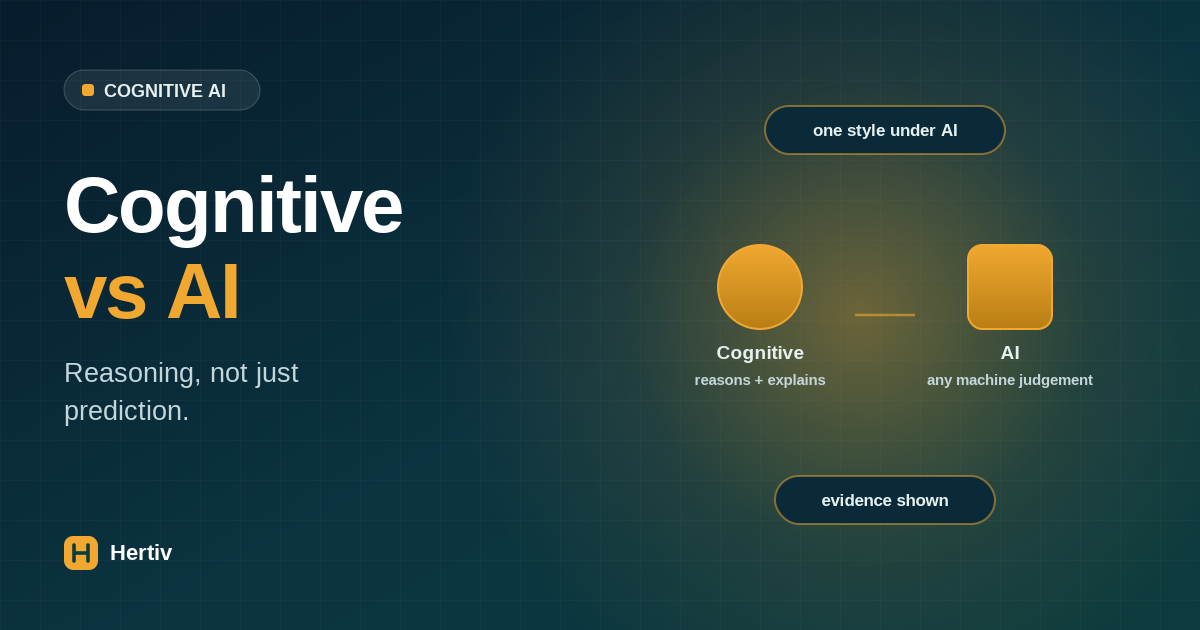
That is the key point: AI is the umbrella term, and cognitive computing is one style under it. Every cognitive system is AI, but most AI is not cognitive computing. If a vendor calls a simple classifier cognitive computing, ask what it reasons about and how it explains its answers.
Cognitive computing vs AI: side by side
The difference between cognitive computing and AI is a difference of scope and style. The table below puts the two side by side so you can see where each label fits.
| Aspect | Cognitive computing | AI in general |
|---|---|---|
| Scope | One style of AI, built to mimic human reasoning | The whole field of machine judgement |
| How it decides | Reasons over facts and links in a knowledge store | Any method, including statistics and fixed rules |
| Explaining answers | Built in: it shows its evidence and reasoning | Optional, and often missing |
| Learning | Learns from feedback and new cases over time | Some systems learn, some are fixed after building |
| Typical use | Advice, research and decisions a person signs off | Any task needing judgement, from sorting to forecasting |
If your use case needs an answer a person can check and defend, the cognitive style is the right lens. If you only need a fast prediction, a simpler AI method will do the job with less effort. A related comparison is Foundation Model vs LLM: What's the Difference?.
When should you choose a cognitive approach?
Choose a cognitive approach when the decision matters and the evidence is messy. Medical support, legal research, insurance checks and complex customer cases all fit: the input is documents and conversations, the answer needs a reason, and a person stays responsible for the final call.
Do not choose it when the task is simple and the answer does not need explaining. Sorting tickets, ranking search results and flagging duplicates are better served by a straightforward classifier or a set of rules, which are cheaper to build and easier to test.
A cognitive system also needs a knowledge store, and building one takes real work: someone must gather the facts, link them and keep them up to date. If your facts change often or live in many places, budget for that upkeep before you start. Without it, the system slowly drifts away from how your team actually works.
Start small. Pick one decision, gather a few hundred past cases with their outcomes, and test whether a cognitive system explains its answers better than the method you use now. Measure the time saved and the errors caught, not the elegance of the technology.
Example (hypothetical): a clinic triages referral letters
Example (hypothetical): a clinic receives 200 referral letters a day. Reading and sorting each one takes about 5 minutes, which is 200 x 5 = 1,000 minutes, or about 17 hours a day across the team.
The clinic builds a cognitive system that reads each letter, pulls out the symptoms and history, and links them to its knowledge store of referral rules. It sorts 160 of the 200 letters on its own and flags 40 for a person to check, taking about 3 minutes each, which is 40 x 3 = 120 minutes, or 2 hours a day.
The sorting time falls from about 17 hours to about 2 hours a day, and each automatic decision comes with the evidence the system used, so a clinician can check it in seconds. The clinic keeps a weekly sample review to catch cases where the rules have changed.
What are the common mistakes?
The most common mistake is treating cognitive computing and AI as the same thing and then buying the wrong system. A vendor that sells a simple classifier as cognitive computing will not give you the reasoning and explanations the label promises.
- Expecting human understanding. A cognitive system mimics reasoning; it does not understand the way a person does, and it can be confidently wrong.
- Skipping the knowledge store. Without curated facts and links, the system has nothing to reason over.
- No person in the loop. Answers that affect health, money or legal rights need a person to check them.
- Starting too broad. A system built for every department usually serves none of them well. Start with one decision.
Ask any vendor to show how the system explains a real answer from your own cases. If it cannot, it is not cognitive computing in any useful sense. For a practical first step, read How to Build an AI Proof of Concept, Step by Step.
Key takeaways
- Cognitive computing mimics human reasoning; AI is the wider field
- A cognitive system reads, reasons over a knowledge store and learns from feedback
- Explanations are built in, which suits decisions a person must sign off
- Simple predictions are better served by a plain classifier or rules
- Start with one decision and a few hundred past cases
- Ask vendors to explain a real answer from your own data
Frequently asked questions
Is cognitive computing the same as machine learning?
No. Machine learning is a method for finding patterns in data, and it is one of the techniques a cognitive system uses. Cognitive computing adds reasoning over a knowledge store and explanations in plain language. A machine learning model can sit inside a cognitive system, but on its own it is not one.
Did IBM Watson invent cognitive computing?
IBM popularised the term with Watson, but the ideas are older: knowledge stores, reasoning and natural language processing all predate it. The term is now used loosely by many vendors, so judge a product by what it does, not by the label on the box.
Can cognitive computing work without a knowledge graph?
It needs some form of organised knowledge to reason over, and a knowledge graph is the most common form. A simple database of facts can work for a narrow task, but it becomes hard to maintain as the number of facts and links grows.
Where is cognitive computing used today?
It is used where decisions need evidence and explanation: medical support, legal research, insurance checks, financial compliance and complex customer support. In each case a person reviews the answer before acting on it.
How is it different from a chatbot?
A chatbot answers questions from a script or a language model, often without showing its reasoning. A cognitive system reads the case, reasons over what it knows and shows its evidence. A chatbot can sit on top of a cognitive system, but the two are not the same thing.
What data does a cognitive system need?
It needs past cases with their outcomes, plus the facts and rules of the domain, organised so the system can link them. The quality of that knowledge matters more than the volume: a small, accurate knowledge store beats a large, messy one.


