How to Choose the Best AI Agent Development Partner
An AI agent development partner should show you working agents, a clear pilot plan and honest limits. Check the work, the team and the contract before you sign.
On this page
Short answer
An AI agent development partner is a company that designs, builds and runs AI agents that act inside your business, such as answering support tickets or drafting quotes. Choose one that can show you a working agent on your own data, explain how it handles mistakes, and hand over code and logs you can keep. A good partner is judged on a small paid pilot, not on a slide deck.
What is an AI agent development partner?
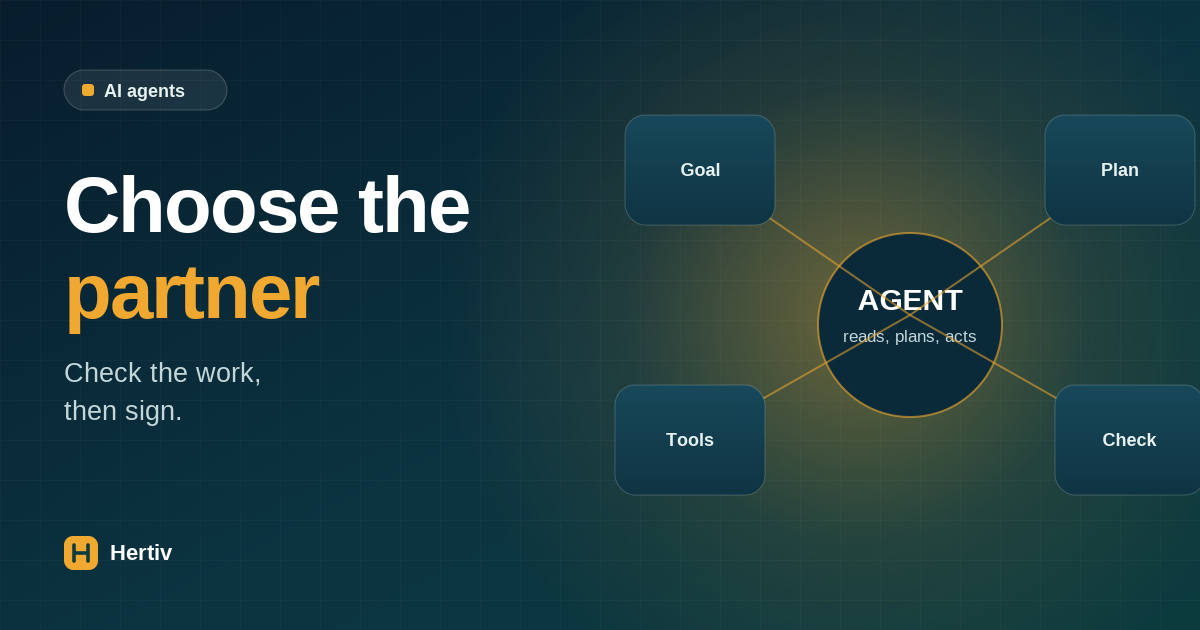
An AI agent development partner is a company that builds AI agents for you: software that reads a request, plans steps, uses your tools and systems, and takes action, with a human able to check or stop it. The partner usually covers design, build, testing, launch and support, so you do not need to hire the whole team yourself.
The difference from a general software vendor is the agent part. The partner must handle prompts, retrieval over your documents, tool permissions, guardrails and evaluation, not just screens and databases. If a vendor only talks about the model and never about what happens when the agent is wrong, that is a warning sign.
| Partner type | What they usually do | Best for |
|---|---|---|
| Agent specialist | Design, build and run agents only | A first agent in production |
| AI consultancy | Strategy, pilot, then build | Choosing where agents fit |
| Product studio | Agent inside a new product | A customer-facing feature |
| Staffing firm | Lends engineers by the month | Teams that already have a plan |
Start by deciding which row you need. A team that needs a working agent in weeks wants a specialist, while a team that is still deciding where agents help wants a consultancy first.
What should the partner show you first?
The partner should show you a working agent, not a demo video. Ask for a live run on a small set of your own cases, with the sources it used and the steps it took visible on screen. If they cannot do that, they are asking you to trust a promise instead of evidence.
Ask for three things: a past agent in production with a named contact you can call, the evaluation results from that project, and a sample of the code and logs they hand over. A partner that owns its work will share all three without a long negotiation.
Also ask who does the work. Some firms sell with senior people and staff the project with juniors. Ask for the names and roles of the people who will actually build your agent, and how much of their week is reserved for your project.
How do you test a partner before signing?
Test the partner with a small paid pilot on one workflow, with a written success bar agreed in advance. A support-drafting pilot, for example, can use 100 real past tickets and measure how many drafts a human accepted without edits.
Run the pilot like a real project. Give the partner your documents, a test set with known good answers, and access to one system they must connect to. Watch how they handle the messy parts: stale documents, conflicting answers, and cases the agent should refuse.
The pilot also tests communication. Do they report problems early, or only at the demo? Do they log every step so you can see why an answer was wrong? The answers matter more than the demo score, because production is mostly edge cases.
- Pick one workflow with a clear owner and a measurable outcome.
- Agree the test set and the pass bar in writing before work starts.
- Give real documents and real past cases, not clean samples.
- Review the logs and the failure cases together, not just the wins.
- Decide on the full build only after the pilot report is in your hands.
A short AI proof of concept with a fixed test set is the cheapest way to learn whether a partner can deliver on your data.
What does a good agent build include?
A good agent build includes the agent, the guardrails, the logs and the handover. The agent itself is only part of the work: it needs retrieval over your documents, tools with narrow permissions, a human approval step for irreversible actions, and a way to roll back.
Ask what happens when the agent is wrong. A serious partner will describe the checks: citations back to source documents, confidence thresholds, a human queue for sensitive cases, and alerts when error rates rise. If the answer is that the model is accurate enough, the partner has not run agents in production.
Also ask about evaluation after launch. Models drift as your documents and systems change, so the partner should re-run the test set on a schedule and report the results. Without that, quality fades quietly until a customer complains.
For the design of the handoff and the checks that matter, AI agents use cases shows which patterns hold up in production.
How much should you budget, and for how long?
Budget in phases: a pilot, a first production version, and then running costs. The pilot is the smallest commitment and the most useful, because it tells you the real effort on your data before you fund the full build.
The first production version usually takes weeks, not days, because the work is integration, evaluation and change management, not the model itself. Connecting the agent to your help centre, CRM and order system takes longer than writing the prompt, and testing takes longer than both.
Running costs include the model, hosting, monitoring and someone to review the logs. Ask the partner to list these separately, so you can see what you pay if you take the agent in-house later. A partner that bundles everything into one number makes that comparison hard on purpose.
Example (hypothetical): a support team handles 300 tickets a day at 5 minutes each, which is 25 hours of work a day. In a pilot, the agent drafts all 300 and a human reviews each draft in about 1 minute, which is 5 hours a day. The saving is about 20 hours a day, but only if the drafts are good enough that reviewers accept most of them without rewriting.
What goes in the contract?
The contract should say who owns the code, the prompts, the test set and the logs. You should be able to take the agent to another team or run it yourself without paying to rebuild it. If the partner keeps the prompts and the evaluation data, you are renting, not buying.
Ask for a written exit clause: what is handed over, in what format, and how long the partner helps after the handover. Also ask how your data is used. Your documents and tickets should not be used to train shared models, and the contract should say so plainly.
Agree the support terms too: who watches the agent at night, how fast they respond when it fails, and what counts as a failure. A partner that only answers during office hours is a poor fit for an agent that serves customers around the clock.
Common mistakes when choosing a partner
Most bad choices come from judging the pitch instead of the work. Teams pick the cheapest quote, skip the pilot, and only learn the partner cannot deliver when the launch date arrives.
- Choosing on price alone, then paying twice when the build is redone
- Skipping the pilot and signing for the full build on a demo
- Accepting a demo on clean sample data instead of your own cases
- Not asking who actually builds the agent, or how much of their time you get
- Forgetting the handover: no code, prompts, test set or logs in the contract
- No plan for who watches the agent and fixes it after launch
- Letting the partner pick the success metric instead of agreeing it yourself
If you are still scoping the work, how to write an AI agent development RFP covers what to put in the brief so partners quote the same thing.
Key takeaways
- Check the work on your own data, not on a demo.
- A pilot with a written pass bar is the cheapest test of a partner.
- Ask who builds the agent and how much of their week you get.
- Own the code, prompts, test set and logs in the contract.
- Plan for monitoring and support after launch, not just the build.
Frequently asked questions
How long does it take to choose an AI agent development partner?
A shortlist and a pilot usually take a few weeks when you know the workflow and the test set. Add time if you need security review or access to production systems, since those approvals often take longer than the pilot itself.
What should an AI agent development partner cost?
Costs vary too much by scope to quote a single figure, so ask each partner to price the same pilot, the same first version and the same running costs. Comparing like with like is the only way the quotes mean anything.
Do we need an AI agent development partner, or can we build in-house?
Build in-house if you already have engineers who have shipped agents and a team to run them. Hire a partner if you need a working agent in weeks, or if you want the guardrails and evaluation patterns from teams that have done it before.
What is the difference between an AI agent partner and a chatbot vendor?
A chatbot vendor usually sells a fixed product that answers questions. An agent partner builds software that plans steps, uses your tools and takes actions, with logs and approvals. The agent needs more integration work and more testing.
Should the partner use our data to train their models?
No, unless you agree in writing. Your documents, tickets and customer data should stay yours, and the contract should say the partner will not use them to train shared models or show them to other clients.
What happens if the pilot fails?
A failed pilot is useful information, not wasted money. It tells you the workflow, the data or the partner was not ready. Keep the test set and the failure report, fix the gaps, and only then decide whether to try again.


