Cardano vs Polkadot vs Solana: How They Compare
Cardano, Polkadot and Solana take three different approaches to speed, security and connecting chains. Compare their design, consensus and best uses.
On this page
Short answer
Cardano, Polkadot and Solana are three blockchains built after Ethereum that each take a different approach: Cardano is a research-led proof-of-stake chain, Polkadot is a network of connected chains sharing security, and Solana is a single high-speed chain. All three run smart contracts, but they differ on speed, fees, developer tools and the kinds of apps they suit best.
What are Cardano, Polkadot and Solana?
Cardano, Polkadot and Solana are three blockchains built after Ethereum that each take a different approach to speed, security and connecting other chains. Cardano is a research-led proof-of-stake chain, Polkadot is a network of connected chains, and Solana is a single high-speed chain.
All three run smart contracts and support apps, tokens and NFTs, but they differ in how they reach agreement, how fast they confirm transactions, and how developers build on them. Those differences decide which one fits a given project.
| Feature | Cardano | Polkadot | Solana |
|---|---|---|---|
| Design | Single chain, research-led | Relay chain plus parachains | Single high-speed chain |
| Consensus | Ouroboros proof of stake | Nominated proof of stake | Proof of history plus stake |
| Speed aim | Steady and measured | Parallel chains | Very fast finality |
| Main language | Haskell and Plutus | Rust and Substrate | Rust and C |
| Best known for | Formal methods, Africa projects | Cross-chain apps | Trading, games, NFTs |
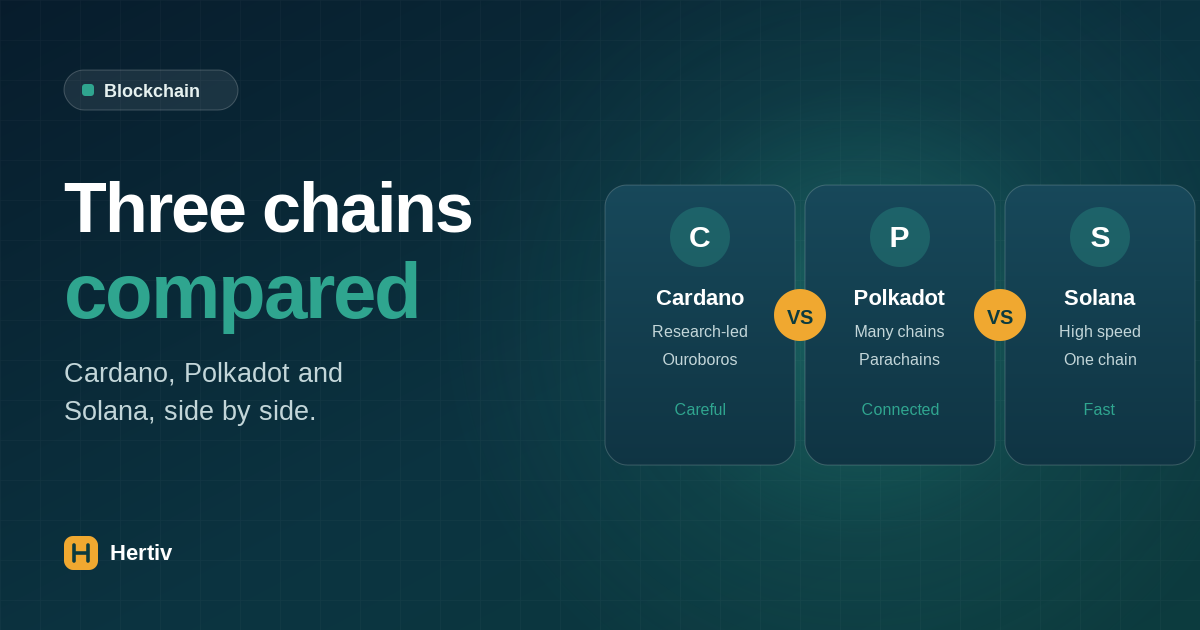
Think of Cardano as the careful builder, Polkadot as the network of connected chains, and Solana as the fast lane. None of the three is best at everything, so the choice depends on what your app needs most.
How does Cardano work?
Cardano is a proof-of-stake blockchain that develops through peer-reviewed research and formal methods, which means its designs are checked with maths before they are built. Its consensus, called Ouroboros, picks block producers from stake holders in a way that is meant to be secure and energy-efficient.
Cardano splits its work into layers: one layer settles transactions and one layer runs smart contracts. That split is meant to keep the base chain simple and let upgrades happen without breaking existing apps.
Developers build on Cardano with Plutus, a language based on Haskell, and with Marlowe for financial contracts. The ecosystem is smaller than Solana's, and learning Haskell takes time, but teams that value formal checking find the tooling a good fit.
Cardano is known for projects in Africa, such as identity and education records, and for a community that votes on funding through its treasury. If your project values careful design and a strong research base, Cardano is worth a look. For a comparison with Ethereum, see Solana vs Ethereum for how a newer chain differs from the largest smart contract platform.
How does Polkadot work?
Polkadot is a network of blockchains rather than a single chain. A central relay chain provides shared security, and independent chains called parachains plug into it and talk to each other. Each parachain can be built for one purpose, such as DeFi, identity or gaming.
The relay chain handles consensus and security, while parachains handle their own transactions in parallel. That design is meant to let the network scale by adding chains instead of cramming more work onto one chain.
Developers build parachains with Substrate, a framework in Rust that lets teams start from a working chain template and change what they need. Substrate is powerful, but running a parachain needs a slot on the network, which is won through auctions or assigned under the newer Agile Coretime model.
Polkadot suits teams that want their own chain with its own rules while still sharing security and talking to other chains. If your app needs custom chain logic and cross-chain messages, Polkadot's model is the most direct fit of the three. Blockchain interoperability explains the cross-chain problem Polkadot is built to solve.
How does Solana work?
Solana is a single high-speed blockchain designed to confirm transactions in under a second with very low fees. It combines proof of stake with proof of history, a way of ordering transactions by time that lets validators agree faster without waiting on each other.
Solana keeps everything on one chain instead of splitting work across many chains. That makes it simple for developers: one chain, one state, and apps that can call each other directly. It also means the whole network must handle all the load, which is why Solana has had outages in the past when traffic spiked.
Developers build on Solana mostly in Rust, with tools for tokens, NFTs and DeFi that are widely used. The ecosystem is large and active, especially in trading, memecoins, games and consumer apps where speed and low fees matter most.
Solana suits apps that need fast, cheap transactions and a large user base, such as exchanges, games and payment apps. If your app must never stop, weigh the speed against the outage history and decide how much downtime risk you can accept.
Cardano vs Polkadot vs Solana: which is fastest and cheapest?
Solana is the fastest and cheapest of the three for ordinary transactions, with confirmation in under a second and fees that are a fraction of a cent in normal conditions. Cardano and Polkadot confirm more slowly, but their designs trade raw speed for different strengths.
Speed alone is a poor way to choose. A payments app needs Solana's speed, a cross-chain app needs Polkadot's connected chains, and a project that must prove its design is correct may value Cardano's formal approach more than either.
Fees also depend on demand. Solana fees rise when the network is busy, and Cardano and Polkadot fees depend on the transaction size and the chain it runs on. Test with real transactions on a test network before promising users a fee or a confirmation time.
Uptime matters too. Solana's speed has come with outages, while Cardano and Polkadot have had fewer long stops. A team that needs steady service may prefer a slower chain that rarely goes down.
Which chain should you build on?
The chain you should build on depends on what your app does, who uses it, and what your team already knows. There is no single right answer, so match the chain to the job.
- Choose Cardano if your project values formal design, works in identity, education or public services, and your team is comfortable with Haskell or willing to learn it.
- Choose Polkadot if you need your own chain with custom rules, want to talk to other chains, and can fund a parachain slot or coretime.
- Choose Solana if you need fast, cheap transactions, a large existing user base, and an ecosystem of trading, gaming and consumer apps.
- Choose none of them yet if your app needs Ethereum's liquidity and tooling, since all three have bridges to Ethereum rather than replacing it.
Check the developer tools before you commit. The quality of wallets, SDKs, documentation and audit support decides how fast your team ships, and it varies more between chains than the marketing suggests. What is Ethereum is a useful baseline for comparing any of the three with the largest smart contract chain.
Example (hypothetical): choosing a chain for a ticketing app
Example (hypothetical): a startup is building a ticketing app that sells 20,000 tickets for a music festival. Tickets are NFTs, and buyers need to receive them fast on the day of the sale.
On Solana, 20,000 tickets at a fee of $0.001 each would cost $20 in total fees, and confirmation would take seconds. On Cardano, the same sale at a fee of $0.20 per ticket would cost $4,000, which is far more than the team budgeted. On Polkadot, the team would need a parachain or an existing chain to host the tickets, which adds setup time.
The team picks Solana for the sale because speed and low fees decide whether buyers complete checkout. It keeps a Cardano version on its roadmap for a later identity feature, where formal checking matters more than speed. The lesson is to price the real workload, not the headline fee, before choosing.
What are the common mistakes?
The most common mistakes are choosing by headline speed alone, ignoring the developer tools, and assuming a bridge solves every cross-chain need.
- Choosing on speed alone. A fast chain that goes down during your launch is worse than a slower chain that stays up.
- Ignoring the team. If your developers know Rust, Solana and Polkadot are natural fits; if they know Haskell, Cardano is the easier path.
- Trusting bridges blindly. Bridges move assets between chains, but they have been hacked often, so treat them as a risk, not a feature.
- Forgetting the users. Users go where the wallets, apps and liquidity already are, so a technically better chain can still lose on adoption.
- Skipping the test network. Fees, confirmation times and tooling all behave differently under real load, so test before launch.
Cardano, Polkadot and Solana each solve a different problem well. Pick the one whose strength matches your app's hardest requirement, and keep the others in mind as your product grows. Solana development covers building on the fastest of the three.
Key takeaways
- Cardano is the careful builder: research-led, formal methods, Haskell and Plutus
- Polkadot is a network of chains: a relay chain plus parachains that share security
- Solana is the fast lane: sub-second confirmation and very low fees on one chain
- Speed alone is a poor way to choose: uptime, tools and users matter as much
- Match the chain to your app's hardest requirement, and test a pilot first
Frequently asked questions
What is Cardano in simple terms?
Cardano is a proof-of-stake blockchain that develops through peer-reviewed research and formal methods. Its consensus is called Ouroboros, and developers build on it with Plutus, a language based on Haskell. It is known for careful design and for identity and education projects.
What is Polkadot in simple terms?
Polkadot is a network of blockchains. A central relay chain provides shared security, and independent chains called parachains plug into it and talk to each other. Developers build parachains with Substrate, a framework in Rust.
What is Solana in simple terms?
Solana is a single high-speed blockchain that confirms transactions in under a second with very low fees. It combines proof of stake with proof of history, a way of ordering transactions by time. It is popular for trading, games, NFTs and consumer apps.
Which is faster, Cardano, Polkadot or Solana?
Solana is the fastest of the three for ordinary transactions, with sub-second confirmation and very low fees in normal conditions. Cardano and Polkadot confirm more slowly, but they trade raw speed for different strengths, such as formal design or connected chains.
Can Cardano, Polkadot and Solana talk to each other?
They can move assets between each other through bridges, but bridges are separate systems with their own risks and have been hacked often. Polkadot's parachains talk to each other natively, while Cardano and Solana rely on bridges for cross-chain transfers.
Which chain is best for beginners?
Solana is usually the easiest to start with, because it has a large ecosystem, widely used tools and many tutorials. Polkadot needs more setup for a parachain, and Cardano needs Haskell skills. The best choice also depends on what your team already knows.


