Cardano: The Third-Generation Blockchain Explained
Cardano is a proof-of-stake blockchain built to fix the scaling and sustainability limits of Bitcoin and Ethereum. This guide explains how it works.
On this page
Short answer
Cardano is a proof-of-stake blockchain that its creators describe as third-generation: it aims to fix the scalability, interoperability and sustainability limits of first-generation Bitcoin and second-generation Ethereum, using peer-reviewed research, a layered design and on-chain governance.
What is Cardano?
Cardano is a proof-of-stake blockchain that its creators describe as third-generation: it aims to fix the scalability, interoperability and sustainability limits of first-generation Bitcoin and second-generation Ethereum, using peer-reviewed research and a layered design.
Cardano was founded in 2015 by Charles Hoskinson, one of Ethereum's co-founders, and launched in September 2017. It is developed by Input Output Global, with the Cardano Foundation and EMURGO handling ecosystem growth and commercial adoption. Its native cryptocurrency is ADA, named after the mathematician Ada Lovelace, with a fixed supply of 45 billion.
Cardano's method is unusual in the blockchain world: protocol changes are based on academic papers and peer review before they are implemented, which makes development slower but more deliberate. That trade-off is the point of the project, and it shapes everything from consensus to governance.
What makes a blockchain third generation?
A blockchain is called third generation when it tries to solve the problems of the first two generations: limited throughput, high energy use, and poor interoperability between chains. Cardano's answer is a proof-of-stake design, a two-layer architecture, and on-chain governance.
| Generation | Example | Main limit | Cardano's answer |
|---|---|---|---|
| First | Bitcoin | Slow, energy-heavy mining | Proof of stake instead of mining |
| Second | Ethereum | Scaling and fees under load | Two layers and sidechains |
| Third | Cardano | Governance and upgrades | On-chain voting and treasury |
The label is a claim, not a standard: there is no authority that certifies generations. Other chains make similar claims, and the fair way to judge them is on throughput, fees, uptime and how easily they upgrade. For the comparison that matters most, the Cardano vs Ethereum guide puts the two designs side by side.
How does Ouroboros proof of stake work?
Ouroboros is Cardano's proof-of-stake consensus protocol, and it was the first proof-of-stake design developed through peer-reviewed academic research. Instead of miners competing with computing power, the network chooses block producers from ADA holders who stake their tokens.
ADA holders can delegate their tokens to a stake pool, which runs a node and produces blocks. The pool is chosen in proportion to the stake it controls, and the rewards are shared with the delegators. Holders keep control of their ADA while it is delegated, and they can move it or change pools at any time.
Time on Cardano is divided into epochs of about five days. In each epoch, stake pools take turns producing blocks according to a schedule set by the protocol. Because there is no mining race, the network uses far less energy than a proof-of-work chain, which is the sustainability argument at the heart of the third-generation claim.
What is Cardano's two-layer design?
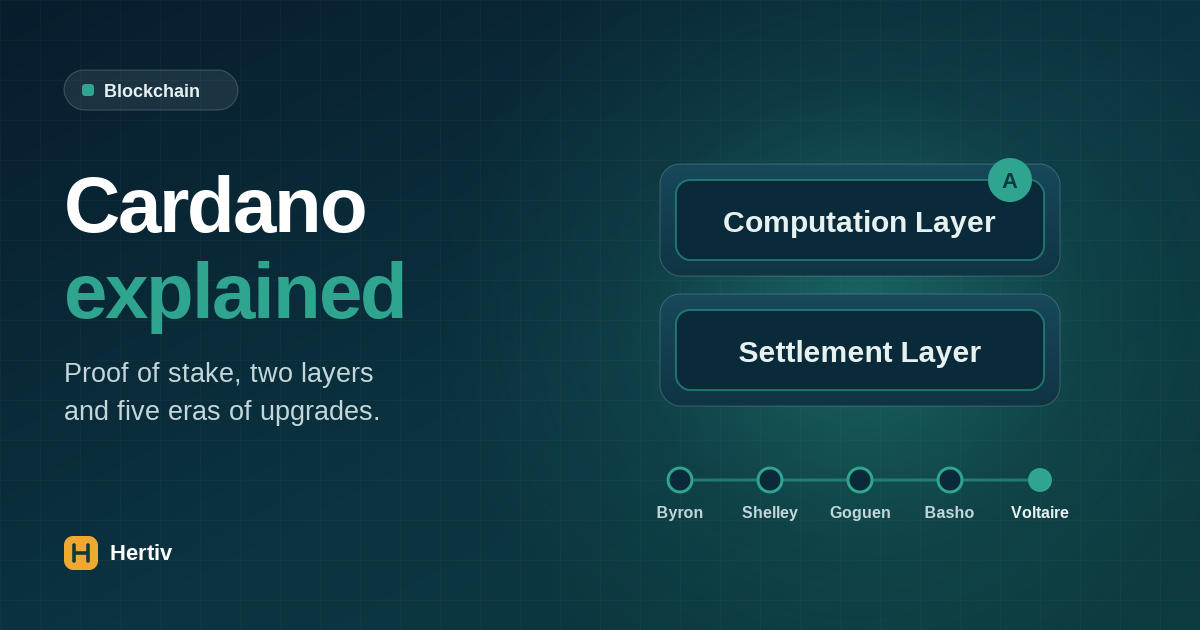
Cardano's two-layer design separates the ledger from the computation. The Cardano Settlement Layer handles ADA transactions, while the Cardano Computation Layer runs smart contracts and decentralised applications, so the two jobs do not compete for the same resources.
The Settlement Layer is the value ledger: it records who owns which ADA and processes transfers. It is deliberately simple, which makes it easier to verify and harder to break. The Computation Layer sits above it and runs the logic of smart contracts, token issuance and decentralised applications, using the Plutus programming language.
The separation has a practical benefit: the settlement layer can be upgraded without touching application logic, and applications can change without risking the ledger. Sidechains such as the Midnight privacy sidechain build on the same idea, running specialised work off the main chain while settling back to it. For teams building on the platform, blockchain development covers how the layers fit into a real product.
What are the five eras of Cardano?
Cardano's development is organised into five eras, each named after a historical figure, and each adding a capability the network did not have before. The eras overlap in practice, but each one marks a clear step in the roadmap.
| Era | Focus | Key change |
|---|---|---|
| Byron | Foundation | Mainnet launch, ADA transactions (Sep 2017) |
| Shelley | Decentralisation | Staking and community block production (Jul 2020) |
| Goguen | Smart contracts | Alonzo hard fork, Plutus contracts (Sep 2021) |
| Basho | Scaling | Vasil upgrade, Hydra scaling work (Sep 2022) |
| Voltaire | Governance | Chang hard fork, on-chain voting (Sep 2024) |
Voltaire is the era that completes the original roadmap: with CIP-1694, ADA holders can vote on protocol changes and treasury spending, so the network is governed by its users rather than by a single company. The Cardano smart contract guide covers what developers can build now that the Goguen era is complete.
Example (hypothetical): a team choosing a chain for a token project
Example (hypothetical): a small team wants to launch a loyalty token for a retail chain, and it compares Cardano with two other networks on cost, speed and governance. The team plans a 12-week build: 4 weeks for design, 5 weeks for development, 2 weeks for audit preparation, and 1 week for launch. Four plus five plus two plus one is 12 weeks, so the plan adds up.
Cardano wins on two points for this team. First, the eUTXO model makes each transaction's outcome predictable before it is submitted, which the team likes for a token that customers will redeem at the till. Second, the on-chain governance means the team can vote on future changes rather than waiting for a company to decide them.
The team also notes the trade-offs. Cardano's ecosystem is smaller than Ethereum's, so there are fewer ready-made tools, and Plutus has a smaller developer pool than Solidity. The team accepts that, because the loyalty token does not need deep DeFi integration, and the predictability of the eUTXO model matters more for a retail product.
What are the common mistakes?
The most common Cardano mistakes are treating the third-generation label as a guarantee, confusing ADA with the network, and assuming the ecosystem is as large as Ethereum's.
- Trusting the label. Third generation is a design claim, not a performance guarantee; judge the chain on throughput, fees and uptime.
- Confusing ADA with Cardano. ADA is the token; Cardano is the network. Holding ADA is not the same as using the network.
- Ignoring the smaller ecosystem. Fewer tools and developers than Ethereum means longer build times for some features.
- Skipping the eUTXO learning curve. Cardano's transaction model differs from Ethereum's account model, and code written for one does not transfer to the other.
- Forgetting governance. On-chain voting is a feature, but it means protocol changes can arrive that your product must adapt to.
Key takeaways
- Cardano is a proof-of-stake chain built on peer-reviewed research
- Bitcoin is first generation, Ethereum second, Cardano claims third
- Ouroboros picks block producers from staked ADA, not miners
- The Settlement Layer handles value; the Computation Layer runs contracts
- Five eras took Cardano from launch in 2017 to on-chain governance in 2024
Frequently asked questions
What is Cardano used for?
Cardano is used for payments, decentralised applications, token issuance and on-chain governance. Its native token ADA pays transaction fees and is staked to secure the network, while smart contracts built with Plutus power applications ranging from DeFi to identity and supply chain tools.
Is Cardano really third generation?
Third generation is a label Cardano's creators use, not an official standard. It refers to the design goals of fixing the scaling, energy and governance limits of Bitcoin and Ethereum. Other chains make similar claims, so the fair test is measured throughput, fees, uptime and how the chain upgrades.
How is Cardano different from Ethereum?
The main differences are consensus and design. Cardano uses Ouroboros proof of stake from launch, with a two-layer architecture and an eUTXO transaction model, while Ethereum moved to proof of stake later and uses an account model. Ethereum has the larger ecosystem and tooling; Cardano emphasises peer review and predictable transactions.
What is ADA?
ADA is Cardano's native cryptocurrency, named after the mathematician Ada Lovelace, with a fixed supply of 45 billion. It pays transaction fees on the network and is staked to secure it: holders delegate ADA to stake pools and share the rewards the pools earn.
Can I build smart contracts on Cardano?
Yes. Smart contracts arrived with the Goguen era and the Alonzo hard fork in September 2021, using the Plutus programming language. Developers can also use Marlowe for financial contracts and Aiken for a lighter-weight alternative to Plutus.
What is Voltaire?
Voltaire is Cardano's governance era, which began with the Chang hard fork in September 2024. It introduced on-chain voting under CIP-1694, so ADA holders can vote on protocol changes and treasury spending, moving control of the network from its founding companies to its users.


