Cardano vs Ethereum: How the Two Chains Differ
Cardano and Ethereum differ in design, fees, languages and ecosystem size. Compare consensus, costs and reach to pick the right chain for your project.
On this page
Short answer
Cardano and Ethereum are both smart contract blockchains, but Ethereum has the larger ecosystem, more developers and deeper liquidity, while Cardano offers lower, steadier fees and a design built around peer-reviewed research. The right choice depends on where your users are and which tools your team knows.
What is the difference between Cardano and Ethereum?
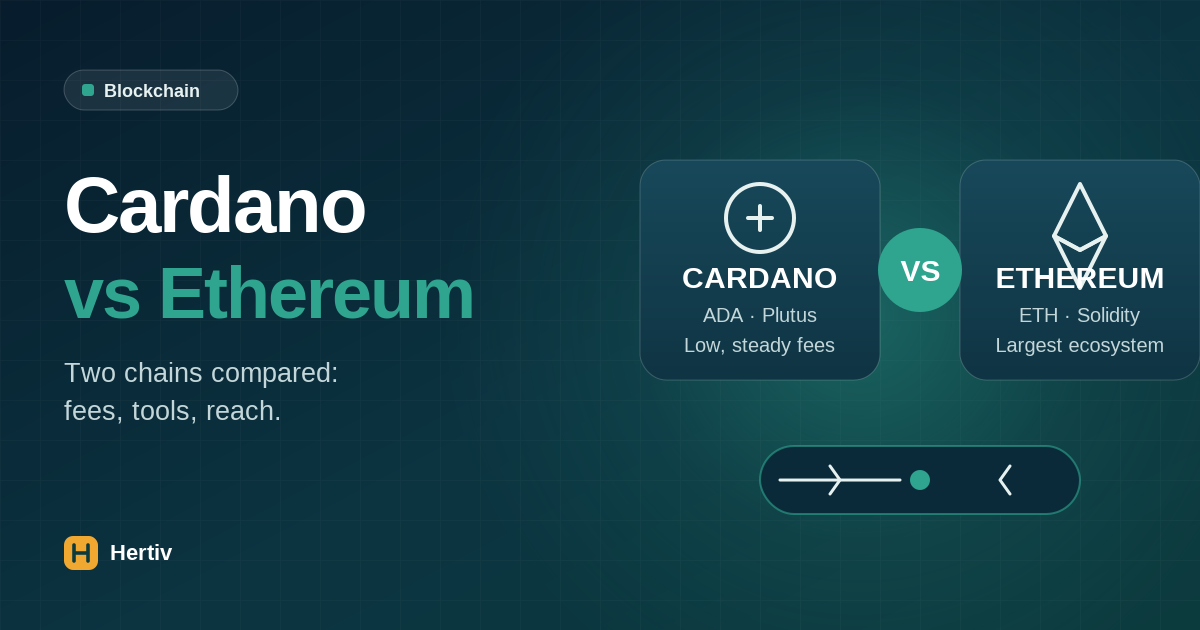
Cardano and Ethereum are both smart contract blockchains, but they were built in different ways: Ethereum launched first and grew into the largest smart contract platform, while Cardano was designed from academic research with a slower, peer-reviewed approach to changes.
The practical difference for builders is tooling and ecosystem. Ethereum has more developers, more wallets, more decentralised apps and more liquidity, while Cardano offers lower fees and a different programming model that some teams prefer for formal, high-assurance work.
Neither chain is better in every case. The right pick depends on what you are building, who your users are and which tools your team already knows. For a related comparison, Cardano vs Solana covers how Cardano compares with another fast, low-fee chain.
What is Cardano?
Cardano is a proof-of-stake blockchain launched in 2017, designed around peer-reviewed research and a layered architecture that separates settlement from computation. Its native token is ADA, and holders can stake it to help secure the network.
Cardano's smart contracts are written mainly in Plutus, a language based on Haskell, and in Aiken, a newer language built for the chain. Both favour careful, verifiable code, which suits financial and identity applications where a bug is costly.
Cardano's ecosystem is smaller than Ethereum's, with fewer apps and less liquidity. That means less competition for users in some niches, but also fewer ready-made tools and fewer users to reach on day one.
What is Ethereum?
Ethereum is a smart contract blockchain launched in 2015, and it is the largest platform for decentralised apps, tokens and DeFi. Its native token is ETH, and since its move to proof of stake, holders can stake ETH to help secure the network.
Ethereum's smart contracts are written mainly in Solidity, the most widely used smart contract language, with Vyper as a simpler alternative. The ecosystem includes thousands of apps, the deepest liquidity in DeFi and the most developer tooling of any chain.
Fees on Ethereum's main network can rise when the network is busy, which is why most apps now run on layer 2 networks that settle to Ethereum. For the chain itself, what Ethereum is and how it works explains the basics in more detail.
Ethereum also has the largest set of developer tools, from testing frameworks to block explorers, which shortens the time from idea to a working app. A team that has built on Ethereum before can reuse much of that knowledge on the next project, while a move to Cardano means learning new tools.
Cardano vs Ethereum at a glance
The table below compares the two chains on the points that matter most to a team choosing where to build. The numbers that change often, such as fees and transaction counts, are described in words rather than quoted, because they move with network demand.
| Point | Cardano | Ethereum |
|---|---|---|
| Launched | 2017 | 2015 |
| Consensus | Proof of stake (Ouroboros) | Proof of stake (since 2022) |
| Native token | ADA | ETH |
| Main contract language | Plutus, Aiken | Solidity, Vyper |
| Fees | Usually low and steady | Varies with demand |
| Ecosystem size | Smaller, growing | Largest in smart contracts |
| Layer 2 options | Hydra and sidechains | Rollups such as Arbitrum and Optimism |
The table shows the trade-off clearly: Ethereum offers reach and tooling, while Cardano offers steadier fees and a design that favours careful code. A team that needs users on day one will usually pick Ethereum; a team that needs low, steady fees may look at Cardano.
Which one fits your project?
Choose Ethereum if your users are already there, your team knows Solidity, or your app needs DeFi liquidity, token standards and wallets that already exist. Most NFT, DeFi and token projects start on Ethereum for exactly those reasons.
Choose Cardano if your project values low, steady fees, your team is comfortable with Plutus or Aiken, or your use case involves identity, education or government-style records where formal methods matter. Cardano's community is active in Africa and in education, where those use cases are common.
A third option is to build on both. Some teams launch on Ethereum for reach and add Cardano later, or build on a layer 2 that settles to Ethereum while keeping fees low. That adds work, so only do it when users on both chains are real.
Cost is only one input, and it changes with the market. A chain that is cheap this month can be busy next month, so check the fee on a real transaction before you commit, and check it again on the day you launch. The same applies to wallets: if your users hold one token and not the other, that fact decides more than any fee comparison.
Example (hypothetical): a ticketing app chooses a chain
Imagine a startup building a ticketing app that sells 20,000 tickets for a festival, each ticket as a token, with a face value of $40. The team compares the two chains on fees, wallets and time to launch.
Suppose the fee per sale is $0.20 on Cardano and $2.00 on Ethereum's main network at a busy time. For 20,000 tickets, fees are $4,000 on Cardano and $40,000 on Ethereum, a difference of $36,000 that comes straight out of the event's margin.
Now suppose the team also checks wallets: most of their buyers already hold ETH and use Ethereum wallets, while few hold ADA. If half the buyers drop out because they must buy a new token first, the lost sales cost far more than $36,000 in fees. The example shows why fees alone do not decide the chain: where the users already are matters as much as the price.
Common mistakes
The most common mistakes are choosing on fees alone, assuming one chain does everything, and picking a chain before knowing where the users are. Each one looks like a technical decision until launch, when it turns into a user problem.
- Choosing on fees alone. Low fees help, but they do not bring users. Reach and wallets matter more.
- Ignoring the ecosystem. A chain with few tools means building more yourself, which costs time.
- Assuming the chains are the same. Plutus and Solidity differ in style and in the bugs they invite, so the team matters.
- Forgetting layer 2. Ethereum's main network fees are not the whole story when rollups exist.
- Picking before talking to users. Ask buyers which wallet they hold before you pick a chain.
Key takeaways
- Ethereum has the reach, Cardano has steadier fees
- Smart contract languages differ more than the chains do
- Layer 2 changes the fee picture on Ethereum
- Pick the chain your users already hold wallets for
- Fees alone should never decide the choice
Frequently asked questions
Is Cardano faster than Ethereum?
Cardano transactions usually settle with low, steady fees, while Ethereum main-network fees rise when the network is busy. Most Ethereum apps now use layer 2 rollups, which bring fees down, so compare the rollup cost, not only the main network.
Which chain is better for DeFi?
Ethereum is better for DeFi today because it has the deepest liquidity, the most protocols and the most users. Cardano's DeFi ecosystem is smaller, though it is growing, and it suits teams that value low fees over reach.
Can I build on both chains?
Yes, some teams launch on one chain and add the other later, or build on a layer 2 that settles to Ethereum. Supporting two chains adds real work, so only do it when users on both chains are already asking.
What language do Cardano contracts use?
Cardano smart contracts are written mainly in Plutus, a language based on Haskell, and in Aiken, a newer language built for the chain. Both favour careful, verifiable code, which suits financial and identity applications.
Is Ethereum still proof of work?
No. Ethereum moved to proof of stake in 2022, so holders can stake ETH to help secure the network. Cardano has used proof of stake since launch, through its Ouroboros protocol.
Which chain has lower fees?
Cardano fees are usually low and steady, while Ethereum main-network fees vary with demand. Layer 2 networks on Ethereum bring fees down a lot, so the practical gap is smaller than the main-network numbers suggest.


