7 Business Benefits of Rapid Application Development
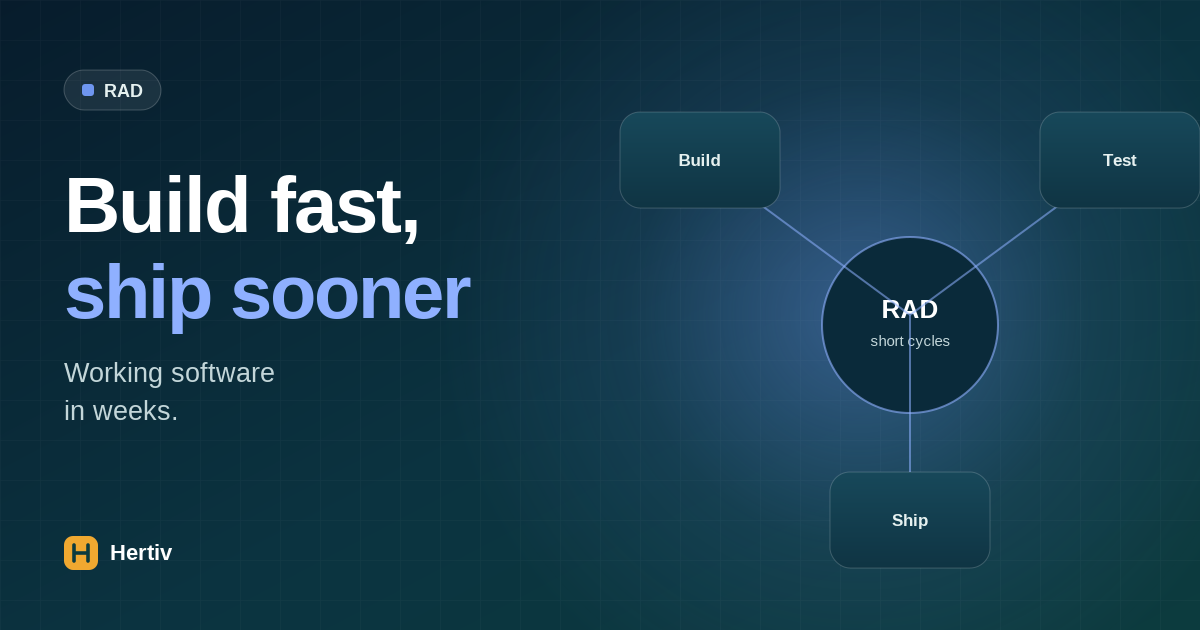
Rapid application development delivers a working version in weeks, not months. The business sees software early and changes direction while change is still cheap.
On this page
Short answer
Rapid application development, or RAD, builds software in short cycles: a working version appears early, users try it, and the team changes it based on what they learn. The business benefits come from that loop: faster delivery, earlier feedback, lower risk and a product that fits the real job. This list covers the seven benefits that matter most, and what each one needs to work.
What are the business benefits of rapid application development?
The main benefit is speed with feedback: a working version appears in weeks, users try it, and the team fixes what is wrong while change is still cheap. Traditional builds show the software late, when changes cost far more.
| Benefit | What it means | Who feels it |
|---|---|---|
| Faster first version | Working software in weeks | Business and users |
| Lower up-front cost | Small team, short first build | Finance |
| Earlier user feedback | Real users try real screens | Product team |
| Easier changes | Direction changes are cheap | Everyone |
| Smaller team needed | Fewer people to start | Management |
| Reusable parts | Common parts built once | Developers |
| Clearer progress | Working software each cycle | Stakeholders |
None of these benefits is automatic. Each one needs a small scope, users who will test, and a team that treats feedback as the plan, not as an interruption.
<h3>1. Faster first version: best for proving the idea</h3>
Rapid application development gets a working version in front of users in weeks instead of months. The first version is small: the core job, a few screens, and nothing extra. That is enough to learn whether the idea works.
Speed matters because a slow build locks the team into guesses. When the first version arrives late, the market, the users and the budget have all moved on, and the team has spent the money before learning anything.
Pros
- Users see real software early, not slides
- Bad ideas fail cheap and fast
Cons
- Early versions look rough, which needs managing
2. Lower up-front cost: best for a tight budget
A RAD build starts small, so the first bill is small. A small team builds the core job, and the business pays for the next cycle only after the first one proves its worth. That is a very different risk from funding a full build up front.
The saving is real but partial: the total cost of a finished product is often similar to a traditional build. The benefit is that the money is spent in steps, with a working version at each step, so the business can stop or change direction without losing everything.
Pros
- Money is spent in steps, each with a working version
- Easy to stop or pause without losing the whole budget
Cons
- Total cost can match a traditional build over time
<h3>3. Earlier user feedback: best for getting the job right</h3>
Users test real screens early, so the team learns what is confusing, missing or unwanted while it is still cheap to fix. A form that takes ten minutes in testing is a design fix; the same form found after launch is a support problem.
The feedback loop only works if real users are in the room. Feedback from the project team alone is not enough, because the team already knows how the software is meant to work.
Pros
- Real problems surface while fixes are cheap
- Users feel heard, which helps adoption later
Cons
- Needs users who will actually test, not just approve
4. Easier changes mid-build: best for shifting needs
Because each cycle is short, a change in direction costs one cycle, not the whole project. When the business learns something new, the next cycle builds it in, and the old plan is dropped without drama.
This is the benefit that matters most in fast-moving work. A team that plans a year ahead and never changes course is not being disciplined; it is ignoring what it learns.
Pros
- New learning reaches the product in the next cycle
- Less time spent defending an old plan
Cons
- Too many changes can stop the product from ever shipping
<h3>5. Smaller team needed: best for starting now</h3>
A RAD project starts with a small team: a product owner, one or two developers, and a designer. There is no need to hire a full department before the idea is proven, which means the business can start this month instead of next quarter.
Small teams also communicate faster. With five people in the room, a decision takes minutes. With fifty, it takes meetings, and the software waits.
Pros
- Start without hiring a large team
- Faster decisions with fewer people
Cons
- Small teams can become a bottleneck later
6. Reusable parts: best for the second project
RAD builds rely on ready-made parts: login, forms, tables, payments and notifications. The team builds the parts that are unique to the business and reuses the rest, which is why the first version arrives so fast.
The saving compounds. Each project adds to the shared parts, so the second app starts further along than the first. Over time, the team spends its hours on the work that is actually different.
Pros
- Common parts are built once and reused
- Later projects start further along
Cons
- Shared parts need maintenance, or they rot
<h3>7. Clearer progress for stakeholders: best for trust</h3>
Each cycle ends with working software the business can try. Stakeholders stop asking for status reports, because they can see the product and use it. That visible progress builds trust faster than any slide deck.
It also makes problems visible early. If a cycle produces nothing usable, everyone sees it at once, and the team can fix the cause instead of hiding it until the deadline.
Pros
- Working software each cycle replaces status reports
- Problems surface early, while they are small
Cons
- Early versions can be mistaken for finished products
How to choose whether RAD fits your project
RAD fits projects where the goal is clear but the details are not, and where users can test early. It fits poorly when the requirements are fixed by law or by a contract, and change is not allowed.
- Check that real users can test a version within a few weeks.
- Confirm the scope can start small and grow in cycles.
- Make sure one person owns the decisions, so feedback becomes action.
- Pick the reusable parts first, then build what is unique.
- Agree what "done" means for each cycle before it starts.
For the shape of that first small version, what is an MVP explains how to scope it.
How to build an MVP covers the steps from idea to launch.
Common mistakes with rapid application development
Most RAD projects fail the same way: the team ships fast but never finishes. Cycles keep adding features, the scope keeps growing, and the product never reaches a stable version that users can rely on.
- Adding features every cycle and never calling a version done
- Skipping testing because the cycle is short
- Letting feedback from one loud user override the plan
- Treating the early version as the finished product
- No owner for decisions, so every cycle reopens old debates
- Reusing parts without maintaining them
- Measuring speed instead of whether users can do the job
Keep the scope small and the cycles short. See MVP app development cost for how a first version is usually priced.
Key takeaways
- A working version in weeks beats a perfect plan in months.
- Spend in steps, each ending with software users can try.
- Real user feedback is the point of the short cycles.
- Reusable parts make the second project faster than the first.
- Each cycle needs a stop rule, or it never ends.
Frequently asked questions
What is rapid application development?
Rapid application development builds software in short cycles: a small working version appears early, users try it, and the team changes it based on what they learn. The goal is fast feedback, not a long plan.
Is rapid application development the same as agile?
They are related but not the same. Agile is a way of working in short cycles with regular review. RAD is a build approach that leans on prototypes and reusable parts to ship a working version fast. Many teams use both.
When is rapid application development a bad fit?
It fits poorly when requirements are fixed by law or contract, when users cannot test early, or when the system needs deep design before any code. In those cases, a slower, planned build is safer.
Does rapid application development mean lower quality?
Not if the cycles include testing. Speed comes from a small scope and reusable parts, not from skipping tests. A cycle without testing just moves the bugs to the users.
How long is one rapid application development cycle?
Usually a few weeks, ending with working software. The exact length matters less than the rule: each cycle must produce something users can try, not just code that is nearly ready.
What does rapid application development cost?
The first cycle costs less than a full traditional build, because the scope is small and the team is small. The total cost of a finished product is often similar, but the money is spent in steps with working software at each step.


