How to Build an Enterprise AI Solution for Finance
An enterprise AI solution for finance helps staff make faster, better-checked decisions under strict rules. Build it in small steps, with governance from day one.
On this page
Short answer
An enterprise AI solution for finance is a system that uses AI to help a bank, insurer or finance team work with financial data while following strict rules about accuracy, privacy and audit. It might draft reports, check transactions, summarise regulations or answer staff questions from internal documents. Building one takes more than a model: it needs clean data, clear rules, human review and proof for every answer.
What is an enterprise AI solution for finance?
An enterprise AI solution for finance is a system that applies AI to financial work at the scale of a whole company, not a single team. It connects to the company's own data, such as transactions, accounts, contracts and regulations, and helps staff do their jobs faster while keeping a record of what the system did and why.
Unlike a simple chatbot, an enterprise solution must meet the rules finance teams live by: answers must be accurate, data must stay inside approved systems, and every decision must be traceable. That is why the build starts with data and governance, not with the model.
| Area | What the AI does | Why it matters |
|---|---|---|
| Reporting | Drafts reports and summaries | Saves hours of manual writing |
| Risk checks | Flags unusual transactions | Catches problems earlier |
| Compliance | Checks documents against rules | Reduces missed obligations |
| Customer service | Drafts answers from policy | Faster, steadier replies |
| Document search | Finds clauses and figures | Less time hunting files |
| Forecasting | Spots patterns in past data | Better planning, with checks |
Start with one area and one team. A solution that works well for one department is easier to extend than a large system that tries to do everything at once. For background on where AI helps in finance today, read where large language models help in finance.
What data and rules come first?
Data comes first. An AI solution is only as good as the data it can read, so the first job is to list the sources: core banking systems, transaction records, contracts, policy documents and regulatory text. For each source, note who owns it, how fresh it is and who may see it.
Rules come next. Finance teams work under regulations about privacy, record keeping and fair treatment of customers. Before you build, agree with your legal and compliance teams on what the AI may read, what it may never do, and how its answers will be checked. Write those rules down: they become the tests the system must pass.
Finally, decide what "good" looks like. A draft report that needs heavy editing is not a success, even if it was fast. Agree on the measure in advance, such as the share of drafts accepted without change, or the time saved per report, and test against it.
How to build it in six steps
Build in small steps, and test each one on real work before you move on. A six-step plan keeps the project honest and gives your team a working system early.
- Pick one use case and one team, and write down how success will be measured.
- Map the data the use case needs, and get approval to use it.
- Build a small proof of concept on real documents, with a person checking every answer.
- Add the controls: access rules, logging, and a review step for risky answers.
- Run a pilot with a small group for four to six weeks and measure the result.
- Roll out to more teams only if the pilot meets the measure you set in step one.
The proof of concept is the most important step. It shows whether the AI can handle your real documents and your real edge cases, before you spend on the full build. The guide to building an AI proof of concept explains how to run one well.
What does the system look like inside?
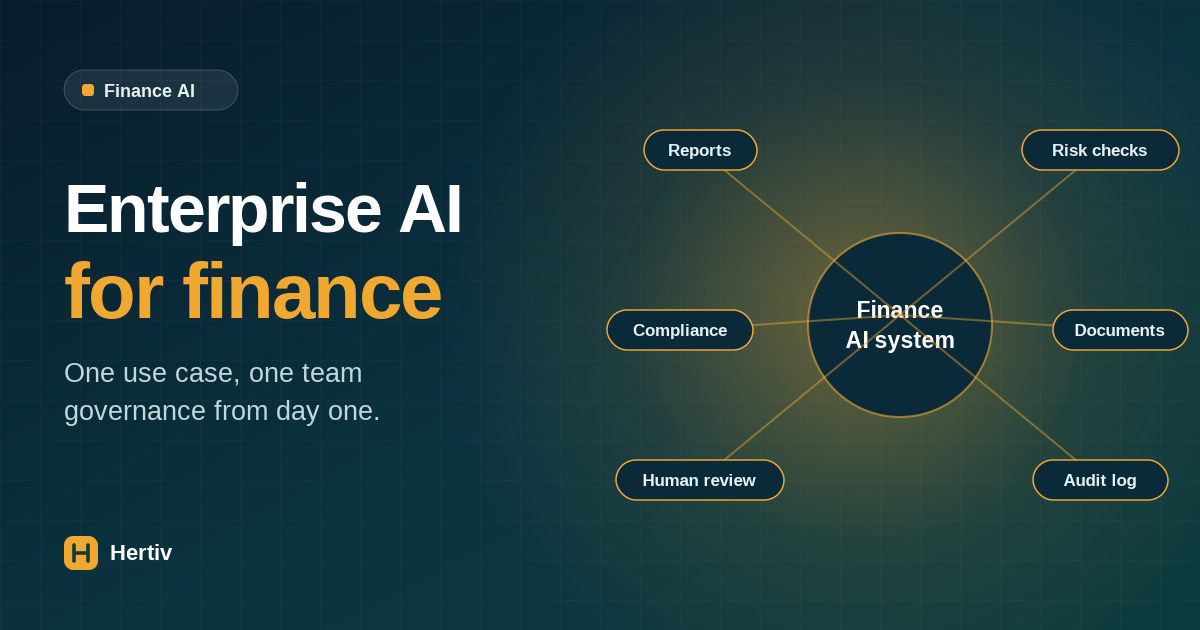
Inside, an enterprise AI solution for finance has four parts. The data layer connects to approved sources and keeps a record of where each fact came from. The model layer reads a question, finds the right documents and drafts an answer. The control layer checks the answer against the rules, blocks anything it should not do, and logs the result.
The fourth part is the human review step. A person checks the answers that matter, such as anything sent to a customer or used in a filing. The review step is not a temporary fix: it is part of the design, because finance teams are responsible for what they send out.
Keep the parts separate so each one can be tested and replaced. If the model changes, the data and controls should still work. If a rule changes, you should be able to update the control layer without rebuilding the whole system. Teams that prepare their data well usually read how to prepare data for AI before they start.
Example (hypothetical): a finance team pilots a reporting assistant
Example (hypothetical): a finance team writes 40 monthly reports, and each one takes a person about 4 hours to draft from the ledger and past reports. That is 160 hours a month. The team builds a small AI assistant that drafts each report from the same sources, and a person checks and fixes it.
With the assistant, drafting takes about 1 hour and checking takes about 30 minutes, so each report takes 1.5 hours instead of 4. For 40 reports that is 60 hours a month, saving about 100 hours. The team spends 10 of those saved hours on a second check for the five reports that go to the board.
The pilot also finds a limit: the assistant struggles with two reports that mix three currencies and an old format. The team keeps those two fully manual. The example shows the pattern: measure the time, keep a human check on the important work, and leave the hard cases to people.
Costs, team and timeline
The cost of an enterprise AI solution for finance has three parts: the build, the running cost and the governance cost. The build covers the team, the data work and the first version. The running cost covers the model, the hosting and the support. The governance cost covers the reviews, the audits and the updates to rules.
A small pilot usually takes a team of four to six people for two to three months: a product lead, one or two engineers, a data person and someone from compliance. A full rollout takes longer, because it adds training, support and more teams.
Do not budget the pilot as if it were the whole system. The pilot proves the idea; the rollout is a separate project with its own budget. Ask for a fixed price for the pilot, then plan the rollout once you have the pilot's results.
Common mistakes
The most common mistake is starting with the model instead of the data. A powerful model fed messy, out-of-date or unapproved data gives confident wrong answers. Spend the first weeks on data and rules, not on model choice.
Another mistake is skipping the human review step to save time. In finance, a wrong number in a report or a wrong answer to a customer can cost far more than the time saved. Keep a person on the answers that matter, and log what the system did.
A third mistake is rolling out too fast. A pilot that works for one team can fail for another with different documents or different rules. Roll out team by team, measure each one, and fix problems before you add the next team.
Key takeaways
- Start with one use case, one team and one clear measure of success.
- Data and rules come before the model: messy data gives confident wrong answers.
- Keep a human review step on every answer that matters.
- Run a small pilot for four to six weeks before any wider rollout.
- Roll out team by team, and measure each one before adding the next.
Frequently asked questions
How long does it take to build an enterprise AI solution for finance?
A small pilot usually takes two to three months with a team of four to six people. A full rollout takes longer, because it adds training, support, governance and more teams. Plan the pilot as its own project with its own budget.
What data does the AI need?
It needs the data for the use case you picked: transactions, accounts, contracts, policy documents or regulatory text. For each source, note who owns it, how fresh it is and who may see it, and get approval before the AI reads it.
Is AI allowed in regulated finance work?
Yes, when it is built with controls: access rules, logging, human review and a way to trace every answer to its source. Your legal and compliance teams should agree the rules before you build, and check the system before it goes live.
How do you check the AI's answers?
A person reviews the answers that matter, and the system logs what it did and which documents it used. The team also runs regular spot checks on a sample of answers, so mistakes are caught early and the rules can be improved.
What does an enterprise AI solution cost?
There is no fixed price, because it depends on the use case, the data and the number of users. Ask for a fixed price for a small pilot, then a separate estimate for the rollout, so you can compare the cost against the time the pilot saves.
Should we build it ourselves or hire a firm?
Build it yourself if you have the engineers, the data skills and the compliance team. Hire a firm if you need the work done quickly or lack those skills in-house. Either way, keep ownership of the data, the rules and the final checks.


