How to Prepare Data for AI: A Practical Guide
Preparing data for AI means collecting, cleaning, labelling and splitting real examples so a model can learn from them. Here is the process, step by step.
On this page
Short answer
Preparing data for AI means collecting real examples of the task, cleaning them, labelling what the right output is, and splitting them into sets for training and testing. Clean, labelled data matters more than model choice, because a model can only learn what the data shows it.
How do you prepare data for AI?
Preparing data for AI is the work of turning raw records into examples a model can learn from. You gather the inputs and the correct outputs, remove errors and duplicates, fill in what is missing, and organise everything into training and test sets.
Most AI projects spend more time on this than on the model. A support assistant needs past tickets with good answers, a document tool needs sample documents with the fields filled in, and a classifier needs examples labelled by hand. Without those examples, there is nothing to train or evaluate on.
The goal is not a perfect dataset. It is a dataset that matches the real task: the same kinds of inputs the model will see in use, with answers that reflect what your team actually considers correct. That match matters more than size.
What does good AI data look like?
Good AI data is representative, consistent and honest about its gaps. It covers the cases the model will meet, labels them the same way every time, and includes the awkward cases rather than only the easy ones.
| Quality | What it means | Sign of trouble |
|---|---|---|
| Representative | Covers the real mix of inputs | Only easy or recent cases |
| Consistent labels | Same answer for the same case | Two people label the same item differently |
| Clean | No duplicates, errors or stale rows | Old records that no longer apply |
| Complete | Key fields are filled in | Blank fields on most rows |
| Fair coverage | All important groups appear | One group dominates the set |
| Traceable | You know where each row came from | Rows with no source or date |
Check these qualities on a sample before you clean the whole set. A sample of a few hundred rows will show the most common problems, and fixing the process that created them is worth more than patching rows one by one.
How to prepare data in six steps
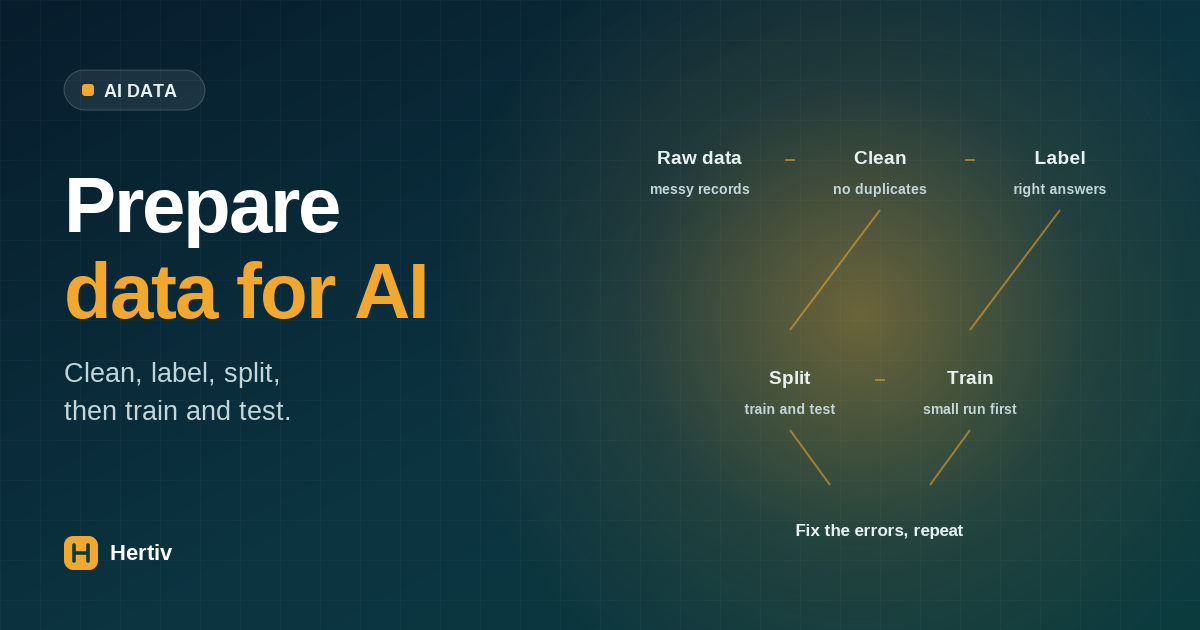
Data preparation follows the same six steps on most projects, and skipping one usually shows up later as a model that works in testing and fails in use.
- Define the task and the output. Write down exactly what the model should produce for a given input, with examples of a good answer and a bad one.
- Collect real examples. Pull records from the systems where the work happens, not from a demo or a template. Keep the source and date of each row.
- Clean the data. Remove duplicates, fix obvious errors, standardise formats such as dates and currency, and drop rows that are stale or out of scope.
- Label the answers. Have people who do the work today mark the correct output for each example, and write a short guide so two people label the same way.
- Split into sets. Keep most examples for training, hold back a test set the model never sees, and use a small validation set while you tune.
- Test before you scale. Train on a small sample first, check the errors by hand, and fix the data problems the errors reveal.
Step six is the one teams skip most often. A small first run will show whether the labels are consistent and whether the test set matches real inputs, and it costs far less than a full run on bad data. If you are scoping a first project, an AI readiness assessment will show which data gaps need closing before you build.
How do you label data well?
Good labelling starts with a short written guide and a person who does the work today. The guide shows examples of each label, including the borderline cases, so two people marking the same item usually agree. Without it, labels drift and the model learns the drift.
Label a small batch first, then check agreement. If two labellers disagree on more than a few items in a hundred, the guide needs clearer examples, not more labellers. Fix the guide, re-label the disputed items, and repeat until agreement is steady.
Keep the labels simple. A handful of clear categories beats a long list of fine distinctions that nobody applies consistently. You can always add detail later, once the basic model works. For tasks where labelling is the bottleneck, data annotation services can handle volume, but the guide and the quality checks stay with your team.
How do you split data for training and testing?
Splitting data means setting aside a test set that the model never sees during training, so you can measure how it handles new inputs. If the test set leaks into training, the score looks good and means nothing.
| Set | Share | What it is for |
|---|---|---|
| Training | About 70 to 80 percent | Teaching the model |
| Validation | About 10 to 15 percent | Tuning choices while you build |
| Test | About 10 to 15 percent | A final check on unseen data |
Split by time or by group when it matters. If your data changes over months, test on the most recent period rather than a random mix, because that is what the model will face in use. And split by customer or case, not by row, when rows from one case would otherwise land in both sets.
Example (hypothetical): a retailer prepares product data
Example (hypothetical): an online retailer wants a model that sorts 10,000 product records into categories. A first look shows 8 percent are duplicates, which is 800 rows, and 1,200 rows are missing a category entirely.
The team removes the 800 duplicates and sets the 1,200 incomplete rows aside. Two staff members label 2,000 of the remaining records, spending about 2 minutes each, which is 2,000 x 2 minutes, or about 67 hours. They check agreement on a sample of 200 and find they disagree on 14, so they tighten the guide and re-label those cases.
Finally they split the labelled set: 1,400 rows for training, 300 for validation and 300 for testing. The first small run shows the model confuses two similar categories, so the team adds clearer examples for those two before scaling up.
What are the common mistakes?
The most common data preparation mistakes are training on data that does not match real use, labelling without a guide, and letting the test set leak into training.
- Training on the wrong mix. Clean demo data teaches a model that fails on messy real inputs.
- Labels with no guide. Two people marking the same item differently teaches the model noise.
- Leaking the test set. Any overlap between training and test data makes the score meaningless.
- Ignoring the long tail. Rare but important cases need examples too, or the model will miss them.
- Skipping the small first run. A full run on untested data wastes weeks that a sample would have saved.
- Forgetting privacy. Personal data in a training set needs the same handling as in any other system.
Key takeaways
- Clean, labelled data matters more than model choice
- Define the task and the right output before you collect anything
- Label with a written guide and check that two people agree
- Hold back a test set the model never sees, and split by time or group when it matters
- Run a small first pass and fix the data problems the errors reveal
Frequently asked questions
How much data do I need for AI?
It depends on the task. A narrow classifier can work with a few hundred labelled examples, while a model that drafts open-ended text needs far more. Start with a small sample, measure how the model does, and add data where the errors are, rather than collecting a large set up front.
What is the difference between training, validation and test data?
Training data teaches the model, validation data helps you tune choices while building, and test data gives a final check on data the model has never seen. The test set must stay separate from the other two, or its score means nothing.
How do I clean data for AI?
Remove duplicates, fix obvious errors, standardise formats like dates and currency, and drop rows that are stale or out of scope. Check a sample first, because the same few problems usually repeat across the set, and fixing the source beats patching rows.
Who should label the data?
People who do the work today should label, because they know what a correct answer looks like. Give them a short written guide with examples, check that two people agree on a sample, and tighten the guide wherever they disagree.
Can I use synthetic data instead of real data?
Synthetic data can fill gaps, such as rare cases you have few examples of, but it should not replace real examples. A model trained mostly on made-up data often fails on real inputs, so use synthetic data to top up, and keep real data at the centre.
What data should I not use for AI?
Do not use personal data you have no right to process, data past its retention date, or records you cannot trace to a source. Mask or remove names, emails and payment details before labelling, and check privacy rules for your region before you start.


