Large Language Models in Finance: Where They Help Today
Large language models help finance teams read documents, draft summaries and answer questions from their own records. The gains are real, and so are the controls.
On this page
Short answer
Large language models in finance are AI systems trained on text that read, summarise and draft financial documents, answer questions from internal records, and flag items for human review. They work as assistants to analysts and advisers, not as replacements for judgement, sign-off or regulatory checks.
What are large language models in finance?
Large language models in finance are language models put to work on the documents and questions that finance teams handle every day: reports, filings, contracts, client messages and research notes. The model reads the text, finds the relevant parts and drafts a summary or an answer.
The model does not know your firm on its own. It becomes useful when it is connected to your documents and rules, so its answers come from your records rather than from general knowledge. That connection is usually called retrieval, and it is what keeps the answers grounded in the firm's own material.
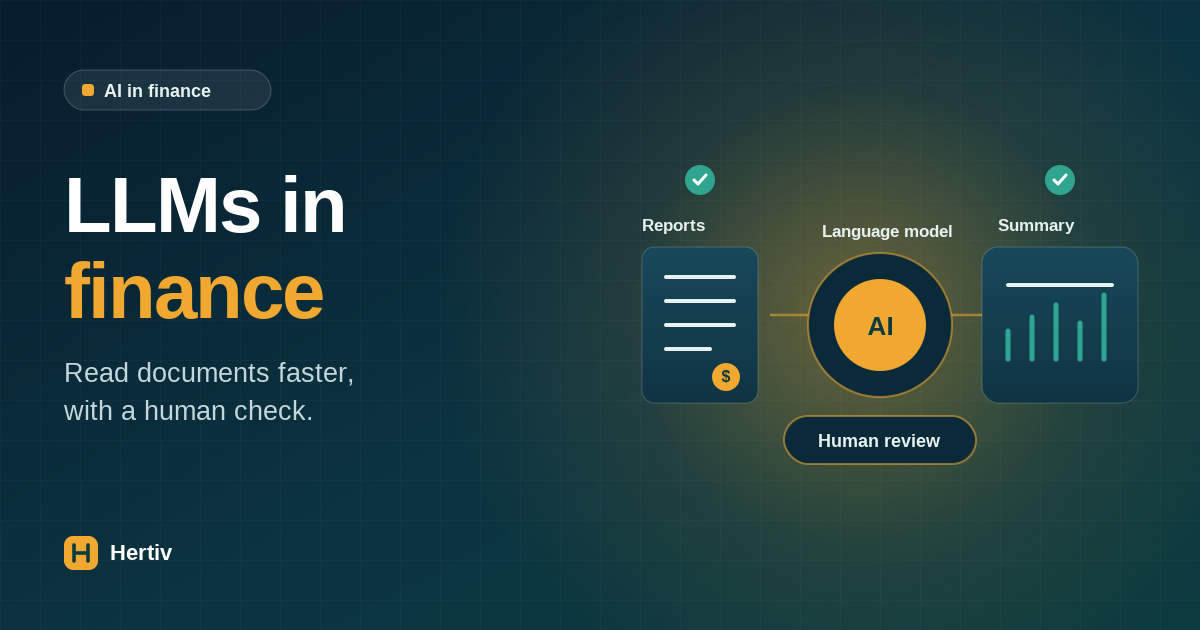
Finance is a careful adopter of this technology. The work involves money, regulation and client trust, so every output needs a human check and an audit trail. A finance AI agent follows the same pattern: the model prepares, and a person decides.
Where do banks and finance teams use LLMs?
Finance teams use language models where the work is reading and writing at volume. The table shows the common uses and the human check each one needs.
| Use case | What the model does | Human check |
|---|---|---|
| Document review | Reads contracts and filings, pulls out key terms | Analyst verifies the extracted terms |
| Research summaries | Condenses reports and earnings calls | Analyst checks figures against sources |
| Client questions | Drafts answers from internal records | Adviser reviews before sending |
| Compliance checks | Flags clauses and missing disclosures | Compliance officer signs off |
| Risk notes | Drafts first versions from data | Risk team edits and approves |
| Meeting notes | Turns calls into structured summaries | Owner corrects names and numbers |
None of these uses hands the decision to the model. The pattern is the same in each case: the model does the reading and the first draft, and a person checks the result before it is used. That is what makes the technology acceptable in a regulated setting.
How do LLMs help with documents and research?
Language models help with documents by reading far faster than a person and by keeping track of what they found. A team can ask for every mention of a covenant in a set of loan documents, or for a summary of a 200-page annual report, and get a structured answer in minutes.
The useful trick is to ask the model to show its sources. When each claim in a summary links back to the page it came from, the analyst can check the answer without re-reading the whole document. Answers without sources are hard to trust, and in finance that is a reason to reject them.
Research works the same way. The model can compare several analyst notes, pull out where they agree and disagree, and draft a briefing. The analyst still reads the originals for the numbers that matter, but the first pass is done. Document AI covers the same reading work for scanned and structured documents.
What are the risks and controls?
The main risks with language models in finance are wrong answers, leaked data and unclear responsibility. A model can state a figure with confidence and be wrong, it can repeat text from a document it should not have seen, and it can be unclear who is responsible when an output is used.
The controls follow from the risks. Keep the model inside your own systems or a vetted provider, so client data does not leave your control. Log every question and answer, so any output can be traced back. And keep a named person responsible for each use case, so a bad output has an owner.
Regulation adds its own layer. Financial advice, disclosures and record-keeping have rules that do not change because a model wrote the first draft. Before a use case goes live, the compliance team should review what the model can see, what it can say and how its outputs are stored. The document AI use cases guide covers similar controls for document work.
How do you start with LLMs in finance?
You start with LLMs in finance by picking one document-heavy job, proving the model helps with it, and only then widening the scope.
- Pick one job. Choose a task with clear inputs and a checkable output, such as summarising research notes.
- Connect your documents. Give the model access to the records it needs, and nothing else.
- Set the checks. Decide who reviews each output and what counts as a wrong answer.
- Run a pilot. Test on a fixed set of past documents and measure how often the model is right.
- Review with compliance. Show the pilot results, the logs and the data controls to the compliance team.
- Roll out slowly. Expand to more users only after the checks are passing week after week.
A pilot that fails is useful too: it shows where the model is weak before any client sees its output. The AI debt collection use cases article shows the same pilot-first pattern in another finance job.
Example (hypothetical): cutting document review time
Example (hypothetical): an analyst team reviews 300 loan documents a month. Reading each one takes 20 minutes, which is 300 times 20 minutes, or 6,000 minutes, which is 100 hours a month.
With a language model drafting the first pass, the analyst checks each draft in 6 minutes instead of reading from scratch. That is 300 times 6 minutes, or 1,800 minutes, which is 30 hours a month. The saving is 100 minus 30, which is 70 hours a month.
The numbers are invented to show the arithmetic, not a real measurement. The saving only holds if the drafts are good enough to check quickly; if the analyst has to re-read every document anyway, the model has saved nothing.
What are the common mistakes?
The most common mistakes with language models in finance are trusting outputs without sources, connecting too much data, and skipping the compliance review.
- Answers without sources. A summary that does not show where each claim came from cannot be checked, and in finance that makes it unusable.
- Too much data access. Giving the model every document in the firm increases the risk of a leak and makes answers harder to trace.
- No named owner. If nobody owns a use case, nobody checks its outputs and nobody fixes it when it drifts.
- Skipping evaluation. Without a fixed test set, the team cannot tell whether the model is improving or getting worse.
- Treating a draft as advice. A model draft is not financial advice until a qualified person has reviewed and approved it.
Key takeaways
- LLMs in finance read documents and draft summaries; people check and decide
- The model is only useful when connected to the firm's own records
- Every use case needs sources, logs and a named owner
- Compliance review comes before rollout, not after
- Start with one document-heavy job and a fixed test set
Frequently asked questions
Can a language model give financial advice?
No, not on its own. A model can draft an answer from your records, but financial advice needs a qualified person who has reviewed it and takes responsibility for it. Regulation in most countries requires a licensed adviser for advice to clients.
Is client data safe with a language model?
It depends on the setup. Data is safer when the model runs inside your systems or with a vetted provider under contract, and when the model only sees the documents the job needs. Never send client data to a public tool without a data agreement.
What is retrieval in this context?
Retrieval means the model searches your documents first and bases its answer on what it finds there. Each claim can then link back to its source page, so an analyst can check it. Without retrieval, the model answers from general knowledge, which is not enough for finance work.
How accurate are LLMs on financial documents?
Accuracy varies by task and by how the system is built. Models do well on summarising and extracting stated facts, and worse on arithmetic and on reading between the lines. The only honest answer comes from testing on your own documents with a fixed test set.
Do regulators allow LLMs in finance?
Regulators generally allow them as tools, with the same rules as any other system: records must be kept, advice must be attributable to a person, and client data must be protected. The firm must be able to explain what the model did and who checked it.
What should a finance team test first?
Start with a task that is high volume, easy to check and low risk, such as summarising internal research notes. Measure how often the draft is right and how long the check takes, then decide whether to expand.


