AI in Debt Collection: Where It Helps, and Where to Start
AI can take over routine work in debt collection: sorting accounts, choosing the right message and time, and drafting replies. Learn the use cases and the limits.
On this page
Short answer
AI in debt collection means using software to handle the routine parts of recovering overdue payments: sorting accounts by likelihood of payment, choosing the best channel and time to contact each person, drafting messages, and answering common questions. Human agents still handle disputes, hardship cases and anything that needs judgement.
What is AI in debt collection?
AI in debt collection is the use of software to do the repetitive parts of collecting overdue payments, while human agents handle the cases that need judgement. The software looks at account data, such as how long a debt has been overdue, how the person has responded before, and what they owe, and it uses that data to decide what to do next.
It does not replace the collector. It takes over the routine work: deciding which accounts to contact first, picking the channel and the time, drafting a message, and answering the questions that come up again and again, such as how to set up a payment plan or where to find a reference number.
The goal is not to contact people more often, but to contact the right people, in the right way, at a time they are likely to respond. A message sent at the wrong time, through the wrong channel, is easy to ignore, and a team that sends more of those messages does not collect more.
How does AI debt collection work?
AI debt collection works by combining account data with a set of rules and models that rank accounts and choose actions. The system reads the data the collector already has, scores each account, and then follows a plan for each score band: a gentle reminder for one group, a payment-plan offer for another, and a human call for the cases that need one.
A typical flow looks like this:
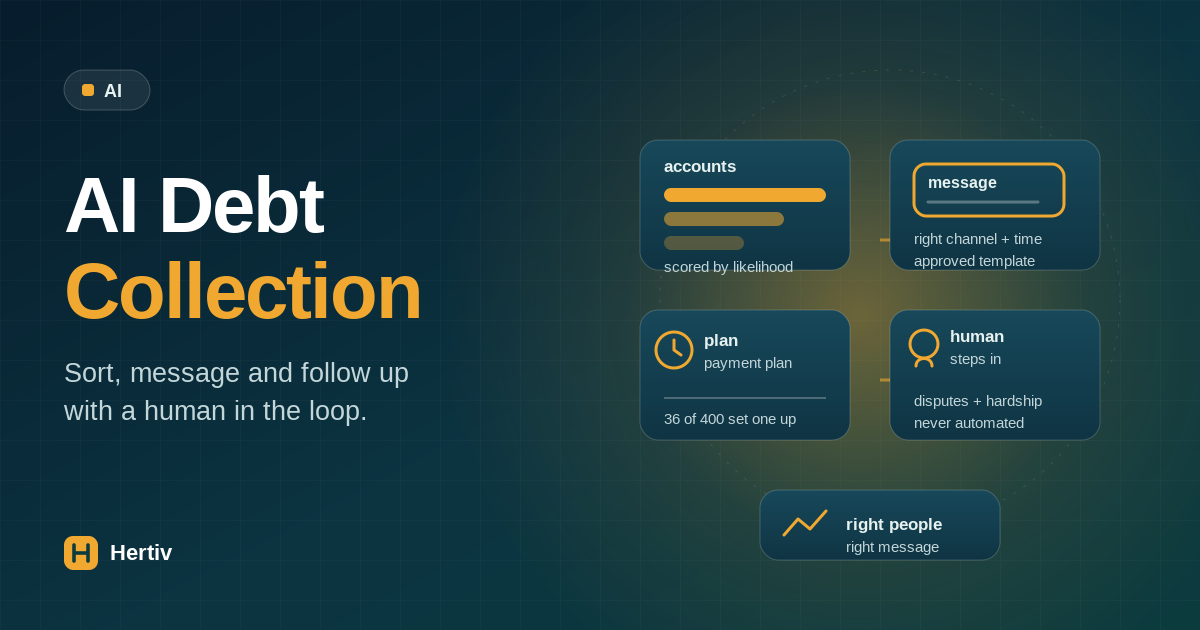
- Score the accounts. The system ranks accounts by likelihood of payment, using data such as overdue age, past responses and payment history.
- Pick the channel and time. For each account, it chooses email, text or a call, and a time the person has responded before.
- Draft the message. The system writes a message in the right tone for the situation, following templates the team has approved.
- Handle replies. A conversational agent answers common questions, such as payment dates and plan options, and passes the rest to a human.
- Learn from outcomes. The team reviews which messages and times worked, and adjusts the plan, rather than letting the system run unchanged.
None of this works without clean data. A system fed with outdated contact details or wrong balances will make confident mistakes, so the first step is usually fixing the data, not buying a new tool. Teams that build these systems often start with AI agents for finance teams, where the same pattern of scoring, drafting and handoff applies.
Where is AI used in debt collection?
AI is used in debt collection in a handful of places where the work is repetitive and the data is clear. The table below maps each use case to what it does and where a human still needs to be involved.
| Use case | What the AI does | Human still needed for |
|---|---|---|
| Account scoring | Ranks accounts by likelihood of payment | Deciding the strategy for large or unusual debts |
| Message timing | Picks the channel and time per person | Approving the message templates |
| Payment plans | Drafts plan options from the balance and rules | Approving exceptions and hardship cases |
| Answering questions | Replies to common questions about balances and dates | Disputes, complaints and vulnerable customers |
| Document handling | Reads statements and letters to pull out key facts | Checking anything the system is unsure about |
| Compliance checks | Flags messages that break the team's rules | Final judgement on regulated wording |
The pattern across the table is the same: the software does the sorting, drafting and first reply, and a human handles the cases where the stakes are high or the person is in difficulty. A team that removes the human from those cases is taking a risk it does not need to take.
Example (hypothetical): sorting 1,000 accounts
Example (hypothetical): a collections team has 1,000 overdue accounts to work through in a month. Without any sorting, agents call them in the order they appear, and about 10 in every 100 people respond, which is 100 responses from 1,000 accounts.
The team adds scoring. The system ranks the accounts and the team contacts the top 400 first, through the channel and at the time each person has responded to before. Of those 400, 15 in every 100 respond, which is 60 responses. Of those 60, 60 in every 100 set up a payment plan, which is 36 plans.
The remaining 600 accounts get a gentler sequence of messages, and 5 in every 100 respond, which is 30 responses. The total is 90 responses and 36 plans from the first group, plus the plans that follow from the second group. The numbers are invented to show the arithmetic, not a real team's results. The point is that sorting changes which accounts get attention first, and that is where the gain comes from.
What are the common mistakes with AI in debt collection?
The most common mistakes with AI in debt collection are automating too much, trusting the data too much, and forgetting the rules. Each one is easy to make when the software looks confident and the team is under pressure to collect more.
- Automating hardship and dispute cases. People in financial difficulty or disputing a debt need a human, not a message sequence. Automating those cases creates complaints and regulatory risk.
- Trusting stale data. Wrong balances, old phone numbers and outdated addresses turn a good system into a source of errors and angry calls.
- Sending more messages instead of better ones. Increasing contact frequency without improving relevance annoys people and can break contact rules.
- Letting the system write its own wording. Messages must follow approved templates and local rules; free-form generation can produce wording the team would never approve.
- No human handoff. A conversational agent that cannot pass a person to a human quickly will frustrate the people who most need help.
A practical guard is to keep a human in the loop for every message template, every hardship flag and every dispute, and to review a sample of automated conversations every week. AI chatbot development teams use the same rule, because the handoff to a human is where most chatbot projects fail.
What should a team check before using AI here?
Debt collection is regulated in most places, and the rules cover who can be contacted, when, how often, and what can be said. A team should check those rules with a qualified adviser in its own jurisdiction before automating anything, because the rules differ by country and by the type of debt.
This article is general information, not legal advice. The practical checks are:
- Contact rules. Which channels, times and frequencies are allowed, and what consent is needed for each one.
- Message wording. What must a message say, what must it not say, and who approves the templates.
- Vulnerable customers. How the team identifies people in difficulty, and what the human process is when it does.
- Data handling. Where account data lives, who can see it, and how long it is kept.
- Complaints and disputes. How a person raises a dispute, and how fast a human must respond.
Teams that already run customer support automation often reuse the same patterns here, and AI agents for customer support show how scoring, drafting and handoff work in a related setting.
How do you start with AI in debt collection?
You start with AI in debt collection by picking one routine job, fixing the data behind it, and testing it on a small group before rolling it out. A team that starts with scoring and message timing usually learns faster than a team that tries to automate everything at once.
- Pick one use case. Account scoring or message timing is a good first step, because the data already exists and the result is easy to measure.
- Clean the data. Check balances, contact details and response history, because the system will only be as good as the data it reads.
- Approve the templates. Write and approve the messages with a qualified adviser, before any automation sends them.
- Test on a small group. Run the system on a few hundred accounts, compare the results with the old method, and review a sample of conversations.
- Keep the human handoff. Make sure every automated conversation can reach a human quickly, and measure how often people use it.
Document handling is a common second step, and document AI can pull the key facts from statements and letters so agents spend less time reading paperwork and more time talking to people.
Key takeaways
- AI handles the routine work in debt collection: scoring, timing, drafting and first replies
- Humans still handle disputes, hardship cases and anything that needs judgement
- Sorting accounts changes which ones get attention first, and that is where the gain comes from
- Message templates must be approved, and contact rules differ by jurisdiction
- Start with one use case, clean the data, and test on a small group first
Frequently asked questions
Is it legal to use AI to contact people about debts?
It depends on where you operate and the type of debt. Most places have rules on who can be contacted, when, how often, and what can be said. A team should check those rules with a qualified adviser in its own jurisdiction before automating any contact, because getting this wrong carries regulatory risk.
Can AI replace debt collection agents?
No. AI can take over routine work such as scoring accounts, choosing message timing and answering common questions, but disputes, hardship cases and complaints need a human. Teams that remove humans from those cases usually see more complaints, not better results.
What data does AI debt collection need?
It needs accurate account data: balances, overdue age, contact details, payment history and past responses. Clean data matters more than the choice of tool, because a system fed with wrong balances or old phone numbers will make confident mistakes at scale.
How do you measure whether it is working?
Useful measures include response rate, payment plans set up, time agents spend on routine work, and complaint rates. Compare a test group using the system with a similar group using the old method, and watch complaint rates as closely as collection rates.
What happens when a person disputes a debt?
The automated conversation should stop and pass the person to a human straight away. Disputes need a person who can read the case, check the records and respond properly. A system that keeps messaging someone who has disputed a debt is a serious problem.
Does AI in debt collection work for small teams?
Yes, if the team has enough accounts for sorting to matter and clean data to work from. A small team can start with scoring and message timing on a few hundred accounts, and expand only if the test shows a clear improvement. A team with very few accounts may not need the system at all.


