Blockchain vs DLT: What Is the Real Difference?
Blockchain is one type of distributed ledger technology. Learn how blocks differ from graph and private ledgers, compare them, and pick the right design.
On this page
Short answer
Blockchain is one type of distributed ledger technology, or DLT. DLT is the broad term for systems where records are shared and kept in sync across many computers, while blockchain groups records into blocks linked in a chain.
What is the difference between blockchain and DLT?
Blockchain is one type of distributed ledger technology, or DLT. DLT is the broad term for any system where records are shared and kept in sync across many computers, with no single central database. Blockchain is the best-known kind, but not the only one.
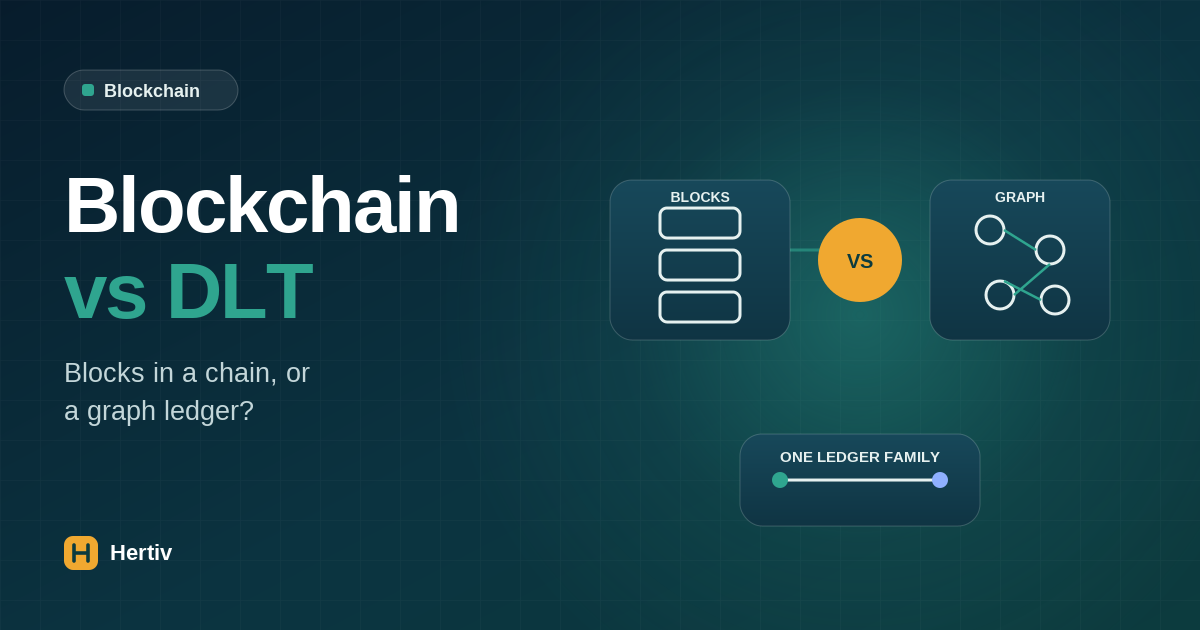
The difference is structure. A blockchain groups records into blocks and links them in a chain, with each block pointing to the one before it. Other DLT designs store records differently, for example as a graph of linked transactions with no blocks at all. Both kinds share records across a network, but only blockchain uses blocks and a chain.
People often use the two words as if they mean the same thing, which causes confusion in project plans. If a vendor says a system uses DLT, ask which design it uses, because the choice changes how the system scales, who can join it and how it reaches agreement. The difference between chains is a separate question, and it matters once more than one ledger is involved.
How does a blockchain work?
A blockchain works by grouping transactions into blocks, linking each block to the previous one with a cryptographic hash, and asking the network to agree on the next block. Once a block is agreed and added, changing it would mean rewriting every block after it, which is what makes the record hard to tamper with.
Agreement, or consensus, is the slow part. Public chains let anyone take part, which is open but slow and costly. Private chains limit who can validate, which is faster but puts more trust in a smaller group. The consensus method decides much of the speed, cost and energy use of the chain.
Blocks also set the rhythm of the system. A chain that adds a block every few seconds can confirm transactions quickly, but each block carries a limited number of transactions. That limit is why public chains often charge fees when demand is high.
How does DLT without blocks work?
DLT without blocks stores each transaction as its own record and links it directly to earlier records, usually in a graph. There is no block to wait for, so a transaction can be confirmed as soon as the network checks it. This design is used by ledgers built for high volumes of small payments or sensor data.
| Design | How records are stored | Speed | Best for |
|---|---|---|---|
| Blockchain | Grouped into linked blocks | Slower, fee per block space | Money, tokens, public records |
| Directed graph | Each transaction links to earlier ones | Faster, often feeless | Small payments, sensor data |
| Private ledger | Shared database with access rules | Fast | Banks and companies sharing records |
Graph-based ledgers trade away some of the simplicity of a chain. Ordering is harder to prove, and the security model depends on how many transactions reference each other. They suit uses where speed matters more than a single, simple history.
Private ledgers are a third shape. They look like a shared database with strict access rules and a log of changes. They are fast and easy to run, but they trust the operator far more than a public chain does.
Blockchain vs DLT: a side-by-side comparison
The table below compares the two ideas directly. Remember that blockchain is a subset of DLT, so the comparison is really between a blockchain and other DLT designs.
| Question | Blockchain | Other DLT |
|---|---|---|
| Structure | Blocks linked in a chain | Graph, log or shared database |
| Who can join | Open or permissioned | Usually permissioned |
| Speed | Limited by block time | Often faster |
| Fees | Usually per transaction | Often low or none |
| Trust model | Trust the network rules | Trust the operator or the graph |
| Best use | Money and public records | High-volume or private sharing |
No design wins on every row. A public blockchain is the strongest choice when no one should control the record, while a private ledger is the stronger choice when a small group of known companies need to share data fast and cheaply.
The practical question is not which is better in general, but which fits the use case. A payment app needs a different ledger from a supply chain tracker, and a tracker needs a different one from a central bank pilot.
When should you choose blockchain, and when DLT?
Choose a blockchain when the record must be public, when no single party should control it, or when the asset itself lives on the chain, such as a token or a payment. Public chains suit money, open marketplaces and records that strangers need to verify without asking permission.
Choose another DLT design when the users are known, when speed and cost matter more than openness, or when the data is private. Banks sharing settlement records, companies tracking goods, and sensor networks all fit this shape better than a public chain.
Ask four questions before you decide: who needs to read the record, who needs to write it, what happens if the operator fails, and how many transactions per second do you need. The answers point to the design.
They also decide the budget, because a public chain and a private ledger have very different build and running costs. Teams that need help weighing the options often start with blockchain consulting before they commit to a design.
Example (hypothetical): a food traceability project
Example (hypothetical): a food company wants to track 10,000 crates of produce a month from farms to shops, with each crate scanned at four points. The team compares a public blockchain with a private ledger.
The arithmetic: 10,000 crates × 4 scans = 40,000 records a month. On a public chain charging $0.10 per transaction, that is $4,000 a month in fees, or $48,000 a year, before any build cost. On a private ledger run by the company and its three largest partners, the running cost is a shared server bill of about $500 a month, or $6,000 a year.
The team picks the private ledger, because the readers are known partners, the data is commercially sensitive, and the fee saving is $42,000 a year. The trade-off is that a shopper cannot verify the record without asking the company, so the team adds a monthly public report that lists the number of crates tracked and the share that arrived on time. That report gives shoppers a check without putting every scan on a public chain.
What are the common mistakes?
The most common mistakes when comparing blockchain and DLT are using the words as synonyms, picking a public chain for a private problem, and ignoring the running cost.
- Using the terms as synonyms. Blockchain is one kind of DLT; saying DLT when you mean blockchain hides the design choice.
- Picking a public chain for known partners. If the readers are known companies, a private ledger is usually faster and cheaper.
- Ignoring fees. A chain fee per transaction can turn a high-volume tracker into a large monthly bill.
- Trusting the word decentralised. A ledger run by three companies is not the same as one run by thousands of strangers.
- Skipping the exit plan. Records on a ledger are hard to move, so check how you would leave before you join.
Key takeaways
- DLT is the broad term; blockchain is one design inside it
- Blockchains group records into linked blocks; other DLT uses graphs or shared logs
- Public chains suit open money and records; private ledgers suit known partners
- Ask who reads, who writes, and what happens if the operator fails
- Fees per transaction can make a public chain costly for high-volume tracking
Frequently asked questions
Is DLT the same as blockchain?
No. DLT is the broad term for ledgers shared across many computers, and blockchain is one design inside it. A blockchain groups records into blocks linked in a chain. Other DLT designs store records as graphs or shared logs, with no blocks at all.
What is an example of DLT that is not a blockchain?
Graph-based ledgers, where each transaction links directly to earlier ones, are the clearest example. Private shared ledgers used by banks and companies are another. Both keep records in sync across many computers without grouping them into blocks.
Is blockchain more secure than other DLT?
It depends on the threat. A large public blockchain is hard to rewrite because changing one block means rewriting all later blocks. A small private ledger can be rewritten by its operator. Security comes from the network size and the rules, not from the label.
When should a business use DLT instead of a database?
Use DLT when several organisations need to share one record and none of them should control it alone. If only one company reads and writes the data, a normal database is simpler, faster and cheaper to run.
Do I need tokens to use DLT?
No. Many private ledgers and graph-based designs have no token at all. Tokens are needed on public chains to pay fees and reward validators, but a ledger shared by known partners can run without one.
Can a DLT system move to a blockchain later?
Moving is hard, because records, identities and integrations are tied to the first design. It is possible, but it usually means rebuilding the ledger and migrating the history. Choose the design for the next five years, not the next launch.


