Blockchain Technology in Marketing: What It Actually Does
Blockchain in marketing is a shared, tamper-proof record for ad transparency, loyalty rewards and verified customer data. It helps where trust is the problem.
On this page
Short answer
Blockchain technology in marketing is the use of a shared, tamper-proof ledger to record marketing events, such as ad views, clicks, loyalty points and consent, so that advertisers, publishers and customers can check the same record. It helps where trust is the problem, and it adds little where trust is not the issue.
What is blockchain technology in marketing?
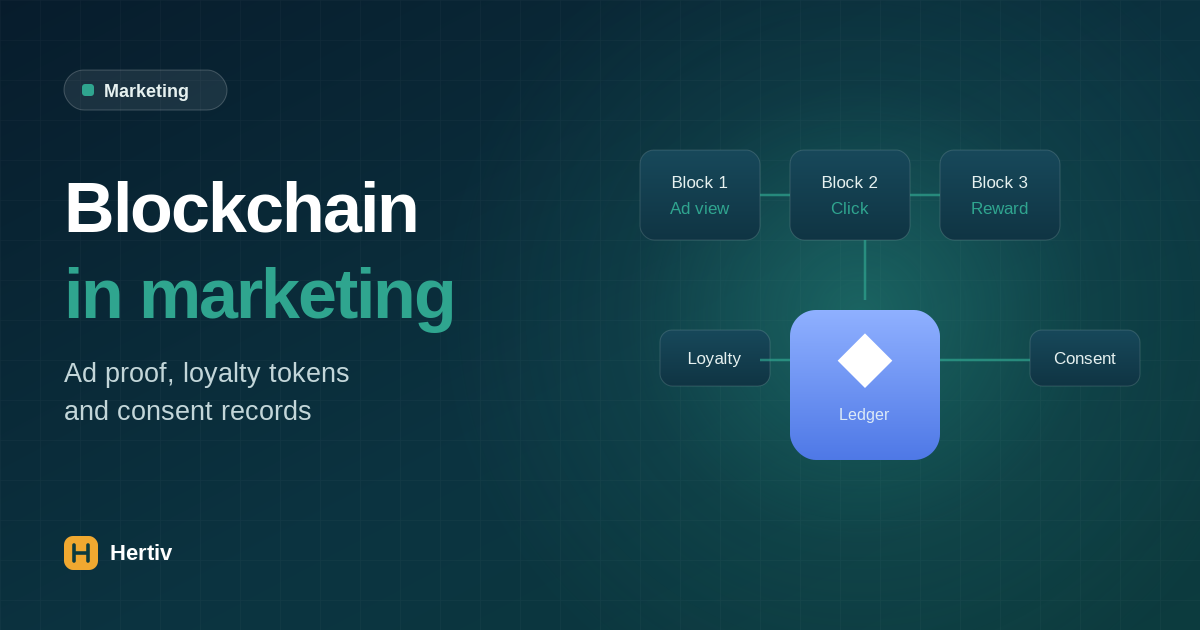
Blockchain technology in marketing is the use of a shared, tamper-proof ledger to record marketing events, such as ad views, clicks, loyalty points and consent, so that advertisers, publishers and customers can check the same record. Each entry is grouped into a block, linked to the one before it, and shared across the parties involved, which makes it hard to change an entry after the fact.
The idea is simple: marketing runs on claims that are hard to check. An advertiser pays for views it cannot see, a publisher reports clicks it cannot prove, and a customer shares data it cannot track. A shared ledger gives all three sides one record to check, instead of three different reports.
Blockchain does not replace marketing tools. It sits beside them, recording the events that need proof, such as an ad being shown, a reward being earned or consent being given. The creative work, targeting and measurement still happen in the usual tools. For the basics of the technology, see what blockchain is.
What can blockchain do for marketers?
Blockchain is useful in marketing in four places: ad transparency, loyalty rewards, customer data and consent, and digital collectibles. Each one solves a trust problem, not a creative problem, so the value shows up in lower fraud and clearer records rather than in better ads.
| Use case | What blockchain records | Who benefits |
|---|---|---|
| Ad transparency | Ad views and clicks | Advertisers and publishers |
| Loyalty rewards | Points earned and spent | Customers and brands |
| Consent and data | What a customer agreed to | Customers and marketers |
| Digital collectibles | Ownership of a token or item | Fans and brands |
| Supply chain proof | Origin and handling of goods | Buyers and sellers |
Loyalty is the most common starting point, because it is easy to explain to customers and easy to measure. A loyalty token that a customer can see, earn and spend is clearer than points locked inside one app. Ad transparency is the most valuable for large advertisers, because it targets fraud directly.
How does blockchain change advertising?
Blockchain changes advertising by giving advertisers a record of where their ads actually ran. Today an advertiser buys impressions through a chain of middlemen, and each one takes a cut and reports its own numbers. A shared ledger can record each impression once, with the publisher, the price and the time, so the advertiser can check what it paid for.
The main gain is against ad fraud. Fake views and clicks cost advertisers money, and a ledger that records real events from verified devices makes fake traffic easier to spot. It does not remove fraud on its own, because a real device can still be used to fake a view, but it makes the chain of events visible.
The limit is scale. Recording every ad view on a public chain is slow and costly, so most projects record a summary or use a private chain shared by the advertiser, the agency and the publisher. The ledger proves the summary, while the detail stays in the usual ad systems.
How do blockchain loyalty programmes work?
A blockchain loyalty programme gives customers tokens instead of points locked in one app. The customer earns tokens for purchases, referrals or reviews, and spends them on rewards, discounts or access. Because the tokens live on a ledger, the customer can see the balance, the history and the rules, and in some programmes can move tokens to another person.
Tokens work best when they are simple. One token should mean one thing, such as one point per dollar spent, and the reward should be clear, such as ten tokens for a free item. Programmes fail when the token rules are hard to follow, because customers stop using a reward they do not understand.
Brands must also decide whether the token is a reward or an asset. A token that can be traded outside the programme raises legal questions in many countries, because it starts to look like a financial product. Most brands keep tokens inside the programme to stay clear of those rules. For how tokens are valued and structured, see what tokenomics is.
How to run a first blockchain marketing pilot
Run a first blockchain marketing pilot in five steps, with one use case and one audience, so the result is easy to judge. A pilot that tries to fix ads, loyalty and data at once will not prove any of them.
- Pick one trust problem. Choose ad fraud, loyalty clarity or consent records, and state what success looks like in one sentence.
- Pick one audience. Run the pilot with one customer group or one publisher, not the whole market.
- Choose the chain. Use a private chain or a low-cost public chain, and record summaries rather than every single event.
- Set the rules in plain words. Write the token or record rules so a customer can understand them without a technical guide.
- Measure against the old way. Compare fraud rates, redemption rates or complaint numbers with the same period last year.
Keep the pilot small and short, usually eight to twelve weeks. A pilot that runs for a year without a clear result is a project, not a test, and it will lose support before it proves anything. For a related use case, see blockchain in the energy industry.
Example (hypothetical): a loyalty token pilot
Example (hypothetical): a coffee chain runs a twelve-week loyalty pilot with 4,000 members. Each member earns an average of 5 tokens, so 4,000 x 5 = 20,000 tokens are earned in total across the pilot.
Of those members, 1,200 redeem a reward that costs 10 tokens each, so 1,200 x 10 = 12,000 tokens are spent. That leaves 20,000 - 12,000 = 8,000 tokens unspent at the end of the pilot, which tells the team that the reward is worth having but the earning rate is too slow for most members.
The team also checks the cost. Running the pilot costs $6,000 in total, and the 1,200 redemptions each bring a member back into a store, so the team can compare the $6,000 cost with the sales from those 1,200 visits. The numbers, not the novelty, decide whether the pilot becomes a full programme.
What are the common mistakes?
The most common mistakes with blockchain in marketing are using a ledger where a database would do, making token rules too complex, and promising customers more than the token delivers.
- Blockchain for everything. If only one company reads the record, a normal database is cheaper and faster.
- Complex token rules. Customers stop using rewards they cannot understand in one sentence.
- Tradable tokens by accident. A loyalty token that can be sold outside the programme can raise legal questions.
- Recording every event. Putting every ad view on-chain is slow and costly; record summaries instead.
- No clear measure. A pilot without a baseline number cannot prove it worked.
- Hype over honesty. Calling a points scheme a blockchain revolution puts customers off when they see the same old points.
Key takeaways
- Blockchain in marketing records events that need proof, not everything
- Ad transparency, loyalty tokens and consent records are the strongest use cases
- Loyalty tokens must be simple: one token, one clear meaning, one clear reward
- Record summaries on-chain and keep the detail in normal ad systems
- Pilot one use case for eight to twelve weeks and measure against the old way
Frequently asked questions
What is blockchain in marketing?
Blockchain in marketing is the use of a shared, tamper-proof ledger to record marketing events such as ad views, loyalty points and consent. Advertisers, publishers and customers can all check the same record, which helps where trust is the problem, such as ad fraud or unclear loyalty balances.
Does blockchain stop ad fraud?
It helps but does not stop it on its own. A ledger makes the chain of ad events visible, so fake views and clicks are easier to spot, but a real device can still be used to fake a view. Blockchain works best combined with fraud detection tools, not as a replacement for them.
Are blockchain loyalty tokens the same as crypto?
No. A loyalty token is usually a reward that only works inside one brand's programme, while a cryptocurrency is a tradable asset. Some loyalty tokens can be traded, but most brands keep them inside the programme to avoid the legal rules that apply to financial products.
How much does a blockchain marketing pilot cost?
A small pilot usually costs a few thousand dollars in software and fees, plus the team's time, because it uses a private chain or a low-cost public chain and records summaries rather than every event. The main cost is the team's time to design the rules and measure the result.
Can small brands use blockchain in marketing?
Yes, for loyalty and consent records. A small brand does not need its own chain; it can use an existing platform or a shared ledger run by a provider. The key is to start with one use case that customers can understand, such as a loyalty token.
What is the difference between blockchain and a normal database in marketing?
A normal database is controlled by one company, which can change its records. A blockchain shares the record across the parties involved, so no single party can quietly change an entry. That matters when advertisers, publishers and customers need to trust the same numbers.


