Blockchain for Intellectual Property: How the Solutions Work
Blockchain helps IP owners prove creation dates, license work through smart contracts and track royalties. Each solution, its limits and how to start.
On this page
Short answer
Blockchain solutions for intellectual property use a shared, tamper-resistant record to prove when a work was created, who owns it and how it may be used. The main solutions are timestamped proof of creation, smart-contract licensing, automated royalty payments, tokenized ownership and anti-counterfeit checks, each with limits that teams should plan for.
What are blockchain solutions for intellectual property?
Blockchain solutions for intellectual property are tools that use a shared, tamper-resistant ledger to record who created a work, when it was created, and what others are allowed to do with it. The ledger does not replace the law, but it gives owners a record that is hard to alter after the fact.
Five solutions cover most use cases, and they can be combined:
| Solution | What it does | Who uses it |
|---|---|---|
| Proof of creation | Records a hash and timestamp for a work | Authors, designers, inventors |
| Smart-contract licensing | Sets licence terms in code | Publishers, music labels, agencies |
| Royalty payments | Splits payments automatically | Musicians, photographers, writers |
| Tokenized ownership | Represents rights as tokens | Investors, rights holders |
| Anti-counterfeit checks | Links a product to its origin | Brands, manufacturers |
The common thread is evidence. A blockchain record shows that a file existed at a certain time and has not changed since, which is useful when two people claim the same work or when a licence dispute reaches a lawyer.
Tokenized ownership is covered in depth in tokenization of IP assets, which explains what kinds of IP can be tokenized and what rights a token carries.
How does blockchain prove a work was created?
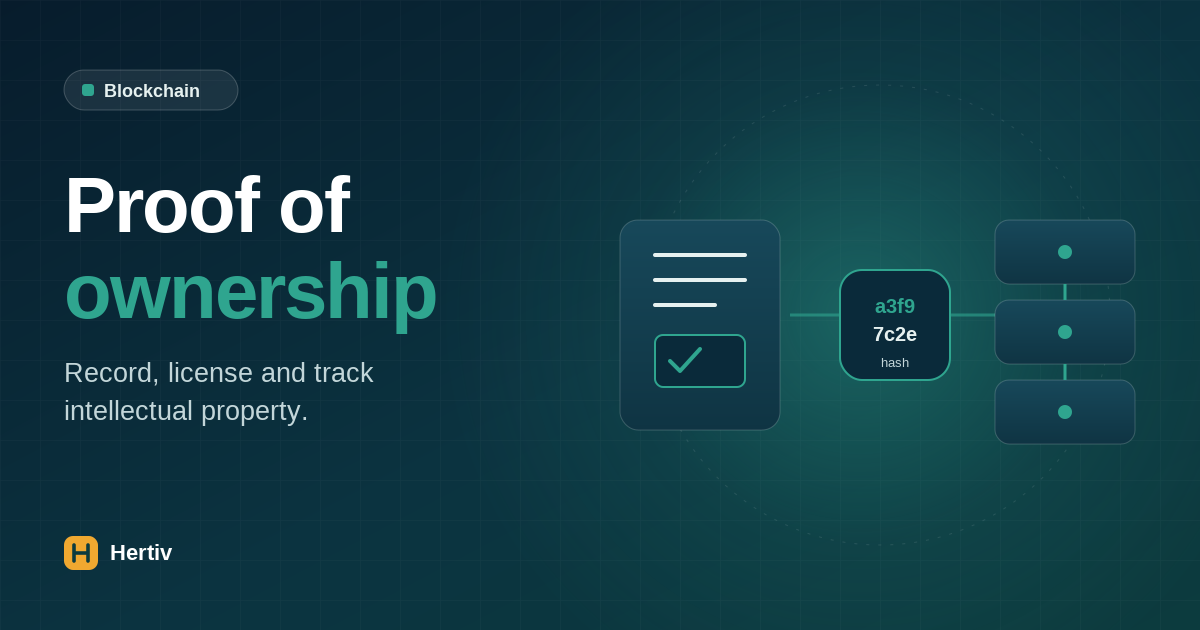
Blockchain proves a work was created by storing a cryptographic hash of the file, together with a timestamp, on a ledger that many independent computers maintain. The hash is a short fingerprint of the file: change one pixel or one word and the hash changes completely.
The process is simple. The creator runs the file through a hashing function, then records the hash in a transaction. Anyone can later hash the same file and compare the result with the record, which shows the file existed in that exact form at that time.
That record is useful in disputes. If two people claim the same design, the earlier timestamp supports the earlier claim. It is not a patent or a copyright registration on its own, and it does not prove who made the work, only that the file existed at a recorded time.
Teams should keep the original file safe. A hash proves a file existed, but it is useless if the file itself is lost, and a hash recorded on a small, little-used chain carries less weight than one on a widely used chain.
How do smart contracts handle licensing?
Smart contracts handle licensing by encoding the licence terms in code that runs on the blockchain: who may use the work, for what purpose, for how long, and at what price. When the conditions are met, the contract grants access or records the permission automatically.
A typical flow works like this. The rights holder publishes the terms, including price and allowed uses. A buyer pays through the contract, which records the licence and releases the file or the access key. Both sides keep a copy of the same record, so there is less room for argument about what was agreed.
Smart contracts suit licences that repeat often, such as stock photos, music for video, or software components. They suit one-off, high-value deals less well, because those deals usually need negotiation, custom terms and a lawyer's review that code cannot provide.
Licence terms still need to be written in plain language alongside the code. Code alone is hard for a court or a licensee to read, and the plain-language terms are what a dispute will turn on.
The contract mechanics themselves are explained in what is smart contract development, which covers how contracts are built and checked.
How do royalties work on a blockchain?
Royalties work on a blockchain by splitting each payment at the moment it arrives, using rules written into a smart contract. When a buyer pays for a licence or a stream, the contract sends each rights holder their agreed share without a middleman holding the money first.
This helps when many people share in a work. A song may have a writer, a performer and a producer; a photo may have a photographer and an agency. Instead of one party collecting and distributing payments weeks later, the contract splits the payment as it arrives and records every split on the ledger.
The limits are practical. Payments in cryptocurrency need conversion to local currency, which adds cost and tax questions. And a smart contract can only split money it receives, so it does not help when a platform reports fewer plays than actually happened.
Teams should start with one catalogue and one payment flow, measure the time saved against the old process, and only then extend the system to more works.
What about counterfeits and enforcement?
Blockchain helps against counterfeits by linking a physical product to a record of its origin. A brand can attach a code to each item, and a buyer can check that code against the ledger to see where the item came from and whether it has changed hands.
That check is only as good as the link between the item and the record. If a counterfeiter copies the code, the ledger cannot tell the fake from the real one. The usual answer is a tamper-evident tag or a one-time code, combined with the ledger record.
Enforcement still depends on the law. A blockchain record can support a takedown request or a court case, but it cannot take a listing down or seize goods by itself. Teams should treat the ledger as evidence, not as enforcement.
The strongest setups pair the ledger with existing tools: registered trademarks, platform takedown processes, and customs recordal where the brand operates. The ledger adds a verifiable trail; the legal tools do the removing.
Example (hypothetical): a photographer licenses a photo
Example (hypothetical): a photographer licenses a popular mountain photo through a smart contract. The licence costs $20 per use, and the photographer keeps 80% while an agency takes 20%.
In one month, 500 licences are sold. Total revenue is 500 times $20, which is $10,000. The contract sends $8,000 to the photographer and $2,000 to the agency automatically, and every payment is recorded on the ledger.
Before the contract, the agency collected payments and sent the photographer's share at the end of the quarter, which meant waiting up to three months. With the contract, the photographer is paid as each licence sells, and both sides can see the same payment record.
The photographer also records a hash of the original file on the chain. When a website uses the photo without a licence, the hash and timestamp support the takedown request, because they show the file existed in that form before the unauthorised use.
What are the common mistakes?
The most common blockchain intellectual property mistakes are treating a hash as legal ownership, writing licence terms only in code, and ignoring the cost of converting crypto payments.
- Confusing a hash with ownership. A hash proves a file existed at a time; it does not prove who created it or who owns the rights.
- Code-only licences. Licence terms need plain language alongside the code, or a dispute has nothing readable to turn on.
- Ignoring payment conversion. Crypto royalty payments need conversion and tax handling, which can eat the savings from automation.
- Recording everything on chain. Only hashes and key facts belong on the ledger; the files themselves should stay off chain for cost and privacy.
- Skipping registration. A blockchain record supports a registered right; it does not replace registration where the law requires it.
How the underlying technology works is explained in how tokenization works, which covers the mechanics that several of these solutions rely on.
Key takeaways
- A blockchain record proves a file existed at a recorded time; it does not prove who owns the rights
- Smart contracts suit repeat licences; one-off, high-value deals still need negotiation and lawyers
- Royalty splits happen automatically when payment arrives, but conversion and tax still need handling
- Anti-counterfeit checks need a physical link, such as a tamper-evident tag, as well as the ledger
- Register the work where the law requires it; the ledger is evidence, not a replacement
Frequently asked questions
Does putting a work on a blockchain give me copyright?
No. Copyright arises from creation in most countries, and registration is a separate step where the law requires it. A blockchain record proves the file existed at a recorded time, which supports a claim, but it does not create the right itself.
What is proof of creation on a blockchain?
It is a record of a file's cryptographic hash and a timestamp on a shared ledger. Anyone can hash the same file later and compare the result, which shows the file existed in that exact form at that time.
Can smart contracts replace licence agreements?
Not fully. Smart contracts work well for repeat licences with standard terms, such as stock photos or music for video. Custom deals still need plain-language agreements and legal review, because code alone is hard for a court to read.
How are royalties paid through a blockchain?
A smart contract splits each payment as it arrives, sending each rights holder their agreed share and recording every split on the ledger. Payments in cryptocurrency still need conversion to local currency and tax handling.
Can blockchain stop counterfeits?
It can help buyers check a product's origin, but only if the link between the item and the record is hard to copy. A tamper-evident tag or one-time code is usually needed alongside the ledger record.
Should the work itself be stored on the blockchain?
No. Store only the hash and key facts on the ledger, and keep the files themselves off chain. Storing large files on chain is expensive, slow, and creates privacy problems when a file must be changed or removed.


