Blockchain for Retail Inventory: How It Works
Blockchain gives every item a shared, tamper-evident record from supplier to shelf, so stock counts, deliveries and returns stop disagreeing across systems.
On this page
Short answer
Blockchain retail inventory management uses a shared ledger to record every movement of stock, from supplier delivery to shelf to sale or return. Because every party writes to the same record and past entries cannot be quietly changed, the warehouse, the store and the supplier stop working from different numbers.
What is blockchain retail inventory management?
Blockchain retail inventory management is the practice of recording stock movements on a shared, tamper-evident ledger instead of in separate systems that each keep their own copy. Every delivery, transfer, sale and return becomes an entry that all parties can see, and once an entry is written it cannot be changed without leaving a trace.
The core idea is simple: inventory goes wrong when different systems disagree. The supplier's system says 500 units shipped, the warehouse system says 480 arrived, and the store system says 460 are on the shelf. Nobody knows which number is right, so teams recount, argue and pad their orders. A shared ledger replaces those three numbers with one.
This is not the same as a normal database. A database has one owner who can edit it. A blockchain ledger is shared across the parties in the chain, and its rules decide who can write what. That shared control is what makes the record trustworthy to everyone who relies on it.
What problems does it solve for retailers?
Retail inventory fails in predictable ways, and most of them come from records that do not match. A shared ledger attacks those failures directly, because the record is the same for everyone who touches the stock.
| Problem | What happens today | What the ledger changes |
|---|---|---|
| Stock counts disagree | Warehouse, store and supplier each keep a different number | One shared record of every movement |
| Shrinkage is hard to trace | Losses surface at the annual count with no trail | Every handover is timestamped and signed |
| Counterfeits slip in | Fake goods enter through a weak supplier link | Each item links back to a verified origin record |
| Returns are slow to verify | Staff check paper trails before refunding | The sale and return share one verifiable record |
| Recalls take days | Teams trace batches by phone and spreadsheet | Affected batches are found in minutes |
None of this removes the need for good warehouse practice. A ledger records what happened; it cannot stop a worker from scanning the wrong box. The gain is that errors and losses become visible quickly instead of surfacing months later.
How does stock data move from shelf to ledger?
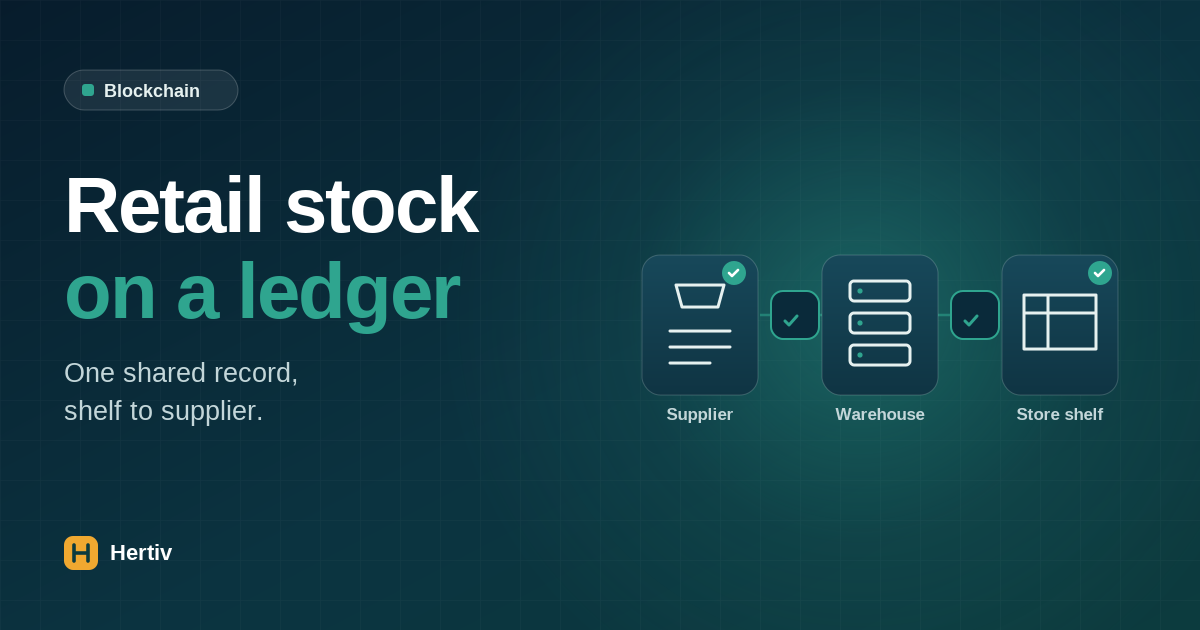
The flow has six steps, and each one ties a physical event to a ledger entry. If any step is skipped, the record stops matching the shelf, so the discipline matters more than the technology.
- Register the item. The supplier creates a record for the batch, with product, quantity and origin.
- Record the handover. When the goods change hands, both sides sign the transfer on the ledger.
- Receive at the warehouse. The warehouse scans the delivery and the ledger checks it against the shipment record.
- Move to store. Transfers between warehouse and store are recorded the same way.
- Sell or return. The point-of-sale system writes the sale, and returns link back to the original sale record.
- Reconcile. The ledger totals are compared with physical counts, and any gap is flagged for review.
Smart contracts can automate parts of this flow, such as releasing payment when a delivery is confirmed, or flagging a batch the moment a recall is issued. The contract only works if the data going in is correct, which is why scanning discipline comes first.
What does a retailer need to run it?
A retailer needs four things before a ledger helps: reliable scanning at every handover, a way to identify each batch or item, agreement from suppliers to join the network, and a system that links the ledger to the existing stock software.
Identification is usually the hardest part. A batch code works for food and clothing, but high-value goods may need serial numbers or tags so each item can be tracked on its own. The choice depends on the product: tracking every T-shirt by serial number costs more than it saves, while tracking every watch is worth it.
Supplier agreement matters just as much. A ledger with only the retailer's own entries is a database with extra steps. The value appears when suppliers and logistics partners write their own entries, so the record covers the whole journey. That takes contracts and onboarding, not just software. Most retailers start with one product line and one or two suppliers, then expand once the flow works.
Example (hypothetical): a 40-store chain counts its stock
Example (hypothetical): a clothing chain with 40 stores puts its winter jacket line on a shared ledger. Each jacket batch is registered by the supplier, scanned at the warehouse, and scanned again when it reaches each store.
In the first month the ledger records 12,000 jackets shipped, 11,940 received at the warehouse and 11,880 on store shelves. The gaps are small but visible: 60 jackets lost between supplier and warehouse, and 60 more between warehouse and stores. Before the ledger, those 120 jackets would have surfaced as a single unexplained gap at the annual count.
The chain also cuts its recall time. When a zip fault is found in one batch of 400 jackets, the ledger shows exactly which 14 stores received them, instead of the team calling every store. The fix reaches the right shelves in a day instead of a week.
What are the limits and risks?
The biggest limit is garbage in, garbage out. A ledger makes records hard to change, but it cannot check whether the worker scanned the right box. If the physical process is sloppy, the ledger faithfully records sloppy data, and the team gains a precise record of its own mistakes.
Cost is the second limit. Tagging, scanning hardware, integration work and supplier onboarding all cost money, and the payback depends on how much stock the retailer loses today. A chain that loses little to shrinkage may never recover the investment.
Privacy is the third risk. A shared ledger means suppliers and partners can see stock movements, so the retailer must decide what each party is allowed to see. Permissioned networks solve this by limiting read access, but the rules need to be set before the first entry is written, not after a partner complains.
What are the common mistakes?
The most common mistake is starting with the whole catalogue. A retailer that tries to put every product on a ledger at once drowns in onboarding and exceptions. Start with one product line where losses are known and the supplier is willing, prove the flow, then expand.
Another mistake is treating the ledger as a replacement for the stock system. The ledger is a record of movements; the stock system still handles ordering, forecasting and reporting. Teams that rip out their stock software and expect the ledger to do its job end up with neither.
A third mistake is ignoring the suppliers. If suppliers will not scan and sign, the ledger has a gap at the start of the chain, and the record is no better than the old one. Get supplier agreement in writing before building anything.
Key takeaways
- A shared ledger gives every party the same record of stock movements.
- It makes shrinkage, counterfeits and recalls easier to trace.
- The flow only works if every handover is scanned and signed.
- Start with one product line and one willing supplier.
- The ledger records what happened; it cannot fix sloppy scanning.
Frequently asked questions
Does blockchain replace a retailer's stock system?
No. The ledger records movements and proves what happened, while the stock system still handles ordering, forecasting and reporting. The two work together: the stock system plans, and the ledger provides the shared record that everyone trusts.
Which products suit blockchain inventory tracking?
Products where losses, counterfeits or recalls are costly: high-value goods, food, medicines and branded items. Cheap, fast-moving goods rarely justify per-item tracking, though batch-level tracking can still pay off for recalls.
Do suppliers have to join the network?
Yes, for the full benefit. If only the retailer writes entries, the ledger is a database with extra steps. The value appears when suppliers and logistics partners record their own handovers, so the trail covers the whole journey from origin to shelf.
How does it help with product recalls?
Each batch links back to its origin record, so the team can find exactly which stores received the affected batch. That turns a recall from days of phone calls into a lookup that takes minutes, and fewer good products get pulled by mistake.
What is the biggest risk when starting?
Bad input data. A ledger makes records hard to change, but it cannot check whether the right box was scanned. If the physical process is sloppy, the team ends up with a precise record of its own mistakes, so scanning discipline comes first.
Is a public or permissioned blockchain better for retail?
Most retailers use a permissioned network, because it limits who can read stock movements and who can write entries. A public chain exposes business data to everyone, which few retailers want, even if the data is only batch totals.


