How Blockchain Is Changing Manufacturing
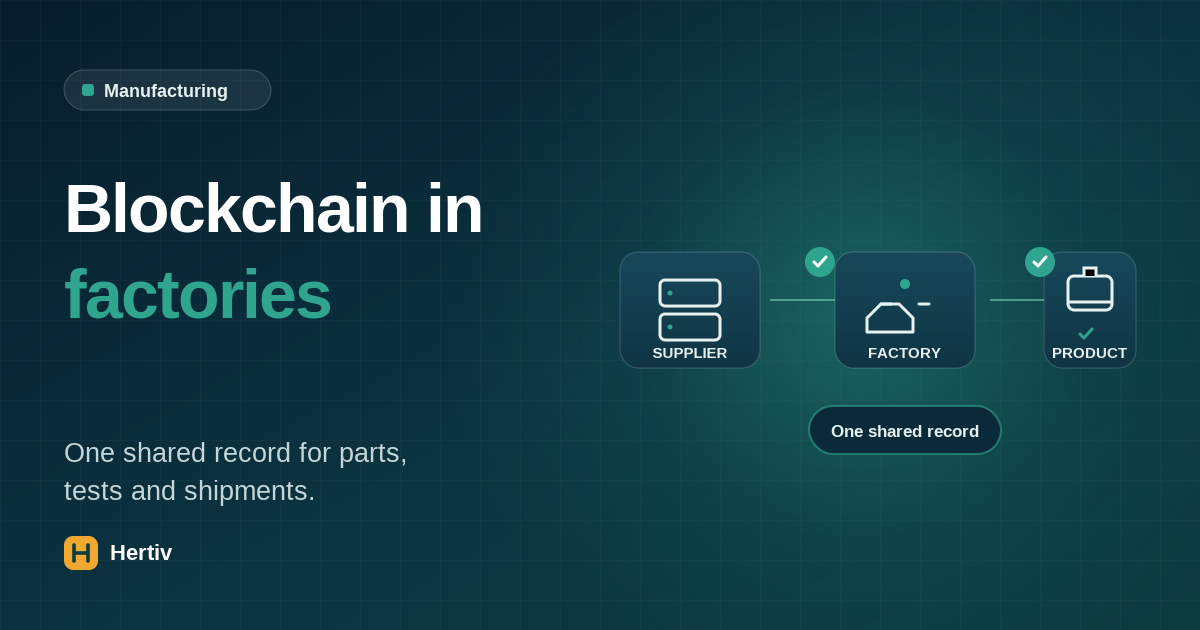
Blockchain gives factories one shared record for parts, orders and quality checks. Here is where it helps, what a first pilot looks like, and where it does not fit.
On this page
Short answer
Blockchain in manufacturing is a shared, tamper-resistant record that follows parts, materials and finished goods from supplier to customer. Each handover is written to the ledger, so every party sees the same history without phoning around for it. It helps most where several companies must trust one record, and helps least inside a single factory that already trusts its own database.
What is blockchain in manufacturing?
Blockchain in manufacturing is a shared, tamper-resistant record that follows parts, materials and finished goods from supplier to customer. Each handover, test result and shipment is written to the ledger, where every party in the chain can read the same history. The record is the point: instead of each company keeping its own version of events, all of them work from one.
The ledger does not replace factory systems. Machines, sensors and planning software still do the work on the shop floor, and the blockchain records what happened so that suppliers, makers and buyers can check it later. It is a record layer, not a production system, and it only helps when several organisations need to trust the same record.
Where does blockchain help a factory?
Blockchain helps a factory most where the record must travel between companies. Inside one factory, a normal database is faster and cheaper, because everyone already trusts the same system. The value appears at the boundary: when a part leaves one company and enters another, and both need proof of what happened.
| Use case | What the ledger records | Who gains |
|---|---|---|
| Parts traceability | Origin, batch and handover of each part | Makers, buyers and regulators |
| Quality records | Test results and inspection sign-offs | Quality teams and customers |
| Supplier payments | Delivery confirmation and payment terms | Suppliers and finance teams |
| Warranty claims | Purchase date, serial number and repairs | Customers and service teams |
| Recalls | Which batches went where | Safety teams and regulators |
| Compliance | Certificates and audit trails | Auditors and import authorities |
Traceability is the most common starting point, because a recall or a faulty batch is the moment a factory most needs a reliable history. Quality records come next, since a signed test result on a shared ledger is harder to dispute than a spreadsheet attached to an email.
How does blockchain track a part through production?
A part is tracked by writing an entry to the ledger at each step of its journey, from raw material to finished product. Each entry links to the one before it, so the history of a part can be read back from the finished product to its origin. If one entry is missing, the gap is visible to everyone.
- The supplier records the material batch and its certificate on the ledger.
- The factory scans the batch on arrival and links it to the production run.
- Each test or inspection writes its result and the name of the checker.
- The finished product gets a serial number tied to the batch history.
- The shipment is recorded with the carrier and the delivery date.
- The buyer reads the full history by scanning the serial number.
The chain works only if the data written to it is correct. A ledger cannot check whether a sensor reading is true or a certificate is genuine; it only proves that the entry was made at a certain time and has not changed since. The weakest point is always the step where the physical world becomes a digital entry.
What does a first blockchain pilot look like?
A first blockchain pilot in manufacturing is small, short and tied to one painful problem, usually tracing a single part or product line. The pilot proves that the record works before anyone spends money on a wider rollout. A pilot that tries to cover the whole supply chain at once is a pilot that never finishes.
- Pick one product line and one problem, such as tracing a faulty batch.
- List the companies that must write to the ledger and what each one records.
- Agree on the data format, so a batch means the same thing to everyone.
- Connect the existing factory systems, rather than replacing them.
- Run the pilot for one production cycle and measure the time a trace takes.
- Decide whether to extend the pilot, change it, or stop it.
A pilot of eight to twelve weeks is long enough to learn whether the record is useful, and short enough to stop if it is not. The measure that matters is time: how long it takes to answer a question about a part before and after the pilot. If that time does not fall, the ledger is not earning its place.
Example (hypothetical): tracing a faulty batch
Example (hypothetical): a maker of electric motors finds a fault in a batch of bearings and must find every motor that used them. By phone and email, each trace takes about 6 hours of staff time, and the team faces 8 traces a month. That is 48 hours a month spent on tracing alone.
With the batch history on a shared ledger, the same trace takes about 20 minutes, because the serial number leads straight to the batch and its shipments. Each trace saves 5 hours and 40 minutes, and 8 traces a month save 45 hours and 20 minutes. The saving is real only if the data on the ledger is complete, which is why the pilot starts with one product line.
The numbers also show the limit. The ledger saves time on tracing, but it does not find the fault or fix the motors. The business case rests on fewer hours spent searching, not on fewer faults. A pilot that promises both is promising more than a record can deliver.
Where does blockchain not help in manufacturing?
Blockchain does not help inside a single factory where everyone already trusts the same database. A ledger adds cost and delay to every write, and a normal database does the same job faster when only one company reads and writes the record. The same applies to machine data that changes every second: a ledger is a poor place to store it.
It also does not help when the problem is bad data rather than missing trust. If suppliers record the wrong batch or skip inspections, the ledger faithfully records the wrong information. Fix the data collection first, and add a shared record only when the data is already reliable. For the wider picture, blockchain in supply chain management covers where the same logic applies outside the factory.
What are the common mistakes?
The most common mistakes in manufacturing blockchain projects are starting with the technology instead of the problem, and trying to record everything at once.
- Starting with the chain, not the problem. A ledger without a painful question to answer is a solution looking for work.
- Recording everything. High-frequency machine data belongs in a database, not on a ledger.
- Ignoring the physical-to-digital step. A record is only as good as the scan or sensor that created it.
- Leaving suppliers out of the design. A ledger that suppliers will not use holds an empty record.
- No exit plan. A pilot should be easy to stop, and its data easy to export.
A manufacturing blockchain project succeeds when it answers one question faster than the old way did. Keep the scope small, measure the time saved, and extend the ledger only where the pilot proved its worth.
Key takeaways
- Blockchain in manufacturing is a shared record for parts, tests and shipments, not a production system
- It helps most where several companies must trust one record, such as traceability and recalls
- A ledger cannot check whether the data written to it is true; the physical-to-digital step is the weak point
- Start with one product line and one problem, and measure the time a trace takes
- Inside one factory, a normal database is usually faster and cheaper than a ledger
Frequently asked questions
What is blockchain used for in manufacturing?
It is used to keep a shared record of parts, materials, tests and shipments that suppliers, makers and buyers can all read. The most common uses are tracing parts, recording quality checks, managing recalls and proving compliance. It works best where several companies must trust the same history.
Is blockchain worth it for a small factory?
Usually not on its own. A small factory with few suppliers can trace parts with a database and good records. Blockchain earns its place when several companies share a chain and need one record they can all trust. A pilot on one product line is the cheapest way to find out.
How does blockchain help with recalls?
A recall needs a list of every product that contains a faulty batch. With the batch history on a shared ledger, that list comes from the serial numbers in minutes instead of days of phone calls. The ledger does not find the fault, but it shortens the search for affected products.
Does blockchain replace ERP or factory software?
No. Planning, machine control and stock management stay in the factory systems that already run them. The blockchain records selected events from those systems so other companies can check them. It is a record layer that sits beside existing software, not a replacement for it.
What data should not go on a manufacturing blockchain?
High-frequency machine data, such as sensor readings taken every second, belongs in a database. Personal data and trade secrets should stay out as well, since ledger entries are hard to delete. Record events, certificates and handovers, and keep the raw data where it already lives.
How long does a manufacturing blockchain pilot take?
A focused pilot on one product line usually runs eight to twelve weeks, from agreeing the data format to measuring the first traces. The measure that matters is time: how long it takes to answer a question about a part before and after the pilot. If that time does not fall, the pilot should stop.


