Blockchain in Invoice Factoring: How It Works
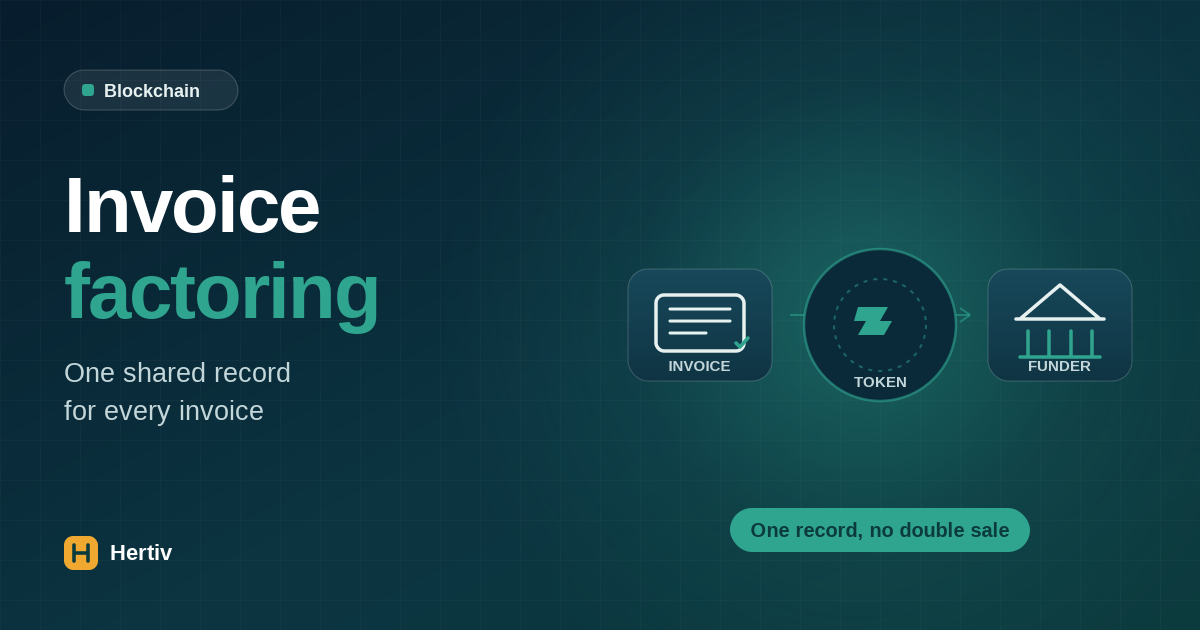
Blockchain factoring records each invoice once on a shared ledger, so funders can verify it, see it has not been sold before, and fund it faster.
On this page
Short answer
Blockchain in invoice factoring means recording each invoice once on a shared ledger, where the buyer confirms it and funders can see it has not already been sold. That shared record cuts verification from days to hours, stops double financing, and lets smart contracts split the payment when the buyer pays.
What is blockchain in invoice factoring?
Blockchain in invoice factoring is the use of a shared ledger to record invoices, verify them once, and let a business sell those invoices for early cash without the paperwork and double-checking that factoring usually needs. Factoring is the practice of selling unpaid invoices to a funder at a discount to get paid sooner.
The problem blockchain addresses is trust. A funder that buys an invoice needs to know the invoice is real, that it has not already been sold to someone else, and that the buyer will pay. Today that checking is slow and manual. A shared ledger lets every party see the same verified record.
| Step | Without blockchain | With blockchain |
|---|---|---|
| Invoice issued | PDF or paper, easy to copy | Recorded once on a shared ledger |
| Verification | Calls and emails to the buyer | Buyer confirms on the ledger |
| Duplicate check | Manual searches, still risky | Ledger shows if already sold |
| Sale to funder | Contracts and signatures | Token transfer with terms attached |
| Payment | Bank transfer, manual matching | Settlement tracked on the ledger |
| Disputes | Email chains and lost papers | One shared record to check |
Blockchain does not make a bad invoice good. It makes a good invoice easier to verify, harder to sell twice, and faster to fund.
How does invoice factoring work today?
Invoice factoring works like this: a business delivers goods or services and issues an invoice payable in 30, 60 or 90 days. Instead of waiting, it sells that invoice to a funder, usually a bank or a specialist finance firm, for most of its value up front. The funder collects the full amount from the buyer later and keeps the difference as its fee.
Small businesses use factoring because waiting 90 days for payment can break cash flow. A supplier that must pay staff and buy materials this week cannot wait three months for a large customer to pay. Factoring turns a future payment into cash now.
The friction is verification. The funder must confirm the invoice is genuine, that the goods were delivered, and that the same invoice has not been sold before. That checking takes days of calls, emails and document review, and it is where most of the cost sits.
Double financing is the risk every funder worries about. The same invoice sold to two funders leaves one of them with nothing when the buyer pays the other. How RWA tokenization works explains the same record-keeping idea for other real-world assets.
What does blockchain change?
Blockchain changes factoring by giving every party one shared record of each invoice. When a business issues an invoice, it is recorded on the ledger with its amount, due date and buyer. The buyer confirms it there, so the funder does not need to call and check.
The ledger also stops double financing. An invoice that has already been sold shows as sold to everyone on the network, so a second funder can see it before paying. This is the change funders care about most, because it removes a risk that manual checks never fully removed.
Smart contracts add the payment logic. When the buyer pays, the contract can split the money automatically: the funder gets its share, the business gets the remainder, and the record updates itself. Nobody needs to chase the payment or reconcile it by hand.
The result is faster funding at a lower cost, because the verification work shrinks. A funder that trusts the ledger can approve in hours instead of days, and smaller invoices become worth funding at all.
How does the process run in practice?
The process runs in five steps, and the business, the buyer and the funder all work from the same record.
- Issue and record. The business issues the invoice and records it on the ledger with the amount, due date and buyer details.
- Verify. The buyer confirms the goods arrived and the invoice is correct, signing that confirmation on the ledger.
- Offer and sell. The business offers the verified invoice to funders, who can see its history and bid. The sale is recorded as a token transfer with the terms attached.
- Advance. The funder pays the business most of the invoice value up front, minus its fee.
- Settle. On the due date the buyer pays, and the smart contract splits the payment between the funder and the business, closing the record.
Each step leaves a timestamped record, so a dispute can be settled by reading the ledger instead of searching email. Banks are exploring the same pattern for other assets, as tokenization in banking describes.
What are the risks and limits?
The risks of blockchain factoring are real, and they sit outside the ledger. A shared record proves an invoice exists and was confirmed, but it cannot prove the goods were good, the buyer will pay, or the business is honest.
- Buyer default. If the buyer never pays, the ledger does not help the funder recover the money. Credit checks still matter.
- Bad data in. A fake invoice confirmed by a dishonest buyer looks real on the ledger. Verification of the business and buyer still matters.
- Legal standing. In many places, the law is still catching up. A token transfer may not yet count as a legal assignment of the invoice.
- Privacy. Invoice details are commercially sensitive, so most systems use permissioned ledgers where only the parties involved can see each invoice.
- Cost and complexity. Building and running the platform costs money, and every party must agree to use it before the network is useful.
The honest test is whether the ledger saves more than it costs. For large volumes of invoices between known parties, it usually does. For one-off invoices, the old way is often cheaper.
Example (hypothetical): a supplier funds 40 invoices
Example (hypothetical): a packaging supplier issues 40 invoices a month, each worth 5,000 units, payable in 60 days. Waiting costs the supplier cash flow, so it factors the invoices at a 3% fee.
Without blockchain, verification takes about 3 days per batch, and the funder charges 3% because it carries the double-financing risk. The supplier receives 40 × 5,000 × 97% = 194,000 units, and waits 3 days for the money.
With the invoices recorded and buyer-confirmed on a shared ledger, verification takes a few hours, and the funder's risk falls enough to cut the fee to 2%. The supplier now receives 40 × 5,000 × 98% = 196,000 units, saving 2,000 units a month and getting the money 2 days sooner. The arithmetic is small per invoice, but it adds up across a year of factoring.
What are the common mistakes?
The most common blockchain factoring mistakes are trusting the ledger too far, ignoring the law, and building a network nobody joins.
- Thinking the ledger proves quality. It proves a record exists and was confirmed. It does not prove the goods were good or the buyer will pay.
- Skipping legal review. The token transfer, the assignment of the invoice and the payment split all need to hold up in court where the parties operate.
- Building for one party. A factoring network needs businesses, buyers and funders. A platform with only one side has no network effect.
- Exposing sensitive data. Invoice amounts and buyer names should only be visible to the parties involved, not to the whole network.
- Automating disputes away. A smart contract cannot settle a genuine dispute about quality or delivery. Keep a human process for exceptions.
If you are building the platform itself, blockchain development covers the ledger and contract design that factoring needs.
Key takeaways
- Factoring sells unpaid invoices for early cash; blockchain makes them verifiable.
- One shared record stops the same invoice being sold to two funders.
- Buyer confirmation on the ledger replaces days of calls and emails.
- Smart contracts split the payment automatically when the buyer pays.
- The ledger cannot prove goods were good or the buyer will pay.
- Start with one buyer and one funder on a small pilot set.
Frequently asked questions
What is invoice factoring?
Invoice factoring is selling unpaid invoices to a funder for most of their value up front, so a business gets cash now instead of waiting 30, 60 or 90 days for the buyer to pay. The funder collects the full amount later and keeps the difference as its fee.
How does blockchain help factoring?
It records each invoice once on a shared ledger, where the buyer confirms it. Funders can see the invoice is genuine and has not already been sold, which cuts verification time and removes the double-financing risk that manual checks never fully removed.
What is double financing?
Double financing is selling the same invoice to two funders, leaving one of them with nothing when the buyer pays. A shared ledger shows an invoice as sold to everyone on the network, so a second funder can spot it before paying.
Do smart contracts pay the funder automatically?
When the buyer pays, a smart contract can split the money between the funder and the business and close the record. The contract handles the split, but a genuine dispute about quality or delivery still needs a human process.
Is blockchain factoring legal?
It depends on the country. The token transfer and the assignment of the invoice need to hold up in court where the parties operate, and the law is still catching up in many places. Get legal review before launching.
Who can see the invoices on the ledger?
Most factoring systems use permissioned ledgers, so only the parties involved in an invoice can see its details. Invoice amounts and buyer names are commercially sensitive and should not be visible to the whole network.


