Blockchain in DeFi: How the Ecosystem Runs Without Banks
Blockchain gives DeFi its shared ledger, settlement and rules: smart contracts hold the logic, tokens move value, and anyone can check the state.
On this page
Short answer
Blockchain is the base layer of the DeFi ecosystem: it records who owns what, runs the smart contracts that lend, swap and pay out, and settles every trade without a bank in the middle. DeFi apps are built on top of blockchains, connected by bridges, oracles and stablecoins. Understanding the base layer explains both what DeFi can do and where it breaks.
What is blockchain in the DeFi ecosystem?
Blockchain in the DeFi ecosystem is the base layer that records ownership, runs the rules and settles trades for financial apps that operate without banks. DeFi apps are programs on top of a blockchain; the blockchain is what makes their records and payments trustworthy without a central operator.
Every DeFi action, from lending and swapping to staking and paying, ends as a transaction on a blockchain. The chain checks the rules, updates balances and keeps a public record that anyone can read. That record is what replaces the bank's ledger.
| Building block | What it does | Example in DeFi |
|---|---|---|
| Base blockchain | Records ownership and settles trades | Ethereum, Solana |
| Smart contracts | Enforce lending and swap rules | Lending pools, exchanges |
| Tokens | Represent value and votes | Governance tokens |
| Stablecoins | Give a steady unit of account | Dollar-pegged tokens |
| Oracles | Bring prices into contracts | Price feeds |
| Bridges | Move value between chains | Cross-chain transfers |
DeFi is not one chain or one app. It is many apps on many chains, linked by bridges and shared standards. The ecosystem works because the base layers agree on how value moves, even when the apps above them differ. For the basics of the apps themselves, see what DeFi is.
How do blockchains power DeFi apps?
A blockchain powers a DeFi app in three ways: it stores the state, it runs the code, and it settles the value. State is who owns what; code is the smart contract that enforces the rules; settlement is the final, shared agreement that a trade happened.
Smart contracts hold the logic that a bank used to hold: who can borrow, at what rate, against which collateral, and what happens if the collateral falls in value. The contract runs the same way for every user, and its code can be read by anyone.
Settlement is what makes DeFi different from a database. When a swap settles on-chain, both sides change at once and the result is final. There is no separate clearing step and no waiting for a bank to confirm. The chain itself is the record, as explained in what a blockchain is.
The code is public, which is both the strength and the risk. Anyone can read a contract before using it, but anyone can also study it for flaws. That is why audits matter, and why unaudited contracts are a warning sign, not a detail.
Which blockchains and layers run DeFi?
Most DeFi runs on a small number of base chains, with the largest share on Ethereum and its layer-2 networks. A base chain, or layer 1, is where final settlement happens. A layer 2 moves most activity off the base chain and settles the result back on it, which lowers fees.
Other chains run their own DeFi ecosystems with different trade-offs: faster settlement, lower fees, or different programming models. An app built for one chain does not run on another without changes, so liquidity splits across chains.
Choosing a chain is a trade-off between security, cost and reach. The most settled chains cost more per trade; cheaper chains settle faster but carry different risks. Most DeFi users end up using more than one chain.
New chains keep appearing with their own DeFi apps, but liquidity follows users, not announcements. A chain with few users has thin markets, which means larger trades move prices more. Check trading volume before trusting a new chain with real funds.
What connects DeFi apps: oracles, bridges and stablecoins
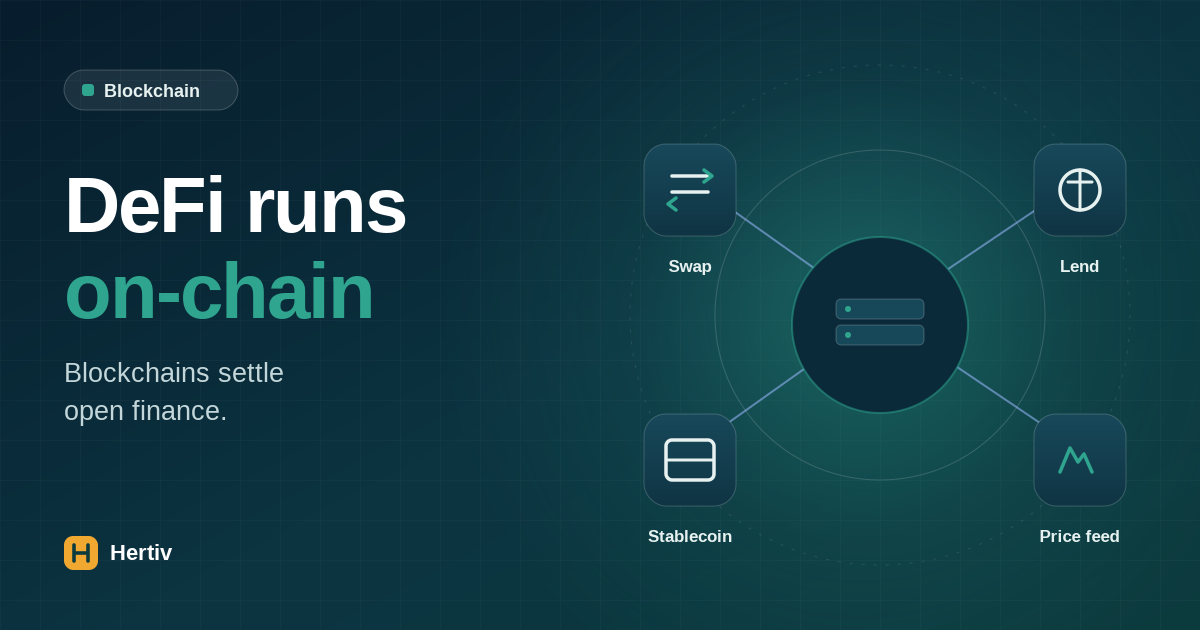
DeFi apps need three connections to the world outside their own chain: oracles bring in prices, bridges move value between chains, and stablecoins give users a unit that does not swing in price.
Oracles feed prices into smart contracts, so a lending app knows when collateral has fallen. If the price feed is wrong or slow, loans can be closed at the wrong time. The oracle is often the weakest link in a DeFi app.
Bridges lock value on one chain and release it on another, which lets a user move funds without a central exchange. Stablecoins are the common unit for all of this: most DeFi lending and trading is priced in stablecoins, not in volatile tokens. See stablecoins in DeFi for how that pricing works.
Stablecoins carry their own risk too. A stablecoin is only as steady as what backs it, and that backing sits outside the chain. If the backing is questioned, the stablecoin can lose its peg, and every app priced in it feels it at once.
How does composability work, and where does it break?
Composability means one DeFi app can use another as a building block: a lending app can take deposits from a swap app, and a yield app can stack both. This is possible because all the apps share the same chain and the same token standards.
The benefit is speed: a new app can reuse existing liquidity instead of building its own. The risk is shared too: if one building block fails, every app built on it feels it. A bug in a lending pool can drain the apps that depend on it.
The practical rule is to know what your app depends on. Before using another protocol, read its audits, check how much value it holds, and ask what happens to your users if it stops. Composability is a strength only when the dependencies are understood.
Teams that build on other protocols usually set limits: a maximum share of funds in any one dependency, and a plan for what happens if it stops. Those limits are the difference between a bad week and a lost treasury.
Example (hypothetical): moving stablecoins through two DeFi apps
Example (hypothetical): a small business holds 10,000 stablecoins from customer payments. It puts 6,000 into a lending app that pays interest, and keeps 4,000 ready for bills.
The lending app takes the 6,000, issues a receipt token, and lends the funds to borrowers who post collateral. Each week the business checks the receipt token's value: after one month it shows 6,030, which is the 6,000 plus 30 in interest.
When a large bill arrives, the business returns the receipt token and takes back its 6,000 plus the 30. The two apps never talked to each other directly; they both read the same chain. The arithmetic is simple: 6,000 in, 30 earned, 6,030 out, and the 4,000 kept aside was never at risk.
The business also checks the lending app's own health before depositing: how much it holds, whether it has been audited, and what happens if borrowers fail to repay. The 30 in interest is small next to the 6,000 at risk, so the checks matter more than the yield.
What are the common mistakes?
Most DeFi losses come from the connections between pieces, not from the base chain itself.
Another common error is ignoring the cost of moving funds. Every step on-chain has a fee, and a chain of three apps means three fees. A strategy that looks good on paper can lose money once the fees are counted.
- Assuming a chain's security covers the app built on it.
- Trusting an oracle or bridge without checking how it is run.
- Stacking apps on top of each other without mapping the dependencies.
- Treating high yields as free money instead of payment for risk.
- Leaving funds in an app whose contract nobody on the team has read.
Key takeaways
- Blockchain is DeFi's base layer: it stores ownership, runs the rules and settles trades
- Smart contracts replace the bank's rulebook, and anyone can read their code
- Oracles, bridges and stablecoins connect DeFi apps to prices, other chains and steady value
- Composability lets apps build on each other, and shares their failures too
- Check dependencies and audits before trusting an app with funds
Frequently asked questions
Is DeFi the same as blockchain?
No. Blockchain is the base layer that records and settles. DeFi is the set of financial apps built on top of it: lending, swapping, staking and payments. You can have a blockchain with no DeFi, but you cannot have DeFi without a blockchain.
Do I need a bank account to use DeFi?
No. You need a wallet and some crypto to pay transaction fees. That is also why DeFi is hard to use for people with no crypto yet: getting the first funds in usually still goes through a bank or an exchange.
What is a smart contract in DeFi?
It is code on a blockchain that holds funds and enforces rules without a human in the middle. A lending contract, for example, releases a loan only when collateral is posted, and closes the loan when the collateral falls too far.
Why do DeFi fees vary so much?
Fees follow how busy the chain is. When many people trade at once, the fee to get a transaction included rises. Layer-2 networks cut fees by doing most of the work off the base chain and settling the result back.
What is the biggest risk in DeFi?
Smart contract bugs, oracle failures and bridge hacks cause most losses. The base chain itself rarely fails, but the apps built on it do. Check audits, dependency maps and how much value an app holds before using it.
Can DeFi work without stablecoins?
Technically yes, but in practice most lending and trading is priced in stablecoins. Without a steady unit, every price moves twice: once for the asset and once for the token it is priced in.


