Blockchain for Smart Cities: Where It Helps Most
Blockchain helps smart cities where records must be shared and trusted: land registries, energy grids and identity checks — not everywhere, and not on its own.
On this page
Short answer
Blockchain helps smart cities in the places where several departments and companies must trust the same record: land registries, energy trading, identity checks and procurement. It gives each record a shared, tamper-evident history, so a department can check a fact without asking the office that created it. It does not replace city systems; it sits beside them.
What is blockchain for smart cities?
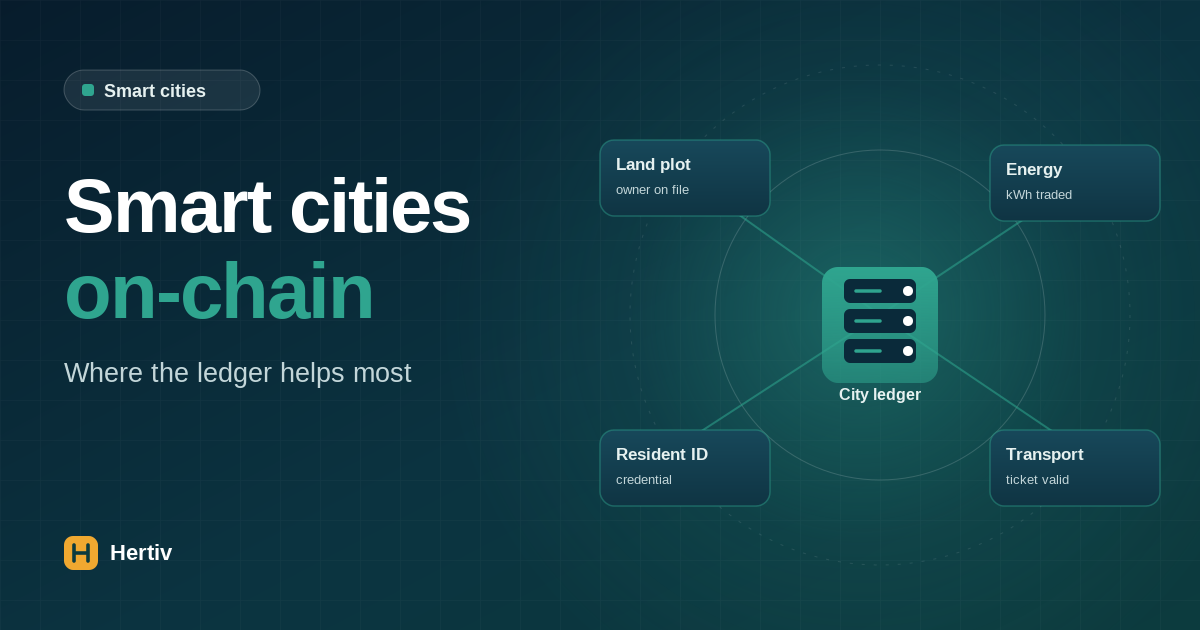
Blockchain for smart cities is the use of a shared ledger to record city facts — who owns a plot of land, how much power a building fed into the grid, whether a permit is valid — so that departments, companies and residents can check the same record instead of asking each office in turn.
The idea is simple: a city runs on records, and those records live in separate systems that do not agree with each other. A ledger gives them one place to agree, with a history that shows who recorded what and when. It works best where trust is the bottleneck, not where speed or storage is the problem.
| City area | What the ledger records | Who checks it |
|---|---|---|
| Land records | Ownership, transfers, liens | Buyers, banks, courts |
| Energy and grids | Generation, trades, credits | Utilities, prosumers, auditors |
| Identity and permits | Credentials, permit status | Departments, inspectors |
| Transport | Tickets, vehicle records, tolls | Operators, regulators |
| Procurement | Bids, contracts, deliveries | Vendors, auditors, public |
A city should start with one area, not five. Land records are the usual first pick because the pain is clear: a buyer waits weeks while offices check the same paper. The basics of the technology are covered in what blockchain is.
Land records and permits
Land records are the strongest smart-city use case because the record is the asset: a plot changes hands only when the registry says so. On a ledger, each transfer is recorded with the buyer, the seller, the price and the date, and the history is visible to the next buyer, the bank and the court.
The gain is not the ledger alone. It is that a bank can check ownership in minutes instead of sending a clerk to the registry office, and a buyer can see whether the plot has a lien before paying. Fraud falls because a second sale of the same plot shows up at once, not months later.
Permits work the same way. A building permit, once issued, can be checked by any inspector on site, and a forged permit fails the check because it is not on the ledger. The city keeps its existing approval process; the ledger only records the outcome.
Energy, grids and carbon credits
City energy grids are getting harder to manage as rooftops, batteries and electric vehicles all feed power in and out. A ledger records how much power each building generated, traded and used, so the utility, the building owner and the auditor all see the same numbers.
Peer-to-peer energy trading is the clearest example. A household with solar panels sells spare power to a neighbour, and the ledger records the trade, the price and the time. Settlement becomes automatic, and disputes fall because both sides can see the same record.
Carbon credits follow the same pattern. A credit is issued once, recorded on the ledger, and retired when it is used, which stops the same credit being sold twice. Tokenised credits are covered in how tokenization works, which explains the mechanics in more detail.
Identity, services and access
City services ask residents to prove who they are again and again: at the clinic, at the school, at the permit office. A ledger-based identity lets a resident hold a credential once — issued by the city — and show it to each service without handing over the underlying documents each time.
The key point is that the ledger holds a proof, not the personal data. The credential itself lives with the resident, and the ledger records only that it was issued and whether it is still valid. That keeps private details out of a shared system while still letting each service check the claim.
Access control works the same way for city staff and contractors. A contractor's permit to enter a site can be checked on the spot, and it stops working when the job ends. The city avoids shared passwords and paper passes, and the access record is there when an auditor asks.
How a city starts: five steps
A city should treat blockchain as one tool in a wider digital plan, not as a project on its own. The steps below keep the first pilot small and measurable.
- Pick one record with a clear pain point, such as land transfers or energy trades, and name the departments that must agree on it.
- Clean the existing records first, because the ledger will preserve whatever is recorded.
- Choose a permissioned ledger, where only approved offices can write, rather than a public chain.
- Run the pilot beside the existing system, so staff can compare the two and fall back if the pilot fails.
- Measure the result in days saved and disputes avoided, then decide whether to expand.
The pilot should have an owner, a budget and a stop date. Without those, it becomes a demo that nobody uses and nobody closes. An enterprise rollout follows the same pattern at larger scale, as covered by enterprise blockchain services.
Example (hypothetical): a mid-size city's land registry
Example (hypothetical): a mid-size city processes 12,000 land-record requests a year. Today, staff spend about 45 minutes on each request checking paper files, which adds up to 540,000 minutes, or 9,000 hours a year.
With the records on a ledger, the same check takes about 10 minutes, because the ownership history, the liens and the last transfer are all in one place. For 12,000 requests that is 120,000 minutes, or 2,000 hours a year — a saving of about 7,000 hours, which the registry office can spend on the hard cases instead.
The saving only happens if the paper records are cleaned first. In this example, the city spends three months fixing errors in the old registry before the first record goes on the ledger, and the pilot runs beside the paper system for a full year before the paper process is retired.
What are the common mistakes?
Most smart-city blockchain projects fail on governance and data, not on the technology. The ledger is the easy part; agreeing who writes to it is the hard part.
- Recording bad paper data and expecting the ledger to fix it
- Picking five use cases at once instead of one with a clear owner
- Using a public chain where a permissioned ledger fits better
- Putting personal data on the ledger instead of a proof of it
- No fallback plan, so staff cannot work when the pilot is down
- Measuring transactions recorded instead of days saved or disputes avoided
- Letting the project run without a budget, an owner or a stop date
Key takeaways
- Blockchain helps where departments must trust the same record, not everywhere in a city.
- Land records are the strongest first use case because the record is the asset.
- Clean the existing records before anything goes on the ledger.
- The ledger should hold proofs, not personal data.
- Run the pilot beside the existing system with an owner, a budget and a stop date.
- Measure days saved and disputes avoided, not transactions recorded.
Frequently asked questions
What is blockchain for smart cities?
It is the use of a shared ledger to record city facts — land ownership, energy trades, permits and procurement — so that departments, companies and residents can check the same record. The ledger gives each record a history that shows who recorded what and when, which cuts the time spent asking offices to confirm facts.
Which smart city use case works best first?
Land records usually work best first, because the pain is clear and the record is the asset. Energy trading is a strong second when a city has many rooftop solar systems. Both have a clear owner, a measurable delay today, and a small set of parties who must agree on the record.
Does a smart city need a public blockchain?
Usually not. Most city records fit a permissioned ledger, where only approved offices can write and the public can read what the city chooses to publish. A public chain makes sense only when the record must be checkable by anyone with no central authority at all.
Is personal data stored on the city ledger?
It should not be. The ledger should hold a proof that a credential was issued and whether it is still valid, while the personal data stays with the resident or in the issuing system. Putting personal details on a shared ledger creates privacy and legal problems that are hard to undo.
How long does a smart city blockchain pilot take?
A single-record pilot typically takes a few months, and most of that time goes to cleaning the existing records and agreeing who can write to the ledger. The technology setup is usually the quickest part. A pilot should run beside the existing system for a full cycle before the old process is retired.
What does blockchain for smart cities cost?
The cost depends on the ledger, the integration work and the data cleaning, and it varies too much to give a single figure. Data cleaning is often the largest cost. Get a scoped quote for one record first, and treat the pilot cost as the real price of finding out whether it works.


