Blockchain Carbon Credit Software: How It Works
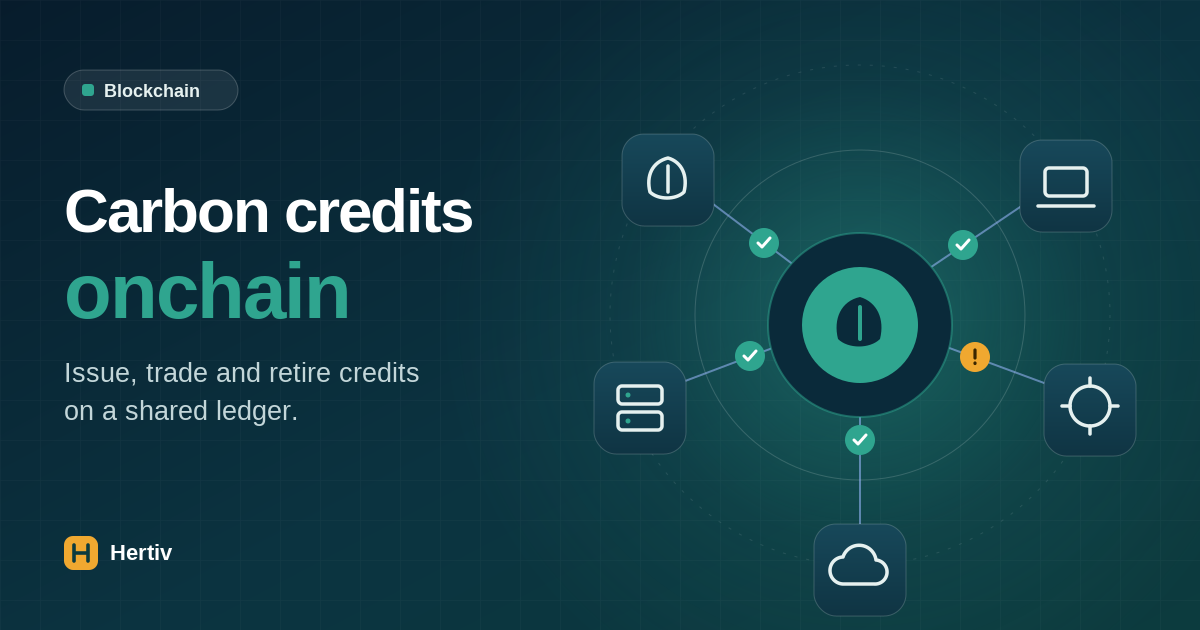
Blockchain carbon credit software records, tokenizes and retires carbon credits on a shared ledger, so buyers can check each credit and trust it was not sold twice.
On this page
Short answer
Blockchain carbon credit software is a system that records carbon credits on a shared ledger, turning each credit into a token that can be held, transferred and retired onchain. It links every credit to its project and registry record, so a buyer can check where a credit came from and confirm it has not been counted twice.
What is blockchain carbon credit software?
Blockchain carbon credit software is a system that issues, holds, transfers and retires carbon credits using a shared ledger instead of a private database. Each credit stands for one tonne of carbon dioxide removed or avoided, and the software records who holds it, where it came from and whether it has been used.
The difference from ordinary carbon credit software is the record itself. In a normal system, the operator keeps the ledger and everyone else trusts it. On a blockchain, the ledger is shared across the parties that use it, so a credit cannot be copied, edited after the fact or sold to two buyers without the record showing it.
The software usually covers four jobs: registering a project and its credits, moving credits between accounts, retiring credits when they are used against a footprint, and giving auditors a record they can check. For the general picture of what this kind of software does, see carbon credit software and how it tracks a credit through its life.
How does a credit move through the system?
A credit moves through a fixed set of states, and the software records each one on the ledger. The sequence is the same whether the credit comes from a forest project, a cookstove programme or a direct air capture plant.
| Stage | What happens | What the ledger records |
|---|---|---|
| Issued | A registry approves the project and creates the credit | Project, vintage, standard, serial number |
| Tokenized | The credit is turned into a token onchain | Token id, registry link, holder address |
| Held or traded | The token moves between buyers and sellers | Each transfer, with time and price if disclosed |
| Retired | The holder uses the credit against a footprint | Retirement claim, date, beneficiary |
Retirement is the step that matters most. A retired credit is spent: the software marks it so it cannot be transferred or retired again. That single rule is what keeps one tonne of reduction from being claimed by two companies.
What does tokenization add to a carbon credit?
Tokenization turns a registry record into a digital token that software can move, split and check automatically. A credit that exists only in a registry database needs a person to confirm each transfer. A token carries its own history, so a buyer can check it without asking the seller to prove anything.
The practical gains are threefold. First, small buyers can buy part of a large credit batch instead of a whole lot, which opens the market to smaller companies. Second, a token can be split and recombined, so a company can retire exactly the tonnes it needs. Third, the token can be checked by any party with access to the ledger, which is the part auditors care about.
Tokenization does not make a bad credit good. A token that points to a weak project is still a weak credit. The quality of the underlying project, the standard that verified it and the registry that issued it matter more than the token itself. See how tokenization works for the mechanics behind turning an asset into a token.
How does the software stop double counting?
Double counting happens when the same tonne of reduction is claimed by two parties, or counted once by a project and once by the country where it sits. Blockchain software stops the first kind by making each credit unique and each retirement final.
Three checks do the work. The token id is unique, so the same credit cannot appear twice in the system. The ledger records every transfer, so a credit sold to one buyer cannot be sold to another without the record showing it. And retirement is a one-way action recorded onchain, so a retired credit cannot be revived and sold again.
The second kind of double counting, between a project and a host country, is a policy problem, not a software problem. The software can record which claims a credit carries, but it cannot decide whether a country also counts the reduction. Buyers should ask how the project handles that question before they buy.
How do you start building or buying it?
You start by deciding which part of the chain you own: issuing credits, running a marketplace, or retiring them for your own footprint. Each choice needs different software, and buying a marketplace when you only need retirement reporting is a waste of money.
- Pick the registries first. Decide which standards and registries your credits will come from, because the software must read their records.
- Define the credit states. Agree what issued, held, traded and retired mean in your system, and who can change each state.
- Choose the ledger. A public chain gives the widest audit trail; a permissioned chain gives tighter control over who can write.
- Build the retirement flow. Make retirement a single, recorded action with a public receipt the buyer can show an auditor.
- Plan the audit trail. Decide what an auditor needs to see and make sure the software exports it without manual work.
Most teams start with one registry and one credit type, then add more. A pilot that covers a single project end to end teaches you more than a platform that tries to cover every standard at once. For the ledger side, what is blockchain explains the shared-record model the software relies on.
Example: a company retires credits onchain
Example (hypothetical): a food company measures its footprint at 2,000 tonnes of carbon dioxide a year. It cuts 500 tonnes through efficiency work, leaving 1,500 tonnes to offset. It buys 1,500 tokenized credits, one tonne each, from a cookstove project.
The credits arrive as tokens in the company wallet. Each token carries the project name, the vintage year and the registry serial number. The company checks the registry link on a sample of 50 tokens and finds every one matches.
At year end, the company retires the credits in four batches of 375, one per quarter. Each retirement is recorded onchain with the date and the claim it covers. The total is 375 times 4, which is 1,500 tonnes, matching the footprint left after the efficiency work.
The auditor checks the chain, not a spreadsheet. The ledger shows 1,500 tokens issued, 1,500 transferred to the company, and 1,500 retired, with no token retired twice. The company keeps the retirement receipts with its annual report.
What are the common mistakes?
The most common mistakes are treating the token as the credit, skipping the registry link, and building a marketplace before anyone needs one.
- Trusting the token alone. A token is only as good as the project and registry behind it. Check both before you buy.
- No registry link. If a token cannot be traced to a registry record, an auditor cannot verify it, and the credit is hard to defend.
- Retiring late or twice. Retire credits in the reporting year they cover, and record each retirement once, or the accounts will not match.
- Ignoring the host country question. Ask whether the country where the project sits also counts the reduction.
- Building too much. A simple retirement and reporting flow covers most buyers; a full marketplace can wait until trading volume justifies it.
Key takeaways
- Blockchain carbon credit software turns each credit into a token with a full history on a shared ledger
- Retirement is a one-way, recorded action, which is what stops one tonne being claimed twice
- Tokenization adds splitting, small purchases and independent checking, not project quality
- The registry link matters more than the token: no link, no verifiable credit
- Start with one registry and one credit type, and build the retirement flow first
Frequently asked questions
What is the difference between carbon credit software and blockchain carbon credit software?
Ordinary carbon credit software keeps its ledger in a private database run by the operator. Blockchain carbon credit software records the same states on a shared ledger, so transfers and retirements can be checked by buyers and auditors without asking the operator to confirm them.
Can a tokenized carbon credit be sold twice?
Not if the software is built correctly. Each token has a unique id, every transfer is recorded, and retirement is a one-way action. A credit sold to one buyer cannot be sold to another without the ledger showing the first sale.
Do I need a public blockchain for carbon credits?
No. A public chain gives the widest audit trail, while a permissioned chain gives tighter control over who can write records. The right choice depends on who needs to check the credits: the public, your auditors, or only your own team.
What should I check before buying tokenized credits?
Check the project name, the vintage year, the standard that verified it and the registry serial number, and confirm the token links to that registry record. Then check whether the host country also counts the reduction, and retire the credit in the year it covers.
Does blockchain make a carbon credit higher quality?
No. Blockchain improves the record of a credit, not the project behind it. A token that points to a weak project is still a weak credit. Project quality depends on the standard, the verification and the registry, not on the token.
How much does blockchain carbon credit software cost?
Costs vary too widely for a single figure, since they depend on whether you buy or build, which registries you connect and how much volume you handle. Ask vendors for pricing against your actual credit types and volumes, or see vendor site for current plans.


