What Makes a Binance Smart Chain Wallet Different?
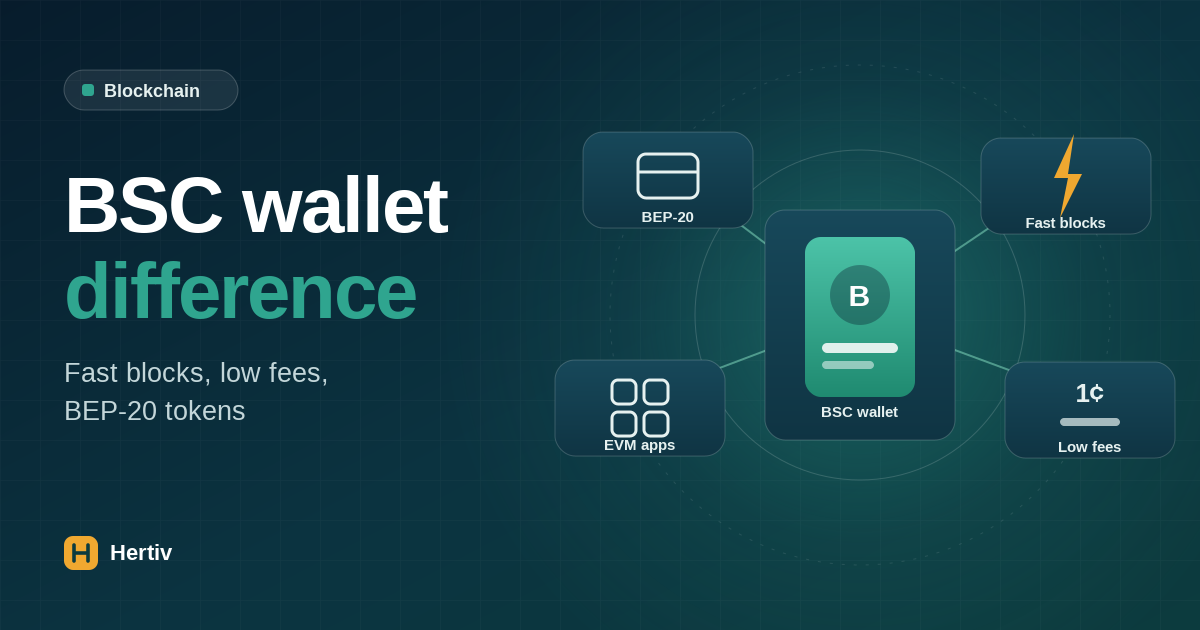
A Binance Smart Chain wallet holds BNB and BEP-20 tokens on BNB Smart Chain, an EVM-compatible network with fast blocks and low fees. Here is what sets it apart.
On this page
Short answer
A Binance Smart Chain wallet is a crypto wallet set up for BNB Smart Chain, a blockchain that runs Ethereum-style smart contracts with BNB as its gas token. It differs from an Ethereum wallet because it speaks to a network built for speed and low cost: blocks arrive about every three seconds, fees are lower than on Ethereum mainnet, and it uses the BEP-20 token standard instead of ERC-20.
What is a Binance Smart Chain wallet?
A Binance Smart Chain wallet is a crypto wallet that stores the keys for addresses on BNB Smart Chain, a blockchain that supports smart contracts and decentralised apps. The chain was launched as Binance Smart Chain and renamed BNB Smart Chain in 2022, but most wallets and apps still call it BSC. A wallet for BSC holds BNB, the chain's native token, and BEP-20 tokens, which are the BSC equivalent of Ethereum's ERC-20 tokens.
The wallet itself is usually the same app people use for other chains. MetaMask, Trust Wallet and similar wallets can add BSC as a network, so a user does not need a separate wallet. What makes it a BSC wallet is the network it is connected to and the tokens it holds, not a different piece of software.
Because BSC is compatible with the Ethereum Virtual Machine, the apps and tools built for Ethereum mostly work on BSC with little change. Developers can move a contract across, and users can use the same address format. That compatibility is the reason BSC grew quickly: it offered Ethereum-style apps without Ethereum-style fees.
A BSC wallet is used to send and receive BNB and BEP-20 tokens, swap tokens on decentralised exchanges, stake BNB, buy NFTs and use lending and gaming apps. The wallet signs each transaction, and the user pays a small fee in BNB for the network to process it.
How is it different from an Ethereum wallet?
The main differences are the network, the token standard, the gas token and the cost of using it. The wallet software is often the same, but what happens on the network is not.
| Feature | BNB Smart Chain wallet | Ethereum wallet |
|---|---|---|
| Network | BNB Smart Chain | Ethereum mainnet |
| Gas token | BNB | ETH |
| Token standard | BEP-20 | ERC-20 |
| Block time | About 3 seconds | About 12 seconds |
| Typical fee | Usually a few cents | Varies, often several dollars or more |
| Validator set | Small, permissioned set | Large, open validator set |
Speed and cost are the practical differences a user notices. A swap or a transfer on BSC usually confirms in seconds and costs a small amount of BNB, while the same action on Ethereum can cost many times more when the network is busy. That makes BSC popular for frequent, small transactions such as gaming and trading.
The trade-off is decentralisation. BSC runs on a small set of validators, which makes it fast but also means fewer independent parties secure the network. Ethereum has a far larger validator set. For a user, that is a judgement about how much they value speed and cost against the independence of the network.
Token standards also differ in name only. BEP-20 and ERC-20 tokens work the same way in practice, but a token on one chain cannot be spent on the other without a bridge, which moves value between chains and adds its own risk.
What can you do with a BSC wallet?
A BSC wallet opens up the apps built on the chain. The most common uses are trading, staking, NFTs and gaming, and most of them need only the wallet and some BNB for fees.
Trading happens on decentralised exchanges, where users swap BEP-20 tokens directly from their wallet without an account. The wallet connects to the exchange, approves the token, and signs the swap. Because fees are low, small trades that would be uneconomic on Ethereum are practical on BSC.
Staking lets BNB holders lock their tokens with a validator and earn rewards, with the details set by the network. Some users stake through a wallet, others through an exchange. Either way, the wallet is where the stake is controlled, so keeping its keys safe matters as much as the return.
NFTs and games are a large part of BSC activity. Wallets hold game items and collectibles as BEP-721 tokens, and games use the wallet to sign in and move items. A wallet that holds a valuable NFT needs the same care as one holding funds, because the item can be moved just as easily as a token.
Lending and yield apps also run on BSC. They let users deposit tokens and earn interest, or borrow against a deposit. These apps carry smart contract risk on top of market risk, so a wallet user should check what a contract does before approving it. For the basics of keeping any wallet safe, see how to secure a crypto wallet.
How do you set one up?
Setting up a BSC wallet takes a few minutes, and most of the steps are the same as for any crypto wallet. The part that needs care is the recovery phrase, which is the only way back in if the device is lost.
- Pick a wallet app. Choose a well-known wallet that supports BSC, such as MetaMask or Trust Wallet, and install it from the official store or site.
- Create a new wallet. The app generates a recovery phrase, usually 12 or 24 words. Write it down on paper and store it somewhere safe. Never store it in a screenshot, a note on the phone, or a message.
- Add the BSC network. Some wallets include BSC by default. In MetaMask, add it as a custom network with the chain's public settings, or use the wallet's built-in network list.
- Receive a small amount of BNB first. Buy or transfer a small amount and check it arrives before moving anything larger. BNB pays the fees, so a wallet with no BNB cannot send anything.
- Test a small transaction. Send a tiny amount to another address you control, or make a small swap, to confirm the wallet and the network work as expected.
- Lock the wallet down. Set a strong password or PIN, turn on biometrics if the app supports them, and keep the app updated.
The recovery phrase is the wallet. Anyone who has it can move everything in it, and nobody can recover it if it is lost. That single fact explains most wallet losses, and it is why the phrase deserves more care than any other step.
What are the risks and limits?
A BSC wallet carries the same risks as any crypto wallet, plus a few that come from the chain itself. The largest is the user: lost phrases, fake apps and phishing pages cause more losses than network faults.
Phishing is the most common attack. Fake wallet sites and fake support accounts ask for a recovery phrase or get a user to approve a malicious transaction. A real wallet app never asks for a recovery phrase after setup, and support staff never need it. If a page asks for it, it is a scam.
Token approvals are a quieter risk. When a user approves a decentralised app to spend a token, that approval can stay open indefinitely. A malicious or buggy app can then move the approved token later. Checking and revoking approvals from time to time is a simple habit that limits the damage.
On the chain side, the small validator set means the network depends on fewer parties than Ethereum, and bridges between chains have been a frequent target for attackers. Tokens that exist only on BSC also depend on the chain's own apps for liquidity, so a token that is easy to buy can still be hard to sell.
Finally, the low fees that make BSC attractive also make scams cheap to run. A new token can be created in minutes, so a wallet user should treat unknown tokens with suspicion, however convincing the website looks. Custody choices matter here too; see custodial versus non-custodial wallets before deciding how to hold larger amounts.
Example (hypothetical): moving tokens to BSC
Example (hypothetical): a user wants to trade small amounts regularly. On Ethereum, assume each swap costs $8 in fees, and the user makes 20 swaps a month, which is $160 a month in fees alone.
On BSC, assume each swap costs $0.20. The same 20 swaps cost $4 a month. The saving is $156 a month, or $1,872 over a year, before the cost of moving funds onto BSC in the first place.
Moving funds costs a bridge fee and a few minutes. Assume the bridge charges $5 and the transfer takes 10 minutes. The user pays that once, then trades cheaply for the rest of the year. The numbers are assumptions, not prices, but they show why frequent small trades favour a low-fee chain and why a single large transfer does not.
The same arithmetic can mislead in the other direction. If the user trades once a month, the saving is about $7.80 a month, which may not be worth the extra steps and bridge risk. The right chain depends on how often you transact, not on which fee is lower in isolation.
What are the common mistakes?
The most common mistakes are sending tokens to the wrong network, approving unlimited spending, and treating a low fee as a sign that a token is safe.
- Sending tokens to the wrong chain. A BEP-20 token sent to an Ethereum-only address, or the reverse, can be hard or impossible to recover. Check the network before every transfer.
- Unlimited approvals. Approving a token once can let an app spend it forever. Review approvals and revoke the ones you no longer need.
- Storing the recovery phrase online. A phrase in a cloud note, an email or a screenshot is one breach away from an empty wallet. Paper, stored offline, is still the safest option.
- Trusting new tokens on looks. A polished website and a low fee do not make a token legitimate. Check the contract, the liquidity and who controls it.
- Keeping everything in one hot wallet. Funds you do not need daily belong in a hardware wallet or a separate address, not in the wallet you connect to every app.
- Forgetting BNB for fees. A wallet full of tokens but empty of BNB cannot send anything. Keep a small BNB balance for fees at all times.
Key management is the skill that matters most with any wallet. A multi-party computation wallet splits the key so no single device holds it, which is one way teams reduce the risk of a single lost or stolen phrase.
Key takeaways
- A BSC wallet holds BNB and BEP-20 tokens on BNB Smart Chain, an EVM-compatible network
- Blocks arrive in about three seconds and fees are usually far lower than on Ethereum mainnet
- The same wallet apps work on both chains, but tokens cannot move between them without a bridge
- The trade-off for speed is a small validator set and the usual phishing and approval risks
- Keep a small BNB balance for fees and store the recovery phrase offline, on paper
Frequently asked questions
What is a Binance Smart Chain wallet?
A Binance Smart Chain wallet is a crypto wallet set up for BNB Smart Chain, a blockchain that runs Ethereum-style smart contracts with BNB as its gas token. It holds BNB and BEP-20 tokens, and it is usually the same app people use for Ethereum, connected to a different network.
Is BSC the same as BNB Smart Chain?
Yes. The chain launched as Binance Smart Chain and was renamed BNB Smart Chain in 2022. Most wallets, apps and guides still call it BSC, and the two names refer to the same network.
Can I use MetaMask for BSC?
Yes. MetaMask and other EVM-compatible wallets can add BSC as a network, either from a built-in list or as a custom network. The same address works on both Ethereum and BSC, so check which network is selected before sending anything.
Why are BSC fees lower than Ethereum fees?
BSC uses a small set of validators and short block times, which keeps throughput high and fees low. The trade-off is less decentralisation than Ethereum, which has a far larger validator set.
What is a BEP-20 token?
BEP-20 is the token standard on BNB Smart Chain, equivalent to ERC-20 on Ethereum. It defines how tokens are transferred, approved and read by apps. A BEP-20 token cannot be spent on Ethereum without a bridge.
Is a BSC wallet safe?
The wallet is as safe as its key management. The main risks are phishing, fake apps, unlimited token approvals and lost recovery phrases. A hardware wallet or a separate address for larger holdings reduces the risk of everyday use.


