Binance DEX: What It Was and What Replaced It
Binance DEX was an order-book exchange built into Binance Chain in 2019. Its order book closed in 2022 and its chain shut down in 2024. Here is what happened next.
On this page
Short answer
Binance DEX was a decentralised exchange built into Binance Chain, launched in April 2019, where users traded from their own wallets. Its order book was shut down in September 2022, and the chain it ran on, later called BNB Beacon Chain, was retired in late 2024, so trading in the BNB ecosystem now happens on automated market makers such as PancakeSwap on BNB Smart Chain.
What is Binance DEX?
Binance DEX was a decentralised exchange built into Binance Chain, the blockchain Binance launched in April 2019. Unlike most decentralised exchanges, which are smart contracts on a general chain, Binance DEX was part of the chain itself: the order book, matching and settlement all happened at the protocol level.
Users kept custody of their own funds and traded BEP-2 tokens, the token standard of Binance Chain. A trade was a transaction on the chain, matched against the on-chain order book, with no company holding user funds in between.
The exchange was designed for traders who wanted the self-custody of a decentralised exchange with the speed of a centralised one. It launched alongside Binance Chain in April 2019 and was one of the first exchanges of its kind. Traders could list new tokens quickly, which drew many small projects to it in its first year.
How did Binance DEX work?
Binance DEX worked as an on-chain order book. Traders placed limit orders, the chain matched buy and sell orders by price and time, and settlement happened in the same block, with the tokens moving directly between wallets.
Three parts made it work. First, the chain itself stored the order book, so anyone could read open orders. Second, validators matched orders as part of producing blocks, which kept matching fast. Third, users signed every order with their own keys, so no deposit was needed before trading.
Listing a token meant issuing it as a BEP-2 asset on Binance Chain. That was simpler than listing on a centralised exchange, which is why many small projects launched there. For the general idea, see what a decentralised exchange is.
Why did Binance DEX close?
Binance DEX closed because traders moved to automated market makers on BNB Smart Chain, and keeping an order book inside the chain no longer made sense. The BNB Chain community passed BEP-151, and the Gödel hard fork in September 2022 blocked new orders and new listings on the Beacon Chain exchange.
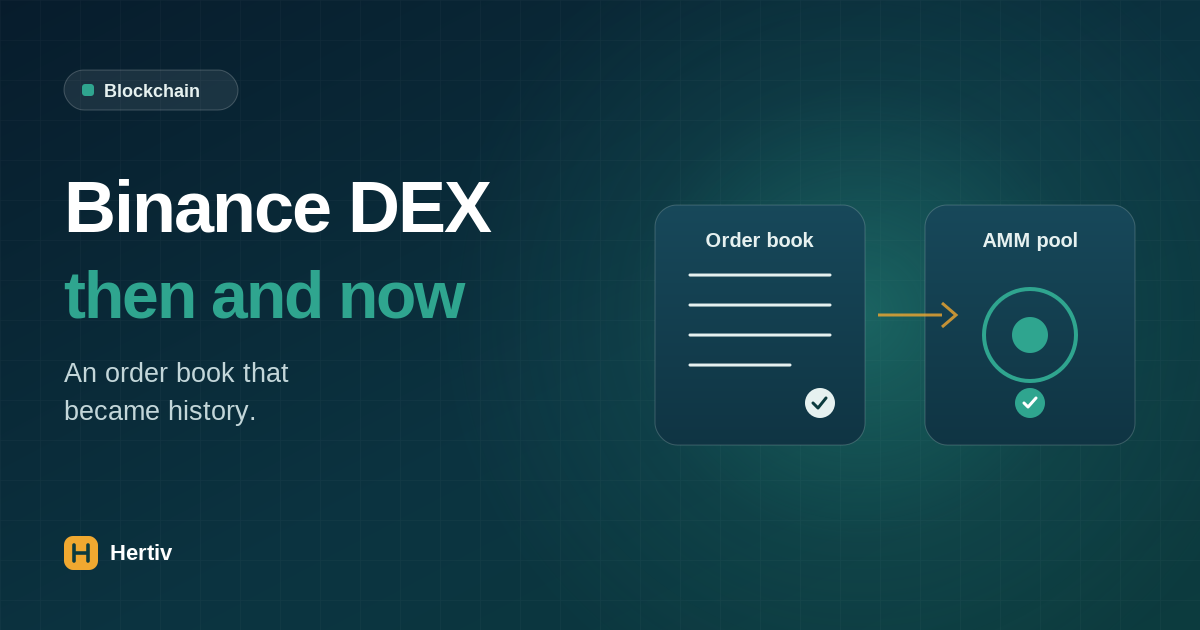
Automated market makers had changed the trade-off. On BNB Smart Chain, a liquidity pool lets anyone trade at any time without waiting for a matching order, and developers can launch a pool with a smart contract instead of asking a chain to run an exchange. Volume followed the pools, and the order book emptied.
Traders also preferred pools because a trade settles in one step against the pool, rather than waiting for another trader to take the other side of an order.
Removing the exchange also cut work for validators and nodes. Running an order book inside every block cost resources on every node, and once usage fell, that cost bought nothing. Open orders expired and funds returned to traders.
What happened to BNB Beacon Chain?
BNB Beacon Chain, the renamed Binance Chain that Binance DEX ran on, was shut down through the BC Fusion programme in late 2024. Its staking, governance and other functions moved to BNB Smart Chain, and the Beacon Chain stopped producing blocks in December 2024.
The shutdown was planned in stages. Holders were asked to move BEP-2 and BEP-8 tokens to BNB Smart Chain as BEP-20 tokens before the chain stopped, and a recovery process was published for assets that were properly bound to the new chain.
The reason was the same as for the exchange: two chains doing overlapping jobs added risk and slowed development. Merging everything onto BNB Smart Chain left one active chain instead of two. Anyone still holding old BEP-2 assets should follow the current BNB Chain recovery documentation, not old guides.
Where does Binance-chain trading happen now?
Trading in the BNB ecosystem now happens on automated market makers on BNB Smart Chain, mainly PancakeSwap, with other decentralised exchanges and aggregators alongside it. The table below shows how the old and new models compare.
| Feature | Binance DEX (2019-2022) | AMMs on BNB Smart Chain |
|---|---|---|
| Matching | On-chain order book | Liquidity pools |
| Token standard | BEP-2 | BEP-20 |
| Chain | Binance Chain | BNB Smart Chain |
| Listing | Issue a BEP-2 asset | Create a pool |
| Custody | Self-custody | Self-custody |
| Status | Closed | Active |
Self-custody stayed the same; the matching changed. A trader still holds their own keys, but the trade now runs against a pool in a smart contract instead of an order book in the chain. Aggregators sit on top of the pools and split a large trade across several of them to find a better price. Compare the two exchange models in DEX vs CEX.
Example (hypothetical): an old BEP-2 holding after the shutdown
Example (hypothetical): a user held 300 BEP-2 tokens on BNB Beacon Chain and bound them to BNB Smart Chain before the shutdown. The binding maps tokens one to one, so 300 BEP-2 tokens become 300 BEP-20 tokens on the new chain.
The user then splits the holding: 200 tokens go into a liquidity pool on PancakeSwap and 100 stay in the wallet. The arithmetic is simple, 200 plus 100 equals 300, and the point is that nothing is lost in the move itself.
What the user cannot do is trade on the old Binance DEX, because the order book no longer exists. Anyone who did not bind their tokens in time must follow the official recovery process, and should be wary of anyone offering to recover funds for a fee.
What are the common mistakes?
The most common Binance DEX mistakes today are following old guides, sending funds to retired addresses, and trusting anyone who offers to recover old BEP-2 tokens.
- Following old guides. Articles and videos from 2019 describe an exchange that no longer runs. Check the date and the current BNB Chain documentation.
- Sending to old addresses. Never send assets to an old bnb1 address from an archived guide. The Beacon Chain is retired.
- Recovery scams. Anyone offering to recover BEP-2 funds for a fee is almost certainly a scammer. Use only the official recovery process.
- Confusing the chains. BNB Smart Chain is active and EVM-compatible; BNB Beacon Chain is retired. They are not the same network.
- Assuming a DEX is a company. A decentralised exchange is software and liquidity, not a support desk. There is nobody to call when a transaction goes wrong.
If you are building a decentralised exchange today, the model to study is the AMM, not the old order book. See how to build a DEX for the current approach.
Key takeaways
- Order-book DEX built into Binance Chain in 2019
- Order book closed in September 2022
- Beacon Chain retired in late 2024
- Trading moved to AMMs on BNB Smart Chain
- Only the official process recovers old BEP-2 assets
Frequently asked questions
Is Binance DEX still running?
No. Its order book was shut down by BEP-151 at the Gödel hard fork in September 2022, and the BNB Beacon Chain it ran on was retired in late 2024. Trading in the BNB ecosystem now happens on automated market makers such as PancakeSwap on BNB Smart Chain.
What was the difference between Binance DEX and PancakeSwap?
Binance DEX was an order-book exchange built into the chain itself, while PancakeSwap is a set of smart contracts on BNB Smart Chain that trades against liquidity pools. Both are self-custody, but PancakeSwap needs no order book and anyone can create a pool.
What happened to BEP-2 tokens?
Holders were asked to bind BEP-2 tokens to BNB Smart Chain as BEP-20 tokens before the Beacon Chain shut down. Tokens that were properly bound can be recovered through the official process; tokens that were never moved may be lost.
Was Binance DEX hacked?
No. It was retired in stages because traders moved to automated market makers on BNB Smart Chain and the order book lost its users. The closure was a community decision through BEP-151, not a security incident.
Can I still trade BNB without a centralised exchange?
Yes. BNB Smart Chain hosts decentralised exchanges such as PancakeSwap, where you trade from your own wallet. You need BNB for gas and a compatible wallet, and you should test with a small amount first.
What is the difference between BNB Beacon Chain and BNB Smart Chain?
BNB Beacon Chain handled trading, staking and governance and did not run smart contracts, while BNB Smart Chain runs contracts and applications. The Beacon Chain was retired in late 2024 and its functions moved to BNB Smart Chain, which is the active chain.


