Best Stablecoins for Startups: 6 Worth Comparing
Startups use stablecoins to hold value, pay suppliers and settle across borders without crypto price swings. These six are the most widely used options to compare.
On this page
Short answer
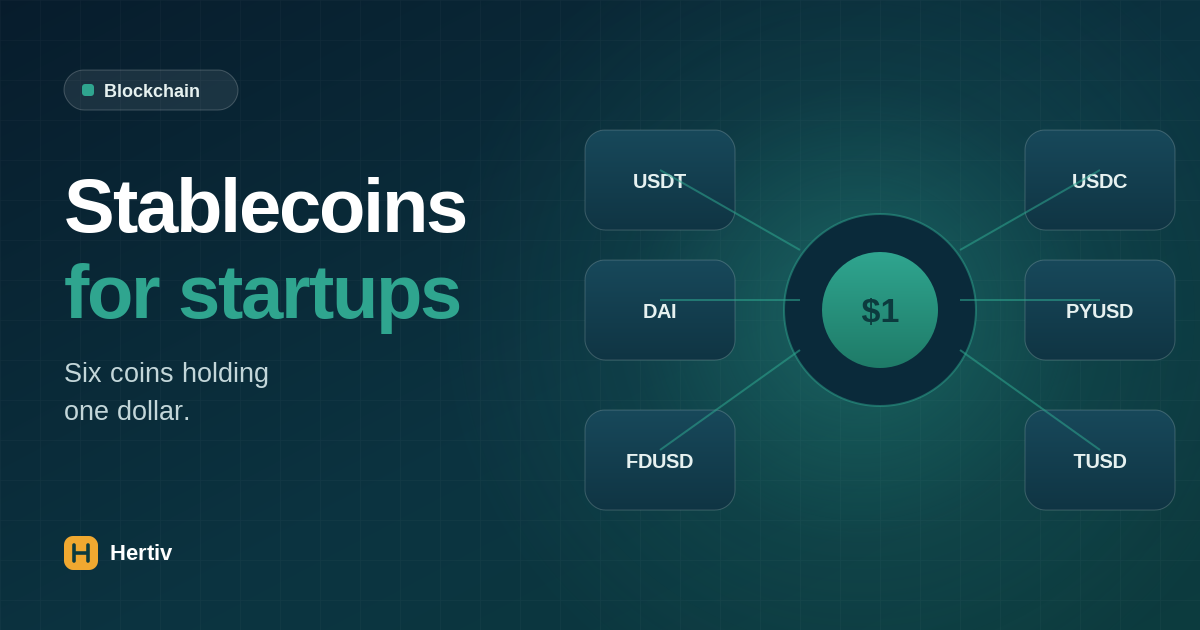
The best stablecoins for startups are USDT, USDC, DAI, PYUSD, FDUSD and TUSD, because each one is widely accepted, easy to move between exchanges and wallets, and designed to hold a steady value near one dollar. The right choice depends on where your customers pay, which chains you use and how much transparency you need about the reserves behind the coin.
Which stablecoins should startups compare?
The stablecoins worth comparing first are the ones people keep using because they solve a real problem: holding value, paying suppliers and settling across borders without crypto price swings. Each runs on a blockchain, so a payment settles in minutes rather than days, and the value stays near one dollar instead of moving with the crypto market.
Use this comparison to shortlist. Reserves, supported chains and redemption rules change over time, so check the issuer's own pages before you hold a large balance.
| Stablecoin | Backing | Best for | Issuer |
|---|---|---|---|
| USDT | Reserves and assets | Widest acceptance | Tether |
| USDC | Cash and short-term bonds | Regulated business use | Circle |
| DAI | Crypto collateral | On-chain use without a bank | MakerDAO |
| PYUSD | Cash and short-term bonds | PayPal users | PayPal |
| FDUSD | Cash and short-term bonds | Exchange trading | First Digital |
| TUSD | Cash and equivalents | Simple dollar holding | TrueUSD |
Start with one stablecoin and a small amount. Learning how wallets, approvals and fees work on a real transaction teaches more than reading about them. For the background, see what a stablecoin is.
<h3>1. USDT: best for widest acceptance</h3>
USDT, issued by Tether, is the most widely used stablecoin, accepted on almost every exchange and in many payment flows. A startup that needs to pay or receive across many platforms will find USDT supported almost everywhere, which removes the need to convert between coins.
Its strength is reach: more trading pairs and more wallets support USDT than any other stablecoin. The trade-off is transparency, since Tether's reserve reporting has drawn more questions than some rivals, so teams that need the clearest reporting often look elsewhere.
- Pros: accepted almost everywhere; deep trading liquidity.
- Cons: reserve reporting draws more questions than some rivals.
<h3>2. USDC: best for regulated business use</h3>
USDC, issued by Circle, is backed by cash and short-term government bonds and publishes regular reserve reports. It is the usual choice for startups that need clean records, clear audits and a straightforward story for their bank or their accountant.
Its strength is trust: the reserve reporting is the clearest of the large stablecoins, and it is widely supported on exchanges, wallets and payment services. The trade-off is that Circle can freeze USDC in wallets linked to sanctioned activity, which some users see as a risk.
- Pros: clearest reserve reporting; widely supported by banks and payment services.
- Cons: the issuer can freeze funds linked to sanctioned activity.
<h3>3. DAI: best for on-chain use without a bank</h3>
DAI, issued by MakerDAO, is backed by crypto collateral locked in smart contracts rather than by bank deposits. It is the main choice for teams that want a stablecoin that runs without a central issuer holding the reserves.
Its strength is independence: no single company holds the backing, and the rules are set by on-chain governance. The trade-off is complexity, since DAI's stability depends on collateral values and governance decisions, and its peg has wobbled during sharp market falls.
- Pros: no central issuer holds the reserves; transparent on-chain rules.
- Cons: stability depends on collateral and governance; the peg has wobbled in sharp falls.
<h3>4. PYUSD: best for PayPal users</h3>
PYUSD, issued by PayPal, is backed by cash and short-term bonds and is built for PayPal's own users. A startup whose customers already pay through PayPal can accept PYUSD without asking them to open a new wallet or learn a new app.
Its strength is distribution: PayPal's large user base means the coin reaches people who would never open a crypto exchange account. The trade-off is reach outside PayPal, since PYUSD is less widely supported on other exchanges and chains than USDT or USDC.
- Pros: easy for PayPal users to adopt; backed by cash and short-term bonds.
- Cons: less widely supported outside PayPal than the larger coins.
<h3>5. FDUSD: best for exchange trading</h3>
FDUSD, issued by First Digital, is backed by cash and short-term bonds and is used mainly on large exchanges, where it serves as a trading and settlement coin. A startup that trades often on one of those exchanges may find FDUSD convenient because it avoids conversion fees on that venue.
Its strength is low friction on the exchanges that support it, including fee discounts on some pairs. The trade-off is that it is less useful outside those exchanges, so a team that needs to pay suppliers or hold funds in a wallet may prefer a more widely supported coin.
- Pros: low friction and sometimes lower fees on supporting exchanges.
- Cons: less useful outside the exchanges that support it.
<h3>6. TUSD: best for simple dollar holding</h3>
TUSD, issued by TrueUSD, is backed by cash and equivalents and is designed as a simple dollar holding on chain. It suits a startup that wants a plain stablecoin for holding funds between payments, without extra features or complex rules.
Its strength is simplicity: the backing is straightforward and the coin works on several chains. The trade-off is thinner liquidity than the larger coins, so moving a large amount can take longer or cost more in slippage.
- Pros: simple backing; works on several chains.
- Cons: thinner liquidity than USDT or USDC for large moves.
How to choose a stablecoin for your startup
Choosing a stablecoin comes down to four checks, and the order matters more than the list itself.
- Check where your customers and suppliers already pay, and pick a coin they accept.
- Check which chains you use, and pick a coin that runs natively on them.
- Read the issuer's reserve reports and redemption rules before holding a large balance.
- Test with a small amount first, including a withdrawal back to your bank.
- Keep a second stablecoin ready, so one issuer's problem does not stop your payments.
For teams that plan to build their own token, see how to launch a stablecoin.
If you only need to accept payments, the stablecoin payments service page covers the setup steps.
What are the common mistakes?
The most common stablecoin mistakes are holding everything in one coin, skipping the reserve check, and ignoring the chain.
- One coin for everything. If that issuer has a problem, your payments stop.
- Skipping the reserve check. Read the issuer's reports before holding a large balance.
- Ignoring the chain. A coin on the wrong chain costs extra fees and time to move.
- Treating stablecoins as risk-free. A stablecoin can lose its peg, so keep a bank balance too.
- No withdrawal test. Test moving funds back to your bank before you need it urgently.
Key takeaways
- USDT has the widest acceptance; USDC has the clearest reserve reporting
- DAI runs without a central issuer; PYUSD suits PayPal users
- Pick a coin your customers and suppliers already accept
- Read the issuer's reserve reports before holding a large balance
- Keep a second stablecoin ready so one issuer's problem does not stop payments
Frequently asked questions
Which stablecoin is best for a startup?
There is no single best stablecoin. USDC suits teams that need clear reserve reporting, USDT suits teams that need the widest acceptance, and DAI suits teams that want no central issuer. Pick the coin your customers and suppliers already accept.
Are stablecoins safe to hold?
Stablecoins are safer than volatile crypto, but they are not risk-free. A coin can lose its peg, an issuer can freeze funds, or reserves can fall short. Read the issuer's reports, test a withdrawal, and keep a bank balance alongside any stablecoin holding.
What is the difference between USDT and USDC?
Both aim to hold one dollar, but they differ in issuer and reporting. USDT is issued by Tether and is the most widely accepted. USDC is issued by Circle, backed by cash and short-term bonds, and publishes clearer reserve reports.
Can a startup pay salaries in stablecoins?
In some places yes, but the rules vary by country and by employment contract. Check local labour and tax rules before paying staff in stablecoins, and get written agreement from each employee who is paid that way.
Do stablecoins work on every blockchain?
No. Each stablecoin runs natively on some chains and not on others, and moving a coin to another chain needs a bridge. Check that the coin you pick runs on the chains your customers and suppliers use.
How do I convert a stablecoin back to dollars?
Use an exchange or an off-ramp that supports your coin and your bank. Test the withdrawal with a small amount first, because fees, limits and processing times differ between services.


