8 Mobile Crypto Wallets Worth Comparing for Everyday Use
A good mobile crypto wallet keeps keys on your phone, opens dApps in a tap and lets you swap without a desktop. Compare eight apps on security and daily use.
On this page
Short answer
The best mobile crypto wallets for everyday use are Trust Wallet, MetaMask, Coinbase Wallet, Phantom, Exodus, Rainbow, OKX Wallet and Ledger Live. They differ in which chains they support, how keys are stored and backed up, whether swaps and dApp browsing work inside the app, and how much control you keep over your funds. Pick the one that matches the chains you use and the way you pay.
Which mobile crypto wallets should you compare?
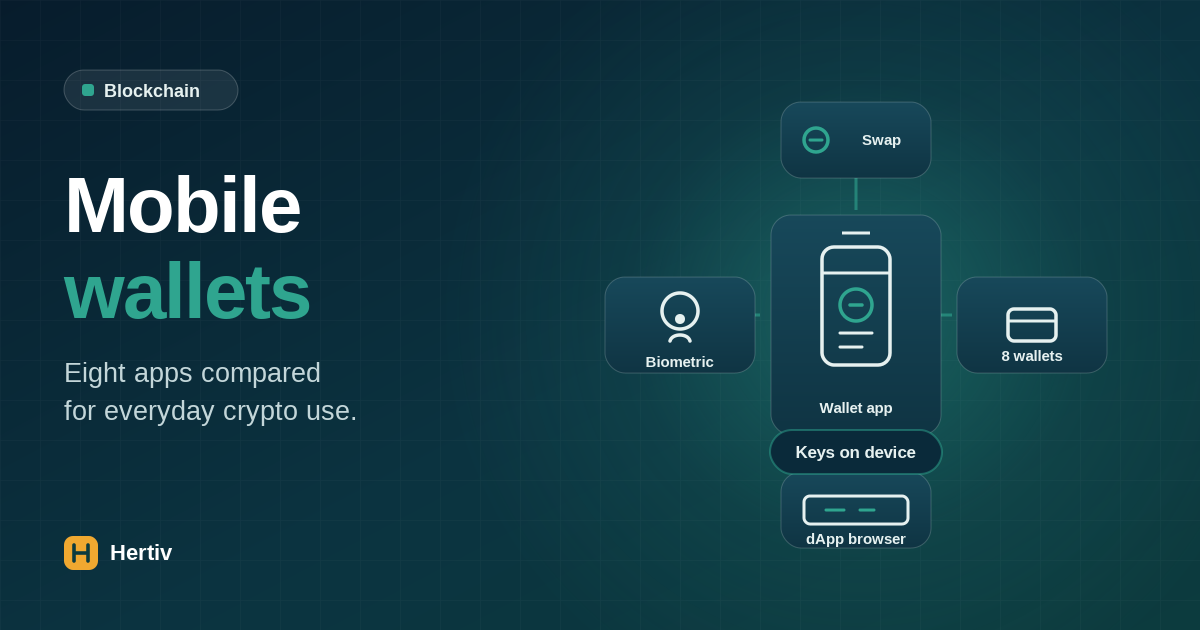
A mobile crypto wallet is an app that stores your keys on your phone and lets you send, receive, swap and use crypto apps without a desktop. The best ones keep the keys on your device, open decentralised apps inside the app, and make a swap take a few taps.
The eight wallets below all run on iOS and Android and keep you in control of your own keys, except where noted. What sets them apart is the chains they support, how they handle backup and recovery, and which everyday tasks they make easy.
If you only use one chain, a focused wallet wins; if you hold coins across several chains, a multi-chain wallet saves you from juggling apps. Start with the table, then read the two or three wallets that fit your habits. For the basics of keeping any wallet safe, read how to secure a crypto wallet.
| Wallet | Best for | Key control | Standout mobile feature |
|---|---|---|---|
| Trust Wallet | Holding many coins on one phone | Self-custody | Built-in swaps and staking |
| MetaMask | Ethereum apps on the go | Self-custody | Built-in browser for dApps |
| Coinbase Wallet | Beginners leaving an exchange | Self-custody | Simple setup and card buys |
| Phantom | Solana on your phone | Self-custody | Fast Solana swaps |
| Exodus | A simple portfolio view | Self-custody | Clear charts and swaps |
| Rainbow | Ethereum collectibles | Self-custody | Collectible gallery |
| OKX Wallet | Trading across many chains | Self-custody | Wide chain support |
| Ledger Live | Hardware wallet on mobile | Hardware device | Bluetooth pairing |
Trust Wallet and MetaMask
1. Trust Wallet: best for holding many coins on one phone
Trust Wallet is a multi-chain wallet that holds coins and tokens across many networks in one app, with built-in swaps and staking for supported assets. It was built as a mobile-first wallet, so the whole experience, from adding a token to swapping it, happens on your phone.
It suits people who hold several different coins and want one place to see them all. The wallet also connects to dApps through its built-in browser, so you can use decentralised exchanges and games without leaving the app. Backup is a seed phrase you write down once; lose it and there is no password reset. Custodial vs non-custodial wallets explains the trade-off in more detail.
Pros
- Supports many chains and tokens in one app
- Built-in swaps and staking for supported assets
- Free to download and use
Cons
- No hardware wallet pairing in the app
- Advanced features vary by chain
2. MetaMask: best for using Ethereum apps on the go
MetaMask is the most widely supported wallet for Ethereum apps, and its mobile app brings the same browser-based wallet to your phone. It opens dApps in a built-in browser, signs transactions with a tap, and works with the large set of Ethereum tools and games that already support it.
It suits people who already use Ethereum apps on desktop and want the same wallet on their phone. Adding other networks is possible by entering the network details by hand, which takes a little setup. A hardware wallet can be connected for extra security, though the flow is simpler on desktop. A hot wallet vs cold wallet comparison helps you decide how much to keep in it.
Pros
- Works with most Ethereum apps and tools
- Built-in browser for dApps
- Strong community support and guides
Cons
- Adding new networks takes manual setup
- Interface can feel busy for beginners
Coinbase Wallet and Phantom
3. Coinbase Wallet: best for beginners moving from an exchange
Coinbase Wallet is a self-custody wallet that is separate from the Coinbase exchange, so you hold your own keys while keeping a familiar interface. It supports several chains, has a built-in browser for dApps, and lets you buy crypto with a card in supported regions.
It suits people who started on an exchange and want to move to self-custody without learning a new style of app. The setup walks you through backup with a seed phrase or a cloud backup option, and the app keeps the everyday screens simple. It is not the most advanced wallet for power users, but it is one of the easiest to start with.
If you hold collectibles, the wallet also shows them alongside your coins, which is why it appears in our NFT wallet comparison.
Pros
- Easy setup for people new to self-custody
- Built-in browser and card buys
- Clear, simple interface
Cons
- Fewer advanced tools than specialist wallets
- Some features depend on your region
4. Phantom: best for Solana on your phone
Phantom started as a Solana wallet and has grown to support more chains, but Solana is still where it feels fastest. Swaps, staking and collectibles all work inside the app, and the interface stays light even when you hold many tokens.
It suits people who use Solana apps, games and collectibles every day. The app shows your tokens and collectibles in one view, and signing a transaction takes a single confirmation. Support for other chains has improved, but if most of your activity is outside Solana, a multi-chain wallet may fit better.
Pros
- Fast, clean Solana experience
- Built-in swaps and staking
- Good collectible display
Cons
- Strongest on Solana, thinner elsewhere
- Fewer fiat on-ramps than exchange wallets
Exodus and Rainbow
5. Exodus: best for a simple portfolio view
Exodus is a multi-chain wallet known for a clear portfolio screen that shows your total balance, a chart and each asset in one place. It supports many coins and tokens, has built-in swaps, and syncs between its mobile and desktop apps.
It suits people who check their portfolio often and want the numbers to be easy to read. The app keeps the design calm, with large balances and simple send and receive screens. It does not support as many chains as some rivals, and it has no hardware wallet pairing on mobile, so large holdings may belong in a hardware wallet instead.
Pros
- Clear portfolio view and charts
- Syncs with the desktop app
- Built-in swaps
Cons
- Fewer chains than the widest wallets
- No hardware wallet pairing on mobile
6. Rainbow: best for Ethereum collectibles on mobile
Rainbow is an Ethereum wallet built around a clean design, with a strong focus on collectibles and the everyday feel of the app. It shows your tokens and collectibles in a colourful gallery, supports swaps, and connects to dApps through its built-in browser.
It suits people who collect art or game items on Ethereum and want the wallet itself to feel like part of the experience. The app is easy to use and pleasant to look at, though its chain support is narrower than the multi-chain wallets. If you hold coins on many different networks, you will need a second wallet alongside it.
Pros
- Best-looking collectible gallery of the eight
- Simple swaps and dApp browser
- Easy to learn
Cons
- Focused on Ethereum, not all chains
- Smaller feature set than rivals
OKX Wallet and Ledger Live
7. OKX Wallet: best for trading across many chains
OKX Wallet is a multi-chain wallet with broad chain support, built-in swaps, a marketplace for collectibles and a browser for dApps. It is aimed at people who trade or move between chains often and want one app that covers a wide set of networks.
It suits active users who need access to many chains and trading tools from their phone. The range of features is wide, which means the app takes longer to learn than the simpler wallets on this list. If you only hold a few coins and rarely trade, the extra features will sit unused.
Pros
- Very wide chain support
- Built-in swaps, marketplace and dApp browser
- Regular new features
Cons
- Can feel complex for beginners
- Many features need an account with the exchange side
8. Ledger Live: best for pairing a hardware wallet with your phone
Ledger Live is the companion app for Ledger hardware wallets, and it turns a hardware device into a mobile wallet. Your keys stay on the device, while the phone app shows balances, lets you prepare transactions and connects over Bluetooth.
It suits people who hold larger amounts and want the keys off the phone entirely. Every transaction must be confirmed on the device itself, so even if the phone is lost or hacked, the keys stay safe. The trade-off is speed: you need the device with you, and it costs money to buy. See crypto wallet development if you want to understand how these apps are built.
Pros
- Keys stay on a hardware device
- Bluetooth pairing with your phone
- Clear portfolio view
Cons
- Needs a hardware device, which costs money
- Slower than a software-only wallet
How to choose a mobile crypto wallet
Choose a mobile crypto wallet by matching it to the chains you use, the amount you hold and how often you transact. A wallet that covers your chains and keeps backup simple will serve you better than one with features you never touch.
Work through these steps:
- List the chains you use. If everything sits on one chain, pick the wallet that does that chain best; if you hold across many, pick a multi-chain wallet.
- Decide how much to keep on your phone. Small everyday amounts are fine in a software wallet; larger holdings belong in a hardware wallet.
- Test the backup flow. Write down the seed phrase, store it offline, and check that recovery works before you send real funds.
- Check the features you need. Swaps, staking, a dApp browser and collectible display are not in every wallet, so confirm yours are there.
- Try a small amount first. Send a tiny test amount, use the wallet for a week, and only then move the rest.
One more check matters: confirm the app you download is the real one. Fake wallet apps appear in app stores from time to time, so download from the vendor's own site or a link you trust, and check the developer name before you install.
What are the common mistakes?
The most common mobile wallet mistakes are skipping the backup, keeping too much on one phone, and trusting every app that asks for a signature. Each one is easy to avoid once you know it.
- Skipping the seed phrase backup. If the phone is lost and the phrase is gone, the funds are gone too. Write it down on paper and store it somewhere safe.
- Keeping life savings in a hot wallet. A phone wallet is for everyday amounts. Move larger holdings to a hardware wallet.
- Signing transactions without reading them. A dApp can ask you to approve a spend you did not expect. Read the amount and the address every time.
- Storing the seed phrase in a photo or cloud note. Anything synced online can be stolen. Keep it offline.
- Downloading a fake app. Check the developer name and download link before you install any wallet.
If you already use a wallet and want to move to a new one, do it with a test amount first. Importing a seed phrase into a second wallet is normal, but a mistyped phrase creates an empty wallet, so confirm the balance appears before you delete the old app. How multi-chain wallets work explains what happens under the hood.
Key takeaways
- A mobile wallet should keep keys on your device and backup simple
- Match the wallet to the chains you actually use, not the longest feature list
- Test with a small amount before moving your full balance
- Keep large holdings on a hardware wallet, not on your phone
- Read every transaction before you sign it
Frequently asked questions
What is the safest mobile crypto wallet?
No single wallet is safest for everyone. A hardware-paired wallet such as Ledger Live keeps keys off the phone, which is the strongest setup for large amounts. For everyday amounts, any well-known self-custody wallet with a backed-up seed phrase and a phone lock is a sound choice.
Are mobile crypto wallets free?
The apps on this list are free to download and use. You still pay network fees when you send or swap crypto, and those fees go to the network, not the wallet. Some wallets add a small service fee on swaps, so check the quote before you confirm.
Can I use the same wallet on two phones?
Yes. You can restore the same wallet on a second phone with your seed phrase, and both phones will show the same balance. Keep in mind that each copy is a new place your keys exist, so only restore on a device you control.
Do mobile wallets support Bitcoin?
Most multi-chain mobile wallets support Bitcoin alongside other coins, including Trust Wallet, Exodus, Coinbase Wallet and OKX Wallet. Wallets built for one chain, such as Phantom, focus on their own network, so check the coin list before you choose.
What happens if I lose my phone?
If you backed up your seed phrase, you can restore the wallet on a new phone and your funds will still be there, because the funds live on the chain, not the phone. If you never wrote the phrase down, the funds cannot be recovered.
Should I keep my seed phrase in a password manager?
A password manager is better than a plain note, but a paper copy stored offline is still the safest option for most people. Whatever you choose, never share the phrase with anyone, and no support team will ever ask for it.


