How to Build a Multi-Chain Crypto Wallet
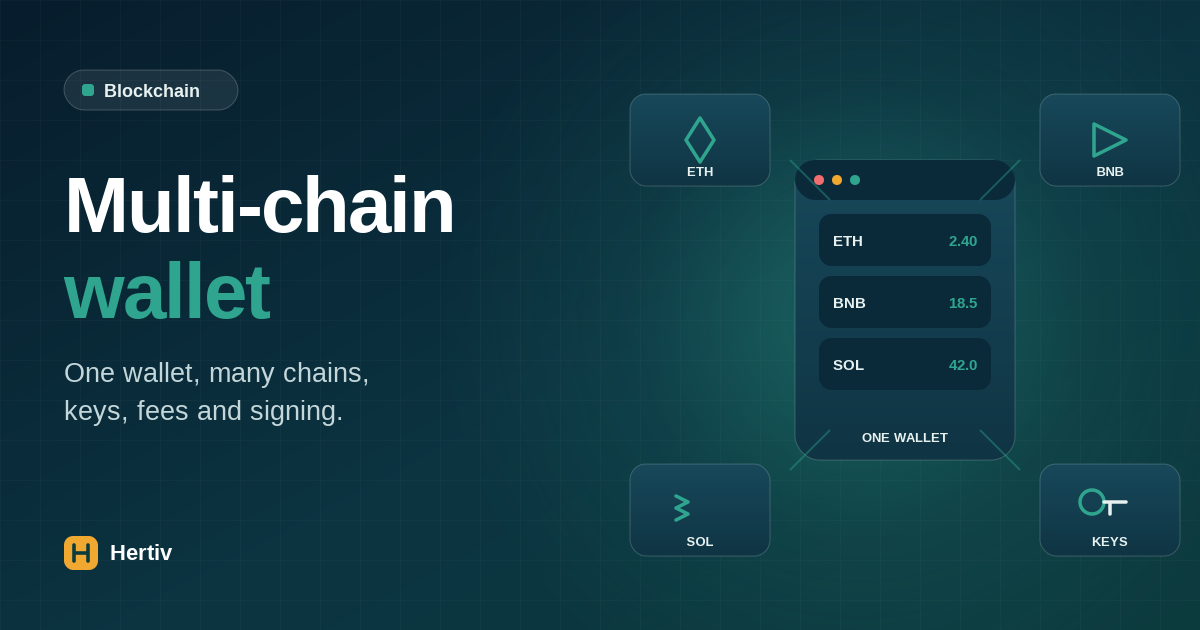
A multi-chain crypto wallet holds assets on several blockchains in one app, with one recovery phrase, separate signing rules per chain and a clear fee per network.
On this page
Short answer
A multi-chain crypto wallet is a wallet app that lets one user hold, send and receive assets on several blockchains, such as Ethereum, BNB Chain and Solana, from a single interface. It uses one recovery phrase to create addresses on each chain, and it signs each transaction with the rules of the chain it belongs to.
What is a multi-chain crypto wallet?
A multi-chain crypto wallet is a wallet that works on more than one blockchain. A user opens one app, sees balances on several networks, and can send tokens on any of them without switching to a different wallet for each chain.
Most wallets start on one chain. A multi-chain wallet adds more chains by generating a separate address for each one from the same recovery phrase. The phrase is a set of words that can rebuild all the addresses, so the user only has to back up one phrase, not one per chain. The addresses look different on each chain, but they all come from the same secret.
Each chain has its own rules. Ethereum and BNB Chain use the same address format, while Solana and Bitcoin use different ones. Fees are paid in different tokens, confirmation times differ, and some chains need extra steps, such as renting an account on Solana or paying for storage. A multi-chain wallet has to hide this complexity without hiding the cost or the risk.
This guide covers building one from scratch or from a white-label base. For the wider comparison of chain models, see multi-chain versus cross-chain.
How does a multi-chain wallet work?
A multi-chain wallet has four parts that work together: key management, chain connections, transaction building and the user interface. Each part must handle every chain the wallet supports.
| Part | What it does | Multi-chain challenge |
|---|---|---|
| Key management | Creates addresses from one phrase | Different address formats per chain |
| Chain connections | Reads balances and sends data | A node or API for each chain |
| Transaction building | Builds and signs transfers | Different signing rules per chain |
| Fee display | Shows the cost before sending | Fees in different tokens and units |
| Token lists | Shows which tokens exist | Same symbol, different contracts |
Key management is the most sensitive part. The recovery phrase never leaves the user's device, and each chain's address is derived from it with a path that follows that chain's standard. If the derivation path is wrong, the wallet shows an empty address and the user thinks their funds are lost.
Chain connections are usually handled through node providers, one per chain, rather than running a node for each network. The wallet asks the provider for the balance, the fee estimate and the transaction status. If a provider is down, that chain looks broken even though the chain itself is fine, so a fallback provider is worth having for the chains that matter most.
Which chains should the first version support?
Picking chains is a product decision, not a technical one. Every chain you add brings new signing rules, new fee logic, new token lists and new testing, so a first version should support two or three chains well rather than ten chains badly.
| Chain | Why teams start here | Extra work to expect |
|---|---|---|
| Ethereum | Largest token and app ecosystem | Higher fees, gas estimation |
| BNB Chain | Same address format as Ethereum | Different token contracts to track |
| Solana | Fast and cheap transfers | New address format and account model |
| Polygon | Same address format as Ethereum | Bridge and token list upkeep |
| Bitcoin | Largest holder base | UTXO model, no smart contracts |
A good first set is Ethereum, BNB Chain and Solana. The first two share an address format, so the key code is written once, and Solana adds a genuinely different model that tests whether your design can handle more than one address style. Bitcoin is worth adding later, because its unspent-output model is different again and takes real work to get right.
Ask your target users which chains they actually hold assets on before you choose. A wallet that supports the three chains your users hold is better than one that supports ten chains nobody uses. The cost of each chain is mostly the same, so the decision is about focus, not budget.
How to develop a multi-chain crypto wallet in 7 steps
Developing a multi-chain crypto wallet takes a small team about three months for a first version with two or three chains. The steps below assume you build a non-custodial wallet, where the user holds their own keys.
- Define the scope. List the chains, the token types and the actions for the first version: send, receive, view balances and connect to apps. Write down what is out of scope, such as swaps and staking, so the team does not drift.
- Build key management first. Generate the recovery phrase on the device, derive addresses for each chain, and encrypt the phrase with a password or device lock. Test recovery from the phrase on a clean device before building anything else.
- Connect one chain end to end. Pick Ethereum, connect to a node provider, show a balance, build a transfer, sign it and send it on a test network. Get this right before adding a second chain.
- Add the second and third chains. Reuse the key and signing code where the address format matches, and write separate signing code where it does not. Each chain gets its own fee estimate and confirmation handling.
- Build the token lists. For each chain, keep a list of known tokens with their contract addresses and symbols, and a way to add a token by contract address. Warn the user when two tokens share a symbol.
- Add safety checks. Show the full destination address, the network name and the fee in both the native token and the user's currency before signing. Block sending to an address on the wrong network.
- Test on test networks, then audit. Run every flow on each chain's test network, test recovery from the phrase, and have the signing and key code reviewed by an independent auditor before launch.
Security is the part that cannot be rushed. A wallet that loses keys loses user funds, and no feature set makes up for that. The guidance in how to secure a crypto wallet covers the protections users should expect.
How to handle fees and signing across chains
Fees and signing are where multi-chain wallets most often confuse users. Each chain charges fees in its own token, and the amount changes with network demand, so the wallet must show the cost clearly before the user confirms.
On Ethereum and BNB Chain, the fee is gas: the user pays a price per unit of work, and the wallet estimates it from recent blocks. On Solana, the fee is small and mostly fixed, but the user also needs a small rent deposit for new token accounts.
On Bitcoin, the fee depends on the size of the transaction in bytes, not its value. A wallet that shows one fee style for all chains will mislead users on at least one of them.
Signing also differs. Ethereum-style chains sign a transaction with the user's private key and a chain identifier that stops the signed transaction being replayed on another chain. Solana signs with a different method and needs the recent block hash included. The wallet must keep these rules separate, because a signature built for one chain is invalid on another.
Two rules keep this safe. First, always show the network name next to the fee and the destination address, so the user can see which chain they are on. Second, never let the user send a token to an address format that belongs to another chain. A wrong-network send is one of the most common ways users lose funds, and it is preventable.
Example (hypothetical): a small team builds a 3-chain wallet
Example (hypothetical): a team of four builds a first version of a multi-chain wallet for Ethereum, BNB Chain and Solana. The plan is 12 weeks, which is three months, and each person costs $8,000 a month including tools and overheads.
The cost of the build is 4 people times 3 months times $8,000, which is $96,000. The team spends the first four weeks on key management and the Ethereum flow, the next four weeks adding BNB Chain and Solana, and the last four weeks on token lists, safety checks and testing.
A security audit is booked for week 11 and costs $20,000, which brings the total to $116,000. The audit finds two issues: the wallet does not warn when a token symbol is shared by two contracts, and the Solana fee display does not include the rent deposit for new token accounts. Both are fixed before launch.
In the first month after launch, 2,000 users install the wallet and 400 of them make at least one transfer. That is 20% of installs, which the team treats as a healthy start. Support gets 30 tickets about wrong-network sends, and the team adds a bigger network warning in the next release.
What are the common mistakes?
The most common mistakes in multi-chain wallets are wrong derivation paths, hidden fees, weak recovery testing and treating all chains as if they worked the same way.
- Wrong derivation paths. If the address path does not follow the chain's standard, the wallet shows an empty address and users think their funds are gone.
- Hidden or wrong fees. Showing an Ethereum gas estimate on a Solana transfer, or omitting rent deposits, makes users overpay or fail to send.
- Untested recovery. If recovery from the phrase has never been tested on a clean device, a bug may only appear when a user has already lost their phone.
- Same symbol, different token. Two tokens can share a symbol on different chains or contracts. Always show the contract address and the network.
- No wrong-network block. Letting a user paste a Solana address into an Ethereum send is a preventable loss.
- Adding chains too fast. Each new chain needs signing, fees, token lists and testing. A half-finished chain is worse than a missing one.
Wallet custody is a separate decision from chain support. The comparison in what crypto custody covers sets out when a user should hold their own keys and when a custodian makes more sense.
Key takeaways
- One recovery phrase can create addresses on several chains, but each chain has its own address format
- Every added chain brings new signing rules, fee logic, token lists and testing
- Start with two or three chains and get key management and recovery right first
- Show the network name, the full address and the real fee before every signature
- Block wrong-network sends and warn when two tokens share a symbol
Frequently asked questions
Do I need a separate wallet for each blockchain?
No. A multi-chain wallet creates an address for each chain from one recovery phrase, so you can hold Ethereum, BNB Chain and Solana assets in one app. You still need the native token of each chain to pay its fees, and each chain keeps its own balance.
Is a multi-chain wallet less safe than a single-chain wallet?
It can be, because each added chain is more code and more signing rules to get right. The risk is managed by testing recovery on every chain, auditing the signing code, and keeping keys on the device. A well-tested multi-chain wallet is safer than a single-chain wallet that was never audited.
What happens if I send tokens to the wrong network?
The tokens usually go to an address that nobody controls on that network, and they are very hard to recover. Good wallets block this by checking the address format against the selected network and showing the network name before you confirm.
Can a multi-chain wallet hold Bitcoin as well?
Yes, but Bitcoin uses an unspent-output model that is different from the account model used by Ethereum and Solana, so it takes extra work to support. Many teams add Bitcoin after the first version, once the account-based chains are stable.
Who holds the keys in a multi-chain wallet?
In a non-custodial wallet, you hold the keys on your device and the recovery phrase is the only backup. In a custodial wallet, a company holds the keys for you. The multi-chain design works for both, but the security duties are very different.
How much does it cost to build a multi-chain wallet?
A first version with two or three chains takes a small team about three months, and the cost depends on team rates and the audit. Adding each further chain adds signing, fee and token-list work, so budget per chain rather than assuming later chains are free.


