Backend Frameworks for Startups: 6 Worth a Shortlist
Django, Express.js, FastAPI, Laravel, NestJS and Rails each suit a different kind of startup. Here is what each one is best for, and how to choose between them.
On this page
Short answer
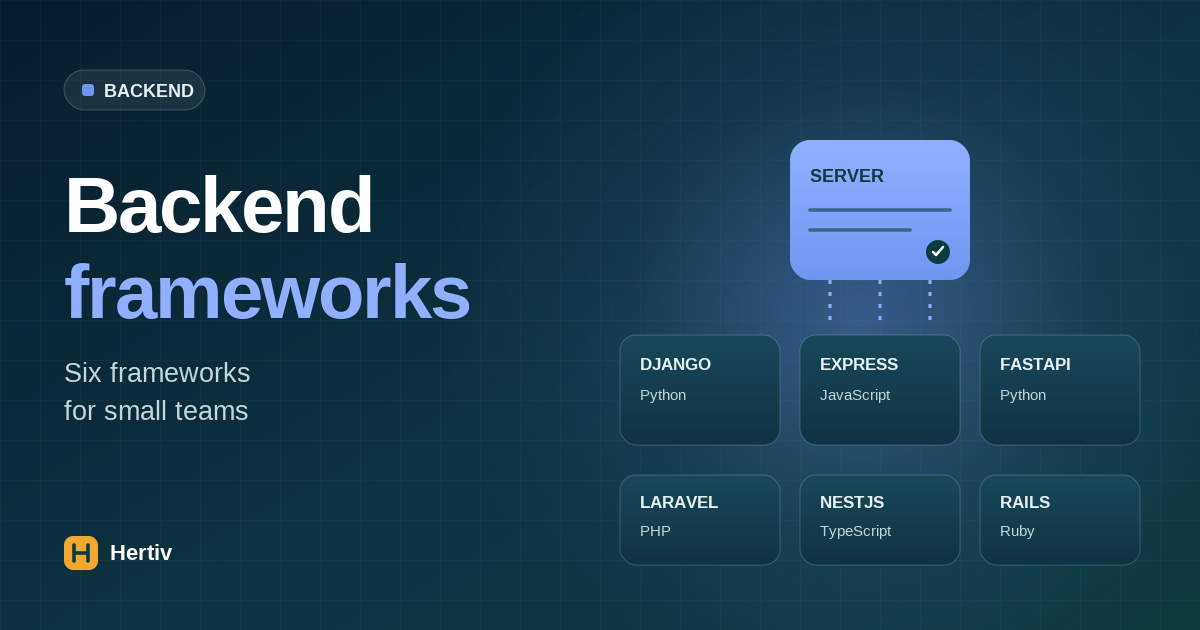
A backend framework gives a startup routing, database access, authentication and background jobs in one package. Django, Express.js, FastAPI, Laravel, NestJS and Ruby on Rails are six proven choices, and the right one depends on the team's skills, the product's shape and who the startup can hire.
Backend frameworks for startups at a glance
A backend framework gives a startup the parts every product needs: routing, database access, authentication and a way to run background jobs. The right one lets a small team ship fast without painting itself into a corner.
| Framework | Language | Best for | Learning curve |
|---|---|---|---|
| Django | Python | Data-heavy products | Moderate |
| Express.js | JavaScript | Small APIs, fast starts | Gentle |
| FastAPI | Python | Typed APIs, AI services | Gentle |
| Laravel | PHP | Full-featured web apps | Moderate |
| NestJS | TypeScript | Structured team projects | Steeper |
| Ruby on Rails | Ruby | Rapid product building | Moderate |
No framework on this list is a bad choice on its own. The differences show up in hiring, in how much the framework decides for you, and in how the codebase holds up when the team grows from two developers to ten.
Django
1. Django: best for data-heavy products
Django is a Python framework that ships with an admin panel, an ORM, authentication and migrations built in. A startup can have a working product with user accounts and a database in days, because the framework has already made most of the routine decisions.
It suits products where the data model is the heart of the product: dashboards, marketplaces, content tools and internal systems. The admin panel alone saves weeks, since staff can manage records without a custom interface.
Pros
- Admin panel, auth and ORM included out of the box
- Strong ecosystem of well-kept packages
- Clear structure that new hires learn quickly
Cons
- Can feel heavy for a tiny API with few endpoints
- Its opinions are hard to work around when you disagree
- Real-time features need extra tooling
Express.js
2. Express.js: best for small APIs and fast starts
Express.js is a minimal JavaScript framework for Node.js that gives a team routing and middleware and leaves the rest to them. A developer can have an API answering requests within an hour, which is why it is a common first choice for a prototype.
Its strength is also its risk: because it decides so little, two Express projects can look nothing alike. A startup that grows fast needs discipline about structure, or the codebase becomes hard for new developers to follow.
Pros
- Very fast to start, with a huge package ecosystem
- Same language as the frontend, so the team shares skills
- Easy to add exactly the pieces you need
Cons
- Little structure by default, so teams must set their own rules
- Auth, validation and database tools are all separate choices
- Callback-heavy code can get messy without care
FastAPI
3. FastAPI: best for typed APIs and AI services
FastAPI is a Python framework for building APIs with type hints, automatic documentation and built-in validation. A developer writes a function with typed inputs, and the framework generates the docs and checks the data before the function ever runs.
It is a strong fit for startups that serve AI features, because the API layer around a model is usually small and needs to be correct. The automatic docs also help frontend developers and partners integrate without asking questions.
Pros
- Automatic API docs and request validation from type hints
- Fast to write and easy to test
- Good fit for model-serving and data APIs
Cons
- Smaller ecosystem than Django for full web apps
- No built-in admin panel or auth system
- Async code adds a learning step for new developers
Laravel
4. Laravel: best for full-featured web apps
Laravel is a PHP framework that ships with routing, an ORM, queues, scheduled jobs, mail and a templating system. It aims to cover the whole web app, so a small team rarely needs to reach for extra packages.
It suits startups building a complete product with a server-rendered frontend and a set of background jobs, such as sending invoices or processing uploads. The documentation is thorough, and the community is large and active.
Pros
- Most web app needs covered in one framework
- Clear docs and a large community
- Queues, jobs and scheduling built in
Cons
- PHP hiring pools are smaller in some markets
- Heavier than a minimal API framework
- Upgrades between major versions need care
NestJS
5. NestJS: best for structured team projects
NestJS is a TypeScript framework that brings a modular, opinionated structure to Node.js, with controllers, services and dependency injection. It is built for teams that want the codebase to stay organised as it grows.
It fits startups that already use TypeScript on the frontend and expect the backend to grow into many modules. The structure makes it clear where new code belongs, which helps when several developers work on the same service.
Pros
- Strong structure that scales with the team
- TypeScript throughout, shared with the frontend
- Good support for testing and modular design
Cons
- More to learn before the first endpoint ships
- Can feel overbuilt for a tiny API
- Smaller hiring pool than Express or Django
Ruby on Rails
6. Ruby on Rails: best for rapid product building
Ruby on Rails is a framework built around convention over configuration: it makes the routine decisions so the team can focus on the product. Scaffolding, migrations, mailers and background jobs are all part of the package.
It has a long record of taking startups from idea to paying users quickly, and it still suits products where speed of building matters more than raw throughput. The community has kept it current with modern frontend options.
Pros
- Very fast path from idea to working product
- Strong conventions keep the codebase consistent
- Mature ecosystem of gems for common needs
Cons
- Ruby hiring pools are smaller than Python or JavaScript
- Performance tuning takes more work at large scale
- Convention can fight you when the product is unusual
How to choose
You choose a backend framework by matching it to your team, your product and your hiring plans, not by chasing the newest option.
- Start from the team. The language your developers already know well beats a better framework they must learn.
- Check the hiring market. A framework nobody nearby knows will slow every future hire.
- Match the product shape. Data-heavy products suit Django or Rails; small APIs suit Express or FastAPI.
- Test the boring parts. Build auth, a database migration and a background job in each candidate before deciding.
- Plan the exit. Pick a framework whose parts can be replaced one at a time as the product grows.
For the other side of the stack, the earlier post on frontend frameworks for startups covers the same decision for the user interface.
If the product will grow into several services, the microservices explainer shows how backends are split apart later.
Custom software development teams can help when the choice needs to fit a larger plan.
Common mistakes
The most common mistakes with backend frameworks are choosing for fashion, ignoring hiring, and letting the codebase drift without rules.
- Chasing the newest framework. A young framework may lack the packages and answers a startup needs.
- Ignoring who you can hire. A great framework is a poor choice if no local developers know it.
- No structure in a minimal framework. Express without agreed rules becomes hard to read within months.
- Overbuilding early. A service mesh and ten microservices are the wrong answer for a first product.
- Skipping the boring test. Auth, migrations and jobs matter more than a fast demo endpoint.
Key takeaways
- The team's existing language skills matter more than the framework's feature list
- Django and Rails ship the most built-in parts; Express and FastAPI stay minimal
- FastAPI suits typed APIs and AI services; NestJS suits structured team projects
- Test auth, migrations and a background job in each candidate before deciding
- A framework that can be replaced piece by piece is safer than one that locks you in
Frequently asked questions
Should a startup use one framework for everything?
Usually yes at first. One framework for the API, admin and background jobs keeps the team small and the codebase consistent. Splitting into services makes sense later, when one part of the product clearly needs to scale on its own.
Is it a mistake to build a backend in JavaScript?
No. JavaScript backends share language and skills with the frontend, which helps small teams. The risk is not the language but the lack of structure, so Express projects need agreed rules about folders, validation and error handling.
How important is performance when choosing a framework?
Less important than most teams think at the start. A startup's first bottleneck is usually the database or a slow query, not the framework. Choose for developer speed and hiring, and optimise the slow parts when real traffic shows where they are.
Can a startup switch frameworks later?
Yes, but it costs time. The usual path is to replace one part at a time, for example moving the API to a new framework while the admin panel stays put. A clean boundary between the API and the rest of the code makes the switch far easier.
Do startups need a framework at all?
For most products, yes. A framework covers routing, auth, database access and jobs that every product needs. Building those parts from scratch takes weeks and usually ends up less secure than the tested code in a mature framework.
What is the safest choice for a first product?
The framework the team already knows best, provided it has a healthy community and the packages the product needs. Developer speed and the ability to hire matter more in the first year than any technical edge.


