Frontend Frameworks for Startups: 6 Worth a Shortlist
The right frontend framework for a startup balances speed, hiring and long-term maintenance. Compare six options and pick by the team you have, not the trend.
On this page
Short answer
Frontend frameworks for startups are the tools teams use to build the user-facing part of a web product. React, Vue, Svelte, Angular, Next.js and Astro each fit a different kind of team and product. The best choice depends on how fast you must ship, who you can hire, and how much of the app is interactive rather than content.
Which frontend frameworks suit startups?
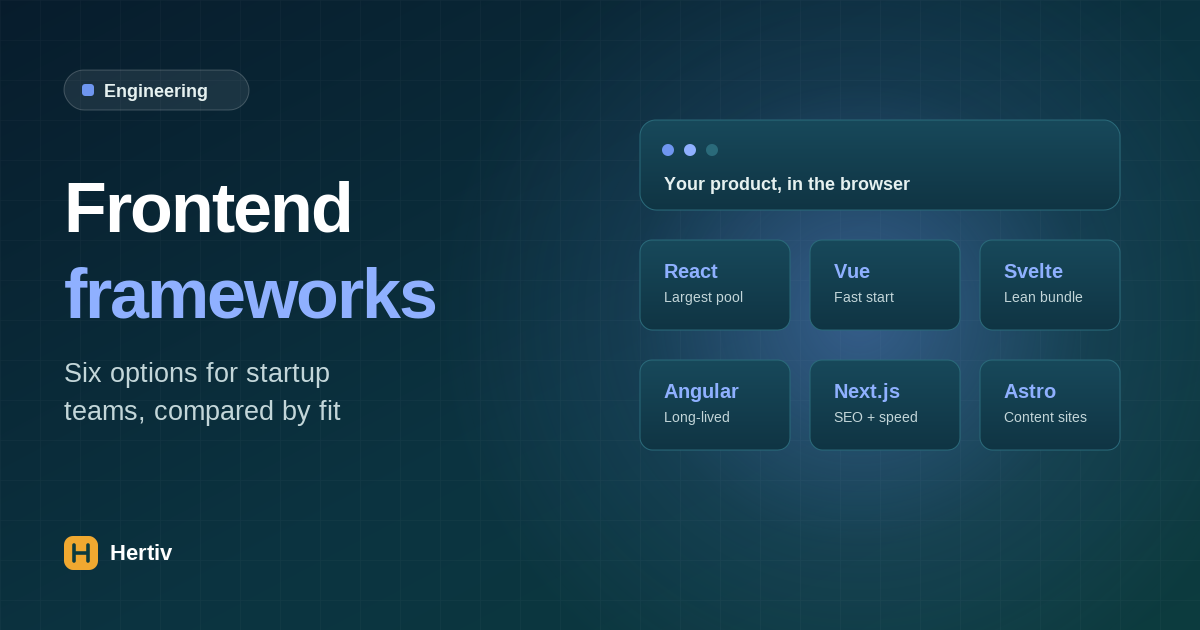
Frontend frameworks for startups differ most on how much they give you up front, how easy they are to hire for, and how much code they need for the same screen. The table below maps the common options to the teams they suit best, so you can shortlist two or three and test them on a real feature.
| Framework | Best for | Learning curve | Hiring pool |
|---|---|---|---|
| React | Interactive apps, large teams | Moderate | Very large |
| Vue | Small teams, fast starts | Gentle | Large |
| Svelte | Lean apps, small bundles | Gentle | Smaller |
| Angular | Large, long-lived products | Steep | Large |
| Next.js | React apps that need SEO and speed | Moderate | Large |
| Astro | Content sites with light interactivity | Gentle | Growing |
None of these is the wrong choice in general. Each one is a reasonable way to build a web product, and the differences show up in hiring, in how fast a new developer becomes useful, and in how the app behaves when it grows. A startup that picks by the team it has, rather than by the framework that is loudest online, usually ships sooner.
React and Vue: the two most common picks
1. React: best for interactive apps and large hiring pools
React is a library for building user interfaces from components, and it is the most widely used frontend choice in startups. Its strength is the ecosystem: almost every UI problem has a tested library, and almost every developer has met React before. A startup that picks React can hire quickly and can find an answer to most problems in public guides.
The trade-off is that React on its own is only the view layer. Routing, data fetching and forms need extra libraries, and the team must choose and wire them together. That freedom is useful for a team that knows what it wants, and a burden for a team that wants one set of defaults.
Pros:
- Largest hiring pool: more developers know React than any other option
- Deep ecosystem: a library exists for almost every UI need
- Flexible: works for small sites and large applications alike
Cons:
- Many decisions: routing, state and forms are all choices the team must make
- Heavier bundles: a React app ships more JavaScript than a Svelte or Astro site
2. Vue: best for small teams that want a fast start
Vue is a framework that gives a team more out of the box: templates, state management and routing are part of the official toolkit, and the learning curve is gentle. A small team can become productive in days rather than weeks, which is why Vue is common in early-stage products.
Vue's hiring pool is smaller than React's, but it is still large, and Vue developers often come from a design background, which suits product-led teams. The main risk is the same as its strength: the official way of doing things is so comfortable that a team may not notice when it has outgrown it.
Pros:
- Gentle learning curve: new developers ship quickly
- Complete toolkit: routing and state are official, not third-party
- Clear templates: easy to read and review
Cons:
- Smaller hiring pool: fewer Vue developers than React developers
- Smaller ecosystem: fewer ready-made libraries for niche needs
If the product also needs a native app, mobile app development teams often reuse the same design system across web and mobile, which keeps the two products looking like one.
Svelte and Angular: lean builds and long-lived products
3. Svelte: best for lean apps and small bundles
Svelte is a compiler, not a runtime framework: it turns components into plain JavaScript at build time, so the shipped app carries almost no framework code. The result is a fast, small bundle, which matters for users on slow connections and for apps that must feel instant.
Svelte code is also short and readable, which suits a small team that wants to move fast. The hiring pool is the smallest on this list, so a startup that picks Svelte should be comfortable training developers or hiring for general JavaScript skill rather than Svelte experience.
Pros:
- Tiny bundles: very little framework code reaches the user
- Short, clear code: less boilerplate than React or Angular
- Fast to write: small teams ship quickly
Cons:
- Smallest hiring pool: harder to hire for Svelte specifically
- Younger ecosystem: fewer libraries for edge cases
4. Angular: best for large, long-lived products
Angular is a full framework with strong opinions: dependency injection, typed templates and a complete toolset come built in. It suits products that will be maintained for years by a larger team, where consistency across many developers matters more than speed of the first release.
The learning curve is the steepest on this list, and a startup with two developers will feel the weight of its ceremony. For a team that is already large, or that expects to be, that structure is a feature: it keeps a big codebase readable and testable.
Pros:
- Complete and opinionated: one way to do each job
- Strong typing: TypeScript is the default, not an add-on
- Built for scale: suits large teams and long-lived code
Cons:
- Steep learning curve: slow for a new developer to pick up
- Heavy for small apps: more ceremony than a small product needs
Teams that want help weighing the options can work with a custom software development partner that has shipped products in more than one of these frameworks.
Next.js and Astro: the framework and the content site
5. Next.js: best for React apps that need SEO and speed
Next.js is a framework built on React that adds server rendering, routing, image handling and deployment in one package. It answers the two questions React leaves open: how the page loads for search engines, and how the app is served. A startup that wants React with sensible defaults usually ends up here.
Next.js is also the most common choice for products that mix marketing pages with an application, because the same codebase can serve fast, search-friendly pages and a rich dashboard. The cost is a little more to learn than plain React, and a little more to host, since server rendering needs a server.
Pros:
- SEO and speed built in: server rendering and routing included
- React ecosystem: all React libraries work
- One codebase: marketing pages and app in the same project
Cons:
- Needs a server: more to host than a static site
- More to learn: rendering choices add decisions
6. Astro: best for content sites with light interactivity
Astro is a framework for content-heavy sites that ships almost no JavaScript by default, adding interactivity only where a page needs it. It suits blogs, docs, marketing sites and product pages, where most of the page is text and only a few parts are interactive.
Astro can use React, Vue or Svelte components inside its pages, so a team does not have to abandon the tools it knows. The limit is that a heavily interactive application, such as a dashboard with live data everywhere, is not what Astro is built for, and forcing it there costs more than picking a runtime framework.
Pros:
- Almost no JavaScript by default: very fast pages
- Works with React, Vue or Svelte: reuse what the team knows
- Great for content: blogs, docs and marketing pages
Cons:
- Not for heavy apps: dashboards with live data fit poorly
- Younger hiring pool: fewer developers know Astro by name
How to choose a frontend framework
You choose a frontend framework by matching it to the product, the team and the hiring plan, not by counting features. Start with the two questions that rule most options out: how interactive is the product, and who will build it?
- Name the product shape. A content site points to Astro; a dashboard points to React, Vue or Svelte; a long-lived enterprise product points to Angular.
- Check who you can hire. If you must hire fast, React gives the largest pool. If the team is already set, pick what they know best.
- Build one real screen. Take the hardest screen in the product and build it in the two finalists. The one that feels easier to change is the right one.
- Check the bundle. Load the prototype on a slow connection and a cheap phone. If it feels slow, the framework choice is already costing users.
- Agree on the stack around it. Routing, state, forms and testing should be decided with the framework, not discovered a month later.
If you are building the product itself, a partner for web application development can help make the choice with the team that will live with it, rather than imposing a stack from outside.
What are the common mistakes?
The common mistakes are choosing by trend, rewriting for the new framework, and ignoring the hiring plan.
- Choosing by trend. The framework that is loudest online is not always the one your team can hire for or maintain.
- Rewriting a working app. A rewrite to the newest framework costs months and rarely changes what users see.
- Ignoring the bundle. A framework that ships heavy JavaScript hurts users on slow connections, and they rarely complain: they leave.
- No decision on the surrounding stack. A framework choice without routing, state and testing decisions is only half a choice.
- Mixing frameworks without a rule. Two frameworks in one product double the learning cost for every new developer.
Key takeaways
- React has the largest hiring pool; Vue and Svelte are faster to learn
- Next.js adds server rendering and routing to React; Astro suits content sites
- Angular fits large, long-lived products, not small teams
- Pick by product shape and hiring, not by trend
- Prototype the hardest screen in two frameworks before committing
Frequently asked questions
Is React still the best frontend framework for startups?
It is the safest default, because of the hiring pool and the ecosystem, but not the best for every product. A content site is better served by Astro, a lean app by Svelte, and a long-lived enterprise product by Angular. React wins when the team must hire fast and the app is interactive. The product shape should decide, not the framework's popularity.
Should a startup use Next.js or plain React?
Use Next.js when the product needs search-friendly pages, fast first loads or a mix of marketing pages and an application. Use plain React when the app lives behind a login and search engines do not matter. Next.js adds server rendering and routing, which is worth it for public pages and unnecessary for a pure dashboard.
Is Vue a good choice for a startup?
Yes, especially for a small team. Vue has a gentle learning curve, an official toolkit for routing and state, and a large enough hiring pool for most teams. The main trade-off is a smaller ecosystem than React, so a team with very unusual needs may find fewer ready-made libraries. For most products, that gap does not matter.
What is the difference between Svelte and React?
Svelte is a compiler that turns components into plain JavaScript at build time, so almost no framework code reaches the user. React ships a runtime that runs in the browser. The result is that Svelte apps are smaller and faster to load, while React apps have a larger ecosystem and hiring pool. Both are reasonable choices for a startup.
Does the frontend framework affect SEO?
Yes, when pages are public. A framework that renders on the server, such as Next.js or Astro, gives search engines a complete page to read. A client-rendered app can still be indexed, but it is slower and less reliable. If search traffic matters, pick a framework with server rendering or static output.
Can a startup change frameworks later?
It can, but it is expensive. A rewrite touches every screen, every test and every habit the team has built. Most teams that switch do so by building new features in the new framework and leaving old screens alone, which creates a mixed codebase. Picking well at the start is cheaper than switching later.


