8 AI Orchestration Tools Compared for Startups
AI orchestration tools connect models, data and tools into working apps. Here are 8 options for startups, from code frameworks to visual builders.
On this page
Short answer
The best AI orchestration tool for a startup depends on how you build: LangChain with LangGraph is the default code stack, LlamaIndex leads for retrieval-heavy apps, CrewAI is fastest for multi-agent prototypes, and n8n suits visual builders. Temporal adds durability for long-running workflows, while Haystack, Prefect and AutoGen cover search pipelines, data workflows and conversational agents.
Which AI orchestration tool should you compare first?
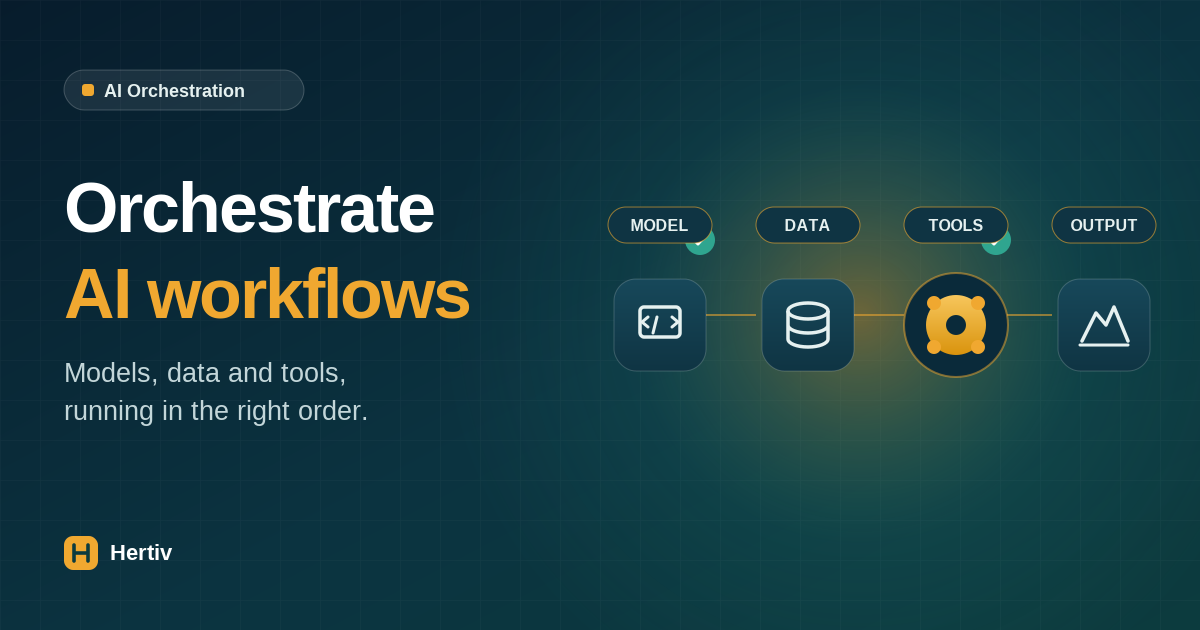
AI orchestration tools connect the parts of an AI app: the model, your data, the tools it can call, and the steps that run in order. Without one, you end up wiring prompts, retries and state by hand, which breaks as soon as a workflow grows past a single call.
Startups usually pick between code frameworks and visual builders. Code gives control over state, branching and evaluation; visual builders get a working flow live faster. The table below shortlists eight tools that are actively maintained and used in production.
| Tool | Best for | Style | Cost |
|---|---|---|---|
| LangChain + LangGraph | General LLM apps and agents | Code, Python/JS | Open source, see vendor site |
| LlamaIndex | Retrieval over private data | Code, Python/TS | Open source, see vendor site |
| CrewAI | Role-based multi-agent teams | Code, Python | Open source, see vendor site |
| AutoGen | Agents that talk to each other | Code, Python/.NET | Open source, see vendor site |
| Haystack | Search and RAG pipelines | Code, Python | Open source, see vendor site |
| Temporal | Long-running, failure-proof flows | Code, many languages | Open source, see vendor site |
| Prefect | Data and AI workflows in Python | Code, Python | Open source, see vendor site |
| n8n | Visual AI workflow automation | Visual builder | Free self-hosted, see vendor site |
Pick by the shape of your problem, not the longest feature list. A retrieval-heavy support bot and a multi-day onboarding workflow need different tools, and the wrong pick shows up as glue code within weeks.
LangChain, LangGraph and LlamaIndex: the developer defaults
1. LangChain and LangGraph: best for the default stack
LangChain is the most widely used framework for building LLM applications, with composable chains that connect models, tools, memory and data. LangGraph sits on top of it and models an agent as a graph, with explicit state, cycles and checkpoints, so multi-step agents can pause, resume and ask a human before acting.
The ecosystem is the draw: the widest set of model providers, vector stores and tool integrations, plus LangSmith for tracing, testing and evaluation. The cost is a learning curve, and LangChain's API has changed often enough that teams pin versions and read the migration notes.
Pros: largest ecosystem and community; LangGraph gives real control over agent state; LangSmith covers observability and evaluation.
Cons: frequent API changes; easy to build something sprawling without discipline; hosted tiers add cost as usage grows.
2. LlamaIndex: best for retrieval-heavy apps
LlamaIndex is a data framework for the AI stack: it ingests, indexes and queries documents, databases and APIs so a language model can reason over your own data. Its parsing and retrieval quality is the reason teams pick it when document search decides whether the app works.
Its Workflows layer adds event-driven orchestration on top of the data layer, so a document pipeline can branch, retry and hand off between steps. It is less suited to general agent logic than LangGraph, and its API surface is large, so expect a week of learning before it feels natural.
Pros: strongest document parsing and retrieval; good fit for RAG-first products; active development and integrations.
Cons: broad API takes time to learn; less control over general agent flow than LangGraph; heavier than needed for simple chat apps.
CrewAI and AutoGen: multi-agent teams
3. CrewAI: best for role-based agent teams
CrewAI is an open-source framework for orchestrating role-playing AI agents that work as a crew. You define agents with roles and goals, then tasks that flow between them, such as a researcher agent gathering facts, a writer drafting, and a reviewer checking the result.
It is the fastest route from idea to a working multi-agent prototype, with a Python framework plus a no-code builder and enterprise governance features. The role abstraction is readable, which helps small teams reason about what each agent is allowed to do.
Pros: fastest path to a working multi-agent demo; readable role-and-task model; no-code builder for non-engineers.
Cons: less control over exact execution order than a graph; debugging a crew's decisions can be slow; newer ecosystem than LangChain.
4. AutoGen: best for agents that negotiate by talking
AutoGen is Microsoft's open-source framework for multi-agent applications, where agents coordinate by exchanging messages. One agent can ask another for a review, challenge an answer, or hand a task over, which suits problems where the plan emerges from discussion rather than a fixed graph.
Recent versions added a more structured core alongside the conversational layer, so teams can mix free-form agent chat with defined steps. It is a strong pick for .NET shops and teams deep in the Microsoft stack, and it pairs well with Azure OpenAI.
Pros: conversational coordination fits open-ended tasks; Microsoft backing and Azure integration; structured core for defined steps.
Cons: message-based flows are harder to trace than graphs; multi-agent chats can loop without strict limits; documentation assumes comfort with agents.
Haystack and Temporal: pipelines and durability
5. Haystack: best for auditable search pipelines
Haystack, from deepset, is an open-source framework for building document search and retrieval pipelines that can be evaluated and audited. Pipelines are built from components such as retrievers, rankers and generators, wired together in a clear, testable shape.
It shines where retrieval quality must be proven, for example in regulated support or legal research, because each pipeline step can be measured separately. It is narrower than LangChain: it is a retrieval framework first, not a general agent platform.
Pros: pipelines are easy to evaluate step by step; strong retrieval components; good fit for regulated use cases.
Cons: not a general agent framework; smaller ecosystem than LangChain; visual tooling is thinner than n8n.
6. Temporal: best for workflows that must not fail
Temporal is not an AI framework at all. It is a durable execution engine that keeps a workflow's state safe across crashes, restarts and long waits, so a multi-day process does not lose its place when a server restarts. AI teams add it underneath an agent framework when reliability matters more than model choice.
A startup orchestrating onboarding, claims or procurement with AI steps will hit Temporal's value quickly: retries, timeouts and human approvals are built in, not bolted on. The trade-off is operational weight, since Temporal is a service you run, not a library you import.
Pros: workflows survive failures and long waits; retries and timeouts built in; proven at scale in production systems.
Cons: you operate a service, not just a library; overkill for short, single-step agents; learning curve for workflow-as-code.
Prefect and n8n: data workflows and visual building
7. Prefect: best for data teams that want plain Python
Prefect is an open-source workflow orchestration tool for data teams, written in plain Python. It schedules, retries and observes pipelines, and AI teams use it to run the jobs behind their apps: ingestion, embedding, evaluation runs and nightly refreshes.
It is less about agents talking and more about jobs running reliably on a schedule. If your AI product depends on fresh data and repeatable evaluation, Prefect covers the plumbing that agent frameworks leave out.
Pros: plain Python, no new language; strong scheduling and observability; good fit for data-heavy AI products.
Cons: not an agent framework; limited built-in LLM tooling; cloud tiers add cost as runs grow.
8. n8n: best for visual AI workflow automation
n8n is a visual workflow builder where AI steps sit alongside webhooks, APIs, databases and messaging tools. A startup can wire a support triage flow, a lead enrichment flow or a content pipeline without writing a backend, and self-host it for free.
The visual model is its strength and its limit. Simple flows are fast to build and easy for non-engineers to change, but complex branching and state become harder to manage than in code. It is the right pick when the workflow is mostly integrations with a few AI steps.
Pros: visual builder non-engineers can change; free self-hosted option; huge library of integrations.
Cons: complex state and branching get messy; less control than code frameworks; AI steps depend on node quality.
How to choose an AI orchestration tool
Choose by the shape of your workflow, not by hype. A retrieval-heavy support bot, a multi-agent research team and a multi-day onboarding flow are different problems, and each tool above wins on a different one.
- Map the workflow first. List the steps, the data each needs, and where a human must approve. If the steps are fixed, a pipeline tool fits; if they branch, you need a graph or agent framework.
- Check retrieval needs. If document quality decides success, start with LlamaIndex or Haystack and test retrieval before anything else.
- Decide code versus visual. Engineers who need state control should pick a framework; teams that need non-engineers to change flows should pick n8n.
- Plan for failure. If a workflow runs for hours or days, add Temporal or a framework with checkpoints and retries.
- Prototype one flow end to end. Build a single real workflow with an evaluation set before committing to a stack.
For background on the concepts, see what AI orchestration is.
The comparison with older automation matters too: AI workflow orchestration versus RPA explains where each fits.
If you need help designing the flow, agentic AI development covers the guardrail patterns.
What are the common mistakes?
The most common mistakes are picking a tool before mapping the workflow, skipping evaluation, and giving agents write access before permissions and logs exist.
- Framework first, workflow second. A graph framework cannot fix a workflow nobody has mapped.
- No evaluation set. Without fixed test cases, you cannot tell whether a change helped.
- Agents with broad write access. Scope permissions per agent and add approval gates for irreversible actions.
- Ignoring durability. A demo that works once is not a workflow that survives a restart.
- Over-engineering the first flow. A single-step assistant with good retrieval beats a multi-agent system nobody can debug.
- Vendor lock-in by accident. Keep prompts, tools and evaluation data portable so a framework change stays possible.
Key takeaways
- LangChain with LangGraph is the default code stack for general LLM apps and agents
- LlamaIndex and Haystack win when retrieval quality decides whether the app works
- CrewAI is fastest for role-based multi-agent prototypes; AutoGen fits conversational agents
- Temporal adds durability for workflows that run for hours or days and must survive failures
- n8n suits visual builders; Prefect covers the data jobs behind an AI product
- Map the workflow and build one evaluated flow before committing to a stack
Frequently asked questions
What is an AI orchestration tool?
An AI orchestration tool connects the parts of an AI app: the model, your data, the tools it can call, and the steps that run in order. It handles state, retries, branching and evaluation, so you do not wire prompts and API calls by hand as the workflow grows.
Is LangChain the same as LangGraph?
No. LangChain is the broader library for composing model calls, tools and retrieval. LangGraph is the agent runtime built on top of it, adding explicit state, cycles and checkpointing, so multi-step agents can pause, resume and ask a human before acting.
Do startups need an orchestration tool?
Not for a first prototype with one prompt and one model call. Once the app chains steps, calls tools, or needs retries and evaluation, an orchestration tool saves more time than it costs. Start simple and adopt one when glue code starts to pile up.
Which orchestration tool is best for RAG apps?
LlamaIndex is the usual pick when retrieval quality matters most, with strong parsing and indexing. Haystack is close behind and easier to evaluate step by step. LangChain with LangGraph also works well when the app needs agent logic beyond retrieval.
Can I self-host these tools?
Most of the frameworks here are open source and run in your own environment: LangChain, LlamaIndex, CrewAI, AutoGen, Haystack, Temporal and Prefect. n8n offers a free self-hosted option. Hosted tiers add managed observability and scaling for a fee.
How do I avoid vendor lock-in?
Keep prompts, tool definitions and evaluation data in your own code and files, not inside a vendor's console. Use standard interfaces where possible, so swapping a framework means rewriting the wiring, not rebuilding the whole product.


