What Does an Autonomous AI Agent Cost to Run?
An autonomous AI agent costs far more than its model calls. This guide breaks down the five running-cost lines and shows how to estimate a monthly bill.
On this page
Short answer
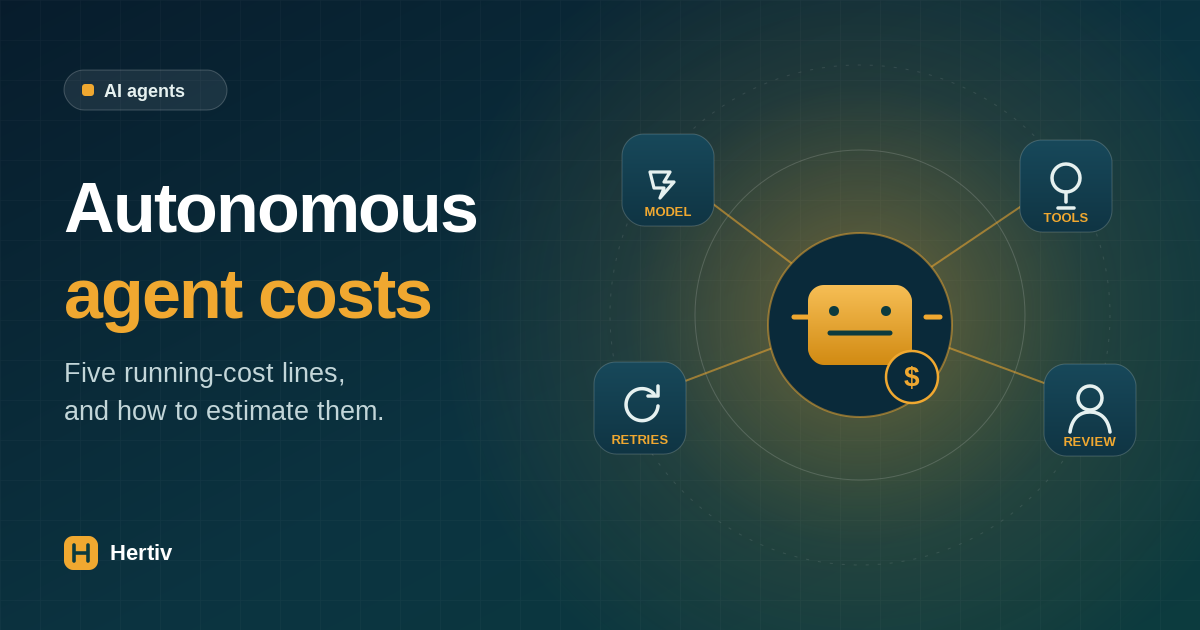
An autonomous AI agent's operational cost is the total monthly spend to keep it running: model calls, tool and API calls, retries after failed steps, human review and supervision, and the infrastructure around it. Model calls are usually the largest line, but retries and human review often surprise teams. A small pilot can cost a few hundred dollars a month, while a busy production agent can cost several thousand.
What is an autonomous AI agent's operational cost?
An autonomous AI agent's operational cost is the total monthly spend to keep the agent running and doing useful work. It covers model calls, tool and API calls, retries after failed steps, human review and supervision, and the infrastructure around the agent.
The number that surprises most teams is not the model bill. A pilot that looks cheap in a demo can cost several times more in production, because a real agent takes many more steps, retries failed ones and needs a person checking its work.
The five cost lines below are the whole bill. If you can estimate each one, you can forecast the monthly cost of an agent before you build it.
| Cost line | What it pays for | When it grows |
|---|---|---|
| Model calls | Tokens the model reads and writes on every step | Longer tasks, more steps, larger models |
| Tool and API calls | Search, databases, payment and other services the agent uses | Tasks that need live data or actions |
| Retries and failures | Repeat work after a wrong step, a timeout or a bad tool result | Fragile tools, vague instructions, long tasks |
| Human review | People checking, correcting and approving agent work | High-stakes tasks, new agents, strict rules |
| Infrastructure | Hosting, logs, memory stores and monitoring | More users, more history, stricter audit needs |
Model calls: usually the biggest line
Model calls are usually the biggest line in an agent's running cost, because the agent calls the model once per step, and a single task can take ten or twenty steps. Each call sends the task, the conversation so far and the tool results back to the model, so the input grows as the task goes on.
Three things set the size of this line. The first is the model: a larger model costs more per token than a smaller one, so routing simple steps to a smaller model cuts the bill. The second is the number of steps: a task that needs five steps costs roughly half as much as one that needs ten. The third is context: long documents and long histories raise the token count on every call.
A useful habit is to count tokens per task, not per call. Track the average input and output tokens for each task type, then multiply by the number of tasks per month. That gives a model bill you can check against the real invoice, and it shows which task types are worth trimming. A guide to LLM API costs per month explains how to build that estimate.
Tool calls, retries and failed steps
Tool calls are the second cost line. An agent that searches the web, checks a database or files a ticket pays for each of those calls, either through a priced API or through the compute the tool itself uses. A task with five tool calls costs more than one that answers from memory alone.
Retries are where the bill quietly doubles. When a tool returns an error, a timeout or a result the agent cannot use, the agent usually tries again, and each retry is another model call plus another tool call. A task that succeeds on the first try can cost three times as much when it needs two retries.
The fix is to make each step more likely to succeed. Short, clear instructions, tools that return structured results and a limit on retries per task all help. Set a maximum number of steps per task, so a confused agent stops instead of looping, and log every retry so you can see which steps fail most often.
Human review and supervision
Human review is the cost line teams most often forget. An autonomous agent still needs people to check its work, handle the cases it cannot resolve and approve actions that carry risk. That time is a real cost, and for high-stakes work it can be larger than the model bill.
The review load depends on how much the agent is trusted. A new agent might need every output checked, while a proven one only needs a sample reviewed and the hard cases escalated. Review queues, approval steps and the time to fix mistakes all belong in the estimate.
Measure review time per task in the pilot, then multiply by the expected task volume. If a reviewer spends two minutes per task and the agent handles 2,000 tasks a month, that is about 67 hours of review time. Price that time at the reviewer's loaded hourly rate, not at zero, or the forecast will understate the real cost.
Infrastructure and data around the agent
Infrastructure is the quietest cost line, but it is not free. The agent needs somewhere to run, a place to store conversation history and task state, logs for debugging and audit, and monitoring that alerts you when the agent stalls or starts failing.
The biggest infrastructure choice is where the model runs. Using a hosted API means you pay per token and nothing for servers. Running a model yourself means paying for GPUs whether the agent is busy or idle, which is why many teams start with a hosted API and only consider self-hosting when volume is high and steady. A look at what self-hosting an LLM costs covers that trade-off.
Memory and logs grow with use. A short-term memory store is cheap, but keeping full histories for every task, plus embeddings for retrieval, adds storage and compute. Set a retention policy early: keep what you need for audit and debugging, and delete or summarise the rest.
Example (hypothetical): a support agent's monthly bill
Example (hypothetical): a small company runs an autonomous agent that drafts replies to support tickets. It handles 2,000 tickets a month. Each ticket takes 8 model steps, and each step averages 1,500 tokens, so the agent uses 24,000,000 tokens a month.
At assumed rates of $2 per million input tokens and $8 per million output tokens, with 60% of tokens as input, the model bill is 14,400,000 input tokens at $2, which is $28.80, plus 9,600,000 output tokens at $8, which is $76.80, for a total of $105.60. Tool calls add 4,000 calls at $0.01 each, which is $40.00.
Human review adds the most. A reviewer spends about 40 hours a month checking drafts and handling escalations at $50 an hour, which is $2,000. Hosting, logs and the memory store add $120. The full monthly bill is $105.60 plus $40.00 plus $2,000 plus $120, which is $2,265.60. The model is less than 5% of the total, and review is almost 90%.
Before scaling that agent, the team should test whether the review time falls as the agent improves. A small AI proof of concept is the right place to measure review time per task, because that number decides whether the agent saves money at all.
What are the common mistakes?
The most common mistakes with autonomous agent costs are forecasting only the model bill, letting retries run without a limit, and treating human review as free.
- Budgeting for the model only. Model calls are often a small share of the total. Include tools, retries, review and hosting from the start.
- No step or retry limit. An agent without a cap can loop for dozens of steps on one task. Set a maximum and log every task that hits it.
- Treating review as free. Review time is the largest line for many agents. Measure it in the pilot and price it at a real hourly rate.
- Ignoring context growth. Long histories raise the token count on every call. Summarise or trim history instead of sending the full conversation each time.
- Scaling before measuring. Doubling task volume before the pilot numbers are known doubles an unknown bill. Measure cost per task first, then scale.
Once you know the cost per task, you can judge whether the agent is worth running. A guide to how to measure AI ROI shows how to compare that cost against the time and money the agent saves.
Key takeaways
- An agent's operational cost has five lines: model calls, tool calls, retries, human review and infrastructure
- Model calls are usually the largest technical line, but human review is often the largest line overall
- Retries multiply the bill: each failed step costs another model call and another tool call
- Measure cost per task in a pilot before scaling, so the monthly bill is a forecast, not a surprise
- A step limit, trimmed context and a retention policy keep the bill under control
Frequently asked questions
What is the biggest cost of running an autonomous AI agent?
Human review is often the biggest cost, followed by model calls. A reviewer checking drafts, fixing mistakes and handling escalations can cost more per month than the tokens, especially for high-stakes work where every output needs a check.
How do I estimate an agent's monthly cost before building it?
Estimate the five lines separately: average tokens per task times tasks per month, tool calls per task, an assumed retry rate, review minutes per task at a real hourly rate, and hosting and storage. A small pilot gives real numbers for each line.
Why does an agent cost more in production than in a demo?
Demos use short tasks, clean data and few retries. In production, tasks are longer, tools fail, the agent retries, and people review the output. Each of these adds model calls, tool calls and review time that the demo never showed.
Does a cheaper model always lower the running cost?
No. A cheaper model that takes more steps, retries more often or needs more human correction can cost more overall. Compare the full cost per completed task, including retries and review, not just the price per token.
How do retries affect the monthly bill?
Each retry repeats a model call and usually a tool call. A task that needs two retries can cost roughly three times as much as one that succeeds first time. A step limit and better tool results keep retry costs down.
Should I self-host the model to cut agent costs?
Only when volume is high and steady. Self-hosting replaces per-token charges with fixed GPU costs, which helps at scale but costs more than a hosted API at low volume. Measure your token spend first, then compare it with the hosting bill.


