Autonomous Agents by Industry: 6 Examples That Work
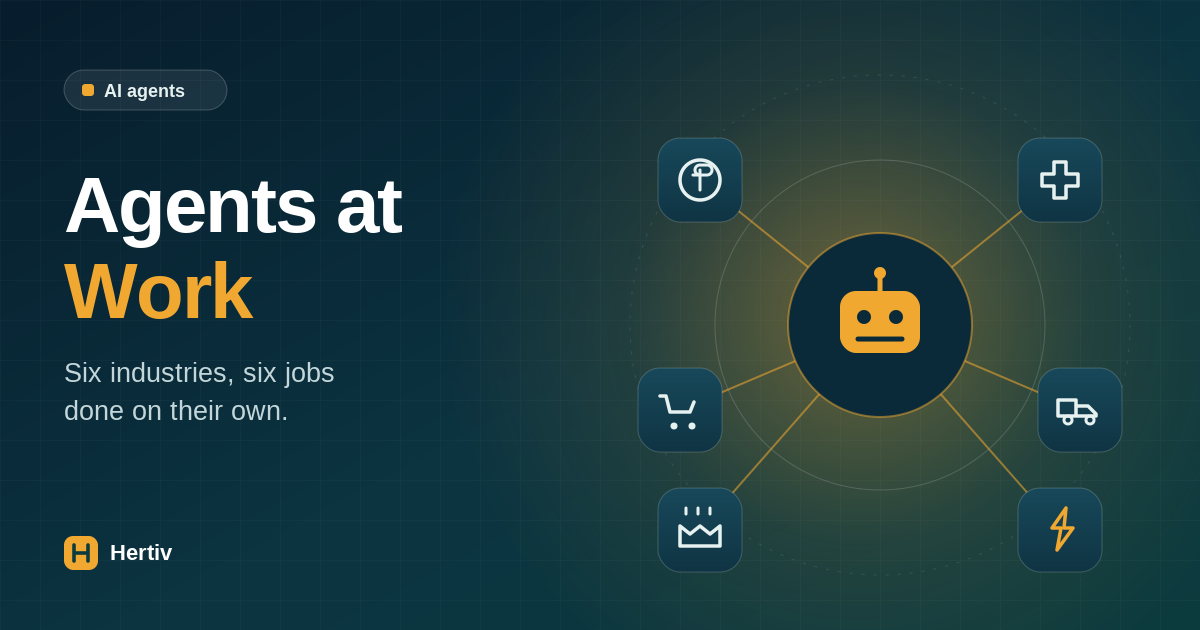
Autonomous agents now run routine jobs in finance, healthcare, retail, logistics, manufacturing and energy. Here are six that work, with the checks behind them.
On this page
Short answer
Autonomous agents run multi-step jobs on their own in finance, healthcare, retail, logistics, manufacturing and energy, from matching payments to balancing a power grid. Each agent follows rules set by people, handles routine cases alone, and passes exceptions to a human. The best first agent is a narrow, high-volume job with a clear human check.
Which industries use autonomous agents today?
Autonomous agents work across finance, healthcare, retail, logistics, manufacturing and energy, doing multi-step jobs that used to need a person watching every step. Each agent follows a goal, uses tools, checks its own work and asks a human when the stakes are high.
Use the table to compare them. The pattern is the same in every industry: the agent handles the routine cases, a human handles the exceptions, and every action is logged so it can be checked later.
| Industry | Agent example | What it does | Human check |
|---|---|---|---|
| Finance | Reconciliation agent | Matches payments to invoices | Reviews unmatched items |
| Healthcare | Scheduling agent | Books and reschedules visits | Approves urgent changes |
| Retail | Restock agent | Orders stock before shelves empty | Approves large orders |
| Logistics | Dispatch agent | Assigns jobs to drivers | Handles failed deliveries |
| Manufacturing | Quality agent | Flags defects on the line | Confirms borderline cases |
| Energy | Balancing agent | Shifts load across the grid | Approves grid changes |
None of these agents work alone. Each one sits inside rules set by people, and each one stops when it meets something it was not built to handle. That is what makes them safe enough to run in production. For the general picture, see the AI agent use cases that apply across industries.
<h3>1. Finance: reconciliation agent: best for teams that match payments daily</h3>
A reconciliation agent matches incoming payments to invoices, flags the ones that do not match, and prepares a short list for a human to review. It reads bank statements, invoices and payment references, then applies the matching rules the finance team wrote.
It suits teams that spend mornings matching payments by hand. The agent clears the routine matches and leaves only the odd cases, so the team starts the day with exceptions instead of a pile of paperwork.
Pros
- Clears routine matches fast
- Leaves a clear audit trail
- Cuts morning admin work
Cons
- Needs clean payment references
- Struggles with partial payments
- Rules need regular review
<h3>2. Healthcare: scheduling agent: best for clinics that book many visits</h3>
A scheduling agent books, reschedules and confirms patient visits, checking doctor availability, room use and patient preferences. It can fill a cancelled slot from a waiting list within minutes, which keeps clinics full without extra phone calls.
It suits clinics where staff spend hours on the phone rebooking visits. The agent handles the routine bookings and passes urgent or complex cases to a person, so no patient is left waiting on a machine.
Pros
- Fills cancelled slots quickly
- Cuts phone time for staff
- Reminds patients and cuts no-shows
Cons
- Needs access to live calendars
- Must handle urgent cases with care
- Privacy rules limit what it can share
<h3>3. Retail: restock agent: best for shops that run out of popular lines</h3>
A restock agent watches stock levels, sales speed and supplier lead times, then raises orders before shelves empty. It learns which lines sell fast on weekends and which ones sit, so orders match real demand instead of a fixed schedule.
It suits retailers with many lines and several suppliers. The agent places small routine orders on its own and asks a manager to approve large or unusual ones, which keeps stock flowing without over-ordering.
Pros
- Orders before shelves empty
- Matches orders to real demand
- Cuts stockouts on popular lines
Cons
- Needs reliable sales data
- Can over-order after a one-off spike
- Supplier delays still need a human
<h3>4. Logistics: dispatch agent: best for fleets that assign jobs all day</h3>
A dispatch agent assigns delivery jobs to drivers based on location, vehicle size, time windows and traffic. When a delivery fails or a driver is delayed, it reassigns the job and tells the customer what changed.
It suits fleets where a dispatcher juggles dozens of jobs at once. The agent handles the routine assignments and leaves the failed deliveries and unhappy customers to a person who can make a judgement call.
Pros
- Assigns jobs faster than a person
- Replans when a delivery fails
- Keeps customers updated
Cons
- Needs live location data
- Bad data leads to bad routes
- Customer complaints need a human
<h3>5. Manufacturing: quality agent: best for lines that inspect every part</h3>
A quality agent watches camera feeds on a production line, flags parts that look wrong, and sorts them for a human to confirm. It checks every part at line speed, which is work no person can sustain for a full shift.
It suits factories where inspection is slow or inconsistent. The agent catches the clear defects and passes borderline cases to an inspector, so the line keeps moving and quality stays steady.
Pros
- Checks every part at line speed
- Catches defects humans miss
- Keeps a record of every check
Cons
- Needs good camera setup
- False flags slow the line
- New part types need retraining
<h3>6. Energy: balancing agent: best for grids with variable demand</h3>
A balancing agent watches demand across a grid, shifts load between sources and storage, and keeps supply matched to use. It reacts in seconds to a change in demand, which is faster than a control room can manage by hand.
It suits grids with solar, wind and storage, where supply changes with the weather. The agent handles routine balancing and asks an operator to approve any change that affects grid stability.
Pros
- Reacts to demand changes in seconds
- Uses storage when prices are low
- Keeps supply matched to demand
Cons
- Needs live grid data
- Grid stability changes need approval
- Bad forecasts lead to wrong shifts
How to choose an autonomous agent to build first
Pick the industry job with the clearest rules and the most routine volume, then build the agent for that job alone. A narrow first agent is easier to test, easier to trust and easier to expand later.
- Pick a job with clear rules. Matching, booking and ordering work better than open-ended judgement.
- Count the volume. A job done a hundred times a day pays back faster than one done weekly.
- Name the human check. Decide in advance which cases go to a person and which the agent may finish alone.
- Start with one industry and one workflow. Prove it there before you copy it to the next team.
- Log every action. If you cannot check what the agent did, you cannot trust it in production.
The best first agent is boring: a routine job, done often, with a clear rule for when to stop. The examples in this article all started that way. Start with a small proof of concept before you commit a team to it.
If you want to see agents already running, read the real-world AI agent examples before you plan your own.
What are the common mistakes?
The most common mistakes are giving an agent too much freedom too soon, skipping the human check, and copying an agent from one industry into another without changing the rules.
- Letting the agent act on high-stakes cases alone. Payments, patient visits and grid changes all need a human check.
- Skipping the logs. Without a record of each action, nobody can find out what went wrong.
- Copying rules across industries. A matching rule from finance does not fit a hospital booking system.
- Building six agents at once. One working agent teaches more than six half-finished ones.
Key takeaways
- Finance agents match payments and leave exceptions to people
- Healthcare agents book visits and fill cancelled slots fast
- Retail agents order stock before shelves empty
- Logistics agents assign jobs and replan failed deliveries
- Manufacturing agents inspect every part at line speed
- Energy agents balance supply and demand in seconds
Frequently asked questions
What is an autonomous agent?
An autonomous agent is software that works towards a goal on its own, using tools, checking its own work and asking a human when the stakes are high. It differs from a chatbot because it takes actions, not just answers questions.
Which industry uses autonomous agents most?
Finance, healthcare, retail, logistics, manufacturing and energy all use them today. Finance was early because matching and checking follow clear rules, but healthcare scheduling and logistics dispatch are growing fast.
Do autonomous agents replace people?
No. They take the routine cases and leave exceptions, complaints and high-stakes decisions to people. The pattern in every industry here is the same: the agent does the bulk, a human handles what matters most.
How do you keep an autonomous agent safe?
Set clear rules for what it may do alone, name the cases that go to a human, and log every action so it can be checked. Start narrow, test on real cases, and widen its freedom only after it proves reliable.
What is the best first autonomous agent to build?
The best first agent is a narrow, high-volume job with clear rules, such as matching payments or booking visits. Build it for one team first, measure the results, and expand only after it works.
Can one agent work across industries?
The pattern can, but the rules cannot. A matching agent from finance will not fit a hospital, because the data, the risks and the checks are different. Copy the design, not the rules, and rebuild them for each industry.


