Why Algorand Works Well for ICO Development
Algorand suits an ICO because its tokens are built into the ledger, transfers settle in seconds, and the compliance controls are part of the token itself.
On this page
Short answer
Algorand is a good fit for an ICO because its tokens are native Layer-1 assets rather than smart contracts, so creating a token takes one transaction instead of a contract deployment. Transfers settle in a few seconds with very low fees, and built-in controls for freezing and clawback give issuers the tools regulators expect from a public sale.
What makes Algorand a good fit for an ICO?
Algorand is a permissionless Layer-1 blockchain that uses Pure Proof-of-Stake consensus, in which holders are chosen at random to propose and vote on blocks in proportion to their stake. It was launched in June 2019 and was designed by Turing Award winner Silvio Micali.
For an ICO, the chain matters because the token, the sale and the settlement all run on the same ledger, and the chain settles a block in a few seconds with no forks.
The feature that sets Algorand apart for token sales is Algorand Standard Assets, or ASAs. An ASA is a token that lives in the ledger itself, not inside a smart contract. Creating one is a single Asset Configuration Transaction that registers the total supply, the number of decimals, the unit name and four role addresses. Because the token is a protocol feature, transfers get the same security and speed as ALGO itself.
That simplicity changes the risk profile of a sale. On chains where a token is a smart contract, the contract code is the attack surface, and a bug in it can drain the sale.
On Algorand the token logic is the protocol's own code, which has been audited and battle-tested across the whole network. The team still needs smart contracts for the sale mechanics, such as pricing and distribution, but the token itself does not depend on custom code.
| Feature | Algorand | Ethereum-style token sale |
|---|---|---|
| Token creation | One on-chain transaction | Smart contract deployment |
| Finality | A few seconds, no forks | Minutes before a block is safe |
| Transaction fees | A fraction of a cent | Varies with network congestion |
| Freeze and clawback | Built into every token | Must be coded into the contract |
| Token standard | ASA, native to the ledger | ERC-20, a contract interface |
Low fees matter more than they look. An ICO that expects thousands of small buyers cannot afford a chain where the fee is a large share of a small purchase. On Algorand the fee is a fraction of a cent, so a buyer sending a small amount still receives nearly all of it as tokens. For a closer look at how token sales are planned, see ICO development for business fundraising.
How do Algorand Standard Assets work?
An Algorand Standard Asset is created by an Asset Configuration Transaction that sets the asset's properties at birth. The creator chooses the total supply, the number of decimal places, a short unit name and a full asset name, plus an optional URL and a metadata hash that can point to the token's documentation or whitepaper.
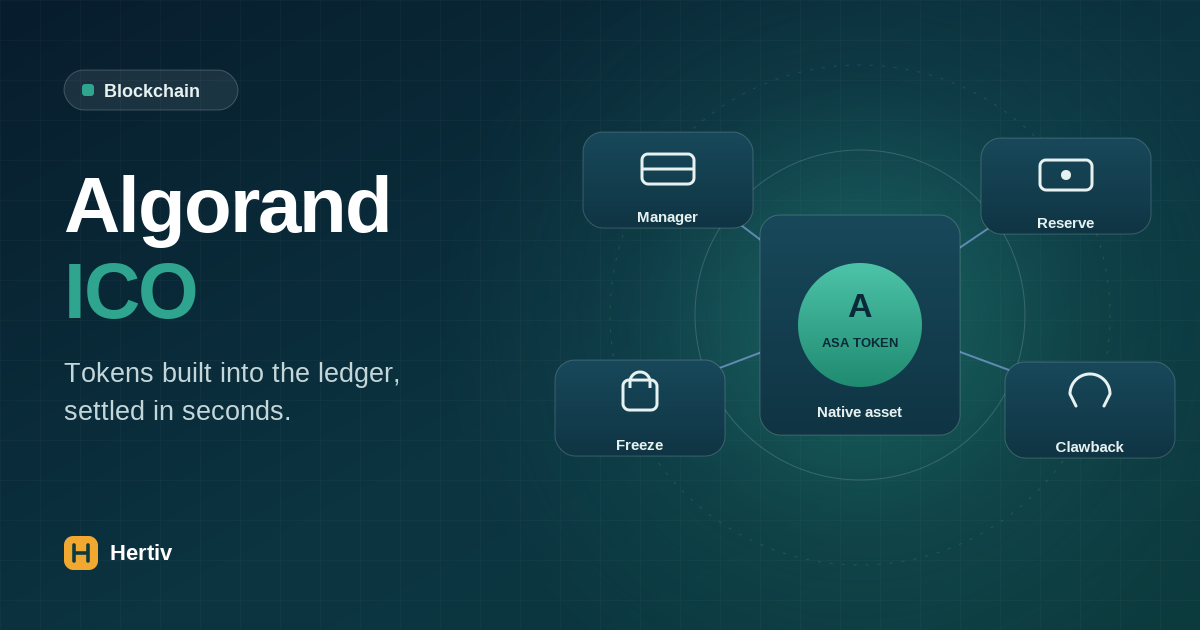
Every ASA also carries four role addresses. The manager can change the role addresses or destroy the asset. The reserve holds the units that are not yet in circulation, and moving units out of the reserve is how new supply is released. The freeze address can freeze or unfreeze a holder's balance, and the clawback address can move tokens between two accounts that have both opted in to the asset.
Any of the four roles can be set to the empty address, which disables that power permanently. A team that wants a fully open token with no admin control sets all four to empty.
A team running a regulated sale keeps the freeze and clawback roles with a legal entity, so it can act on a court order or a compliance failure. The choice is made once, at creation, and it is visible on chain for any buyer to check.
Accounts must opt in to an ASA before they can receive it, which costs a small minimum-balance increase. Opt-in stops unwanted tokens being sent to an account, and it means the buyer takes a deliberate step to accept the token. The opt-in model also keeps the ledger clean, because tokens are only held by accounts that chose to hold them.
ASAs support fungible tokens, non-fungible tokens and restricted versions of both, so the same standard covers a sale token, a loyalty point, a governance token or a tokenised real-world asset. Because the standard is the same for every issuer, wallets, exchanges and block explorers all understand every ASA without extra integration work.
What does an ICO on Algorand look like, step by step?
An ICO on Algorand follows the same broad shape as a sale on any chain, but the token step is shorter. The work breaks into seven steps, and the token itself is created in the middle of the sequence rather than at the start.
- Define the token. Decide what the token does, how many exist, how many decimals it has, and who receives the supply. A fixed supply with a clear split between the public sale, the team, the treasury and the community is easier to explain to buyers than a supply that can change later.
- Sort out the legal position. Work out whether the token is a security in each market where it will be sold, and what that means for who can buy it. This step decides the freeze and clawback settings and the sale's eligibility rules.
- Create the ASA. Send the Asset Configuration Transaction with the chosen supply and role addresses. The token then exists on chain and can be inspected by anyone before a single unit is sold.
- Build the sale contract. A smart contract written in TEAL or PyTeal handles pricing, accepts ALGO or another asset, and sends the sale tokens to the buyer. The contract is the part that needs an audit, because it holds the sale funds.
- Run the sale. Buyers opt in to the ASA, send payment to the sale contract, and receive tokens. The ledger settles each payment in seconds, so the sale can show live progress without waiting for confirmations.
- Distribute the supply. Release the remaining units from the reserve address on the published schedule, such as a cliff followed by monthly releases for the team and the treasury.
- List and support the token. List on a decentralised exchange such as Tinyman, keep the documentation and the reserve movements public, and answer buyer questions through a support channel.
The audit step deserves a real budget. The token is safe by design, but the sale contract is custom code, and a flaw there can freeze funds or let an attacker buy at the wrong price. A team that skips the audit to save money is taking the largest risk in the whole project. See how to launch a security token for the legal side of a regulated sale.
How do the built-in compliance controls help?
The built-in compliance controls help because they give an issuer the same powers a regulated market expects, without writing custom code.
The freeze address can stop a specific account from moving its tokens, which is what an issuer needs when a holder is sanctioned or when a court orders a freeze. The clawback address can move tokens between two opted-in accounts, which is what an issuer needs to reverse a mistaken transfer or to reclaim tokens after a successful legal claim.
These controls also make the token workable for institutional buyers. A fund that needs to show its auditor that stolen or misdirected tokens can be recovered will not buy a token that has no recovery path. An ASA with a named clawback address gives that path in a standard form the fund's lawyers can read, rather than in a custom contract they must review from scratch.
The trade-off is trust. A clawback address is a power over holders' tokens, and buyers who value a fully open token will avoid one.
The honest way to handle this is to name the role holder, publish the policy that governs when the power is used, and set a date after which the role is disabled if the project no longer needs it. Some teams put the roles in a multi-signature wallet or a governance contract so no single person can act alone.
For a sale that targets buyers in several countries, the controls also help with transfer restrictions. A freeze can stop tokens moving to a jurisdiction where the sale was not allowed, and a clawback can undo a transfer that broke the rules.
That is not a substitute for legal advice, but it gives the legal plan a technical way to work. The difference between an ICO and a regulated token offering is mostly a legal one; see ICO vs IPO for the comparison.
What does it cost to run an ICO on Algorand?
Running an ICO on Algorand costs far less in chain fees than on a congested smart-contract chain, but the chain fees are the smallest part of the budget. Creating an ASA costs 0.001 ALGO, and each transaction costs a fraction of a cent, so even a sale with ten thousand buyers spends only a few dollars on fees. The real money goes to legal work, the audit, development and marketing.
A realistic budget has five parts. Legal advice and the sale's legal structure come first, because they decide the token's design. The sale smart contract and the sale website come second. The security audit comes third and should cover the sale contract, the website's payment flow and the key management for the role addresses. Marketing and community work come fourth, and listing and exchange work come fifth.
As an indicative range, a small team can run a modest sale for $50,000 to $150,000 including legal work and an audit, while a larger sale with several jurisdictions, a longer audit and paid marketing can reach $300,000 or more. These are planning ranges, not quotes, and the legal bill is the part that varies most, because it depends on how many markets the sale targets.
Two costs catch teams out. The first is the minimum balance that the sale contract and the reserve accounts must hold on chain, which is small but must be funded before the sale starts. The second is the time the team spends answering buyers, which is a real cost even though it never appears on an invoice. A sale that sells out in a day still needs weeks of support afterwards.
One cost that does not appear on Algorand is the fee spike that hits sales on congested chains, where a rush of buyers pushes the price of a transaction far above the price of the tokens being bought. Algorand's fees stay flat, so a buyer who arrives late pays the same fee as a buyer who arrived first.
Example (hypothetical): a startup sells 10 million tokens
Example (hypothetical): a startup plans to sell 10 million tokens at $0.10 each, which would raise $1,000,000 if the whole supply sold. The team splits the supply into 40 percent for the public sale, 25 percent for the team, 20 percent for the treasury and 15 percent for community rewards.
The public sale is 4,000,000 tokens, which at $0.10 each is $400,000. The team allocation is 2,500,000 tokens, the treasury is 2,000,000 tokens and the community allocation is 1,500,000 tokens. The four parts add up to 10,000,000 tokens, and the dollar value of the whole supply at the sale price is $1,000,000.
On the first day, 2,000 buyers each buy $100 of tokens, which is 1,000 tokens per buyer and $200,000 in total. Each buyer pays a chain fee of a fraction of a cent, so the fees for the whole day are only a few dollars. The sale contract sends 2,000,000 tokens to the buyers and holds the $200,000 in ALGO for the team to withdraw under the published rules.
The team allocation vests over two years with a six-month cliff, so no team tokens move for the first six months and then 2,500,000 tokens release in equal monthly parts over the remaining 18 months, which is about 138,889 tokens a month.
The treasury releases 2,000,000 tokens over four years at 500,000 a year. Publishing this schedule before the sale is what lets buyers check that the team cannot dump its tokens in the first week.
What are the common mistakes?
The most common mistakes are treating the token as the product, leaving the compliance roles in one person's hands, and skipping the audit on the sale contract.
- Building the token before the product. A token with no working product behind it is a promise, not a business. Buyers who have seen one failed sale will ask what the product does before they ask what the token does.
- One person holding the roles. If the manager, freeze and clawback addresses all belong to one wallet, that wallet is a single point of failure. Use a multi-signature wallet or a governance contract, and publish who controls it.
- Skipping the audit. The ASA is safe by design, but the sale contract is custom code. An unaudited sale contract is the largest risk in the project, and it is the first thing a serious buyer asks about.
- Vague supply numbers. A supply that can change, or a split that is not published, makes buyers assume the worst. Fix the supply, publish the split, and publish the release schedule.
- Ignoring the opt-in step. Buyers must opt in to the ASA before they can receive tokens, and a sale page that does not explain this step will fill the support channel with the same question.
- Promising a price. Never promise that a token will rise in value. The sale document should say what the token does, not what it will be worth.
Key takeaways
- Algorand Standard Assets make a token a native ledger feature, not a smart contract
- Transfers settle in seconds with fees of a fraction of a cent, which suits sales with many small buyers
- Manager, reserve, freeze and clawback roles give an issuer the controls a regulated sale needs
- The sale contract still needs an audit, because it holds the sale funds
- Publish the supply split and the release schedule before the sale opens
Frequently asked questions
What is an Algorand Standard Asset?
An Algorand Standard Asset is a token that lives in the Algorand ledger itself rather than inside a smart contract. It is created with a single Asset Configuration Transaction that sets the total supply, decimals, unit name and four role addresses, and it settles with the same speed and security as ALGO.
How fast do Algorand transactions settle?
An Algorand block settles in a few seconds, and finality is immediate with no forks, so a payment or a token transfer is confirmed almost at once. That is useful for a token sale, where buyers expect to see their tokens arrive without waiting for extra confirmations.
Do I need a smart contract to create a token on Algorand?
No. Creating an ASA is a single transaction and needs no contract code, which removes the contract bug risk from the token itself. A sale still needs a smart contract for pricing, payment and distribution, and that contract should be audited.
What do the freeze and clawback roles do?
The freeze address can stop a specific account from moving its tokens, and the clawback address can move tokens between two accounts that have opted in to the asset. Issuers use them for sanctions, court orders and mistaken transfers, and they can be disabled permanently by setting them to the empty address.
How much does it cost to create a token on Algorand?
Creating an ASA costs 0.001 ALGO, and each transaction costs a fraction of a cent, so the chain fees for a whole sale are only a few dollars. The real budget goes to legal work, the audit, development and marketing, which are far larger than the chain fees.
Can an ASA be used for a regulated token sale?
Yes, and the built-in roles are the reason. A regulated sale can keep the freeze and clawback roles with a named legal entity, publish the policy that governs their use, and give buyers and auditors a standard control to read. The legal position still depends on the market, so the team needs advice for each one.


