AI Updates: How to Follow Them and Decide What Matters
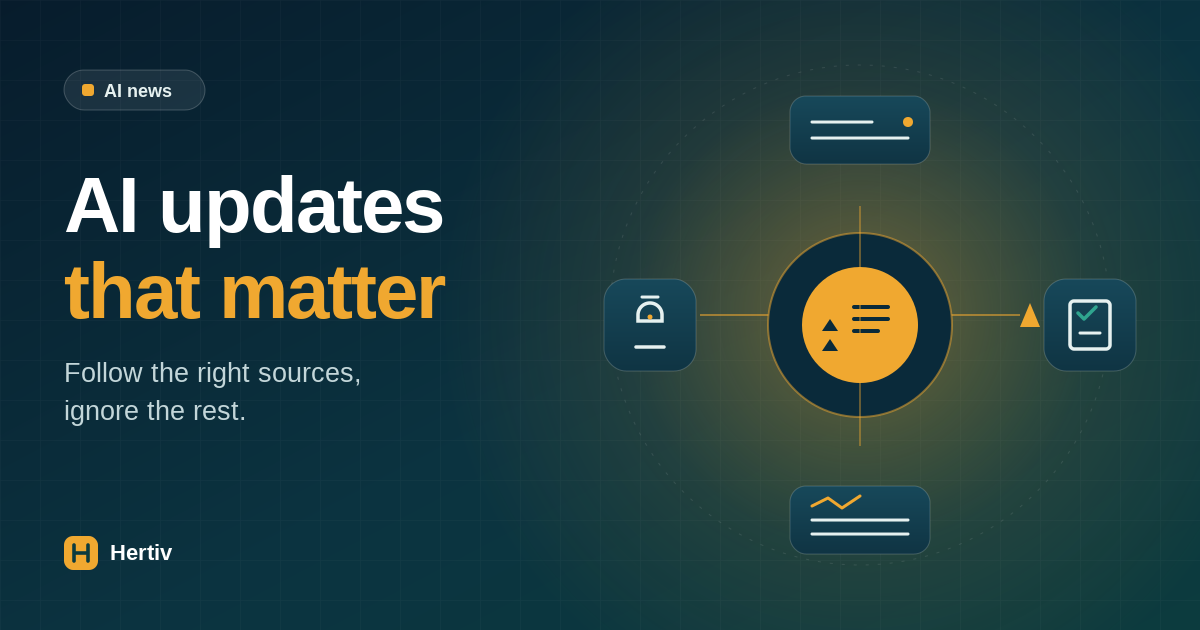
AI updates arrive almost daily, but most do not change your work. Learn where to follow them, how to judge each one, and what to do when a model you use changes.
On this page
Short answer
AI updates are the new model releases, feature changes, price changes and policy changes that AI providers publish, plus the research and regulation news that shapes them. Most updates matter only to a narrow group, so the skill is filtering: follow the official sources, judge each update against your own use, and test before you change anything.
What are AI updates?
AI updates are the changes that AI providers, researchers and regulators announce: a new model version, a new feature in a tool you use, a price change, a safety rule or a research result that changes what is possible. They arrive almost daily, and most of them do not change what you should do next.
The updates that matter fall into four groups. Model updates change what a model can do or how well it does it. Product updates change the tools around the model, such as new features in a chat app or an API. Price and access updates change what a model costs or who can use it. Policy updates change the rules: data handling, safety limits or regulation.
Following AI updates is not about reading everything. It is about knowing which sources to trust, checking each update against the work you actually do, and ignoring the rest until it becomes relevant.
Where do AI updates come from?
AI updates come from many places, and the source decides how much to trust them. Official provider blogs and changelogs are the most reliable, because they describe what actually changed. Research papers and model cards describe what a new model can do, with the limits included. Community posts and social media are faster but often wrong about details.
| Source | What it tells you | How much to trust it |
|---|---|---|
| Provider blog | New models and features | High, but it is marketing too |
| Changelog and docs | Exact changes and dates | High, check the date |
| Model card | What a model can and cannot do | High, read the limits |
| Research paper | New methods and results | High, but check the test |
| Community posts | What people are trying | Low, verify before acting |
| Regulator notices | New rules and deadlines | High, read the original |
One official source beats ten second-hand summaries. When an update matters, read the provider's own post or changelog, not a summary of it.
How do you follow AI updates without drowning in them?
You follow AI updates without drowning by narrowing the sources and checking them on a schedule, instead of reading everything as it arrives. A short routine beats constant checking.
Pick three sources and no more: the changelog of the model or tool you actually use, one provider blog, and one trusted newsletter or digest. Check them once a week, at a fixed time, and keep a short list of updates that touch your work. Everything else can wait until it shows up in the weekly check.
Ignore benchmarks quoted without context. A model that scores higher on a test may not be better at your task, and a headline number rarely says which test was used or what changed. If a claim matters, look for the test and the comparison, not just the score.
How do you judge whether an update matters to you?
You judge an AI update by asking three questions: does it touch something I use, does it change the result, and does it change the cost or the rules. If the answer to all three is no, the update can wait.
First, check the scope: a new model version matters only if you use that model or a tool built on it. Second, check the result: does the update fix a failure you actually see, or add a feature your users asked for? Third, check the cost and the rules: a price change, a retired model or a new data rule can force a change even when the model itself is fine.
When an update passes all three checks, test it before adopting it. The evaluation guide in how to evaluate an LLM application covers how to run that test with real cases from your own work.
What should you do when a model you use changes?
When a model you use changes, treat it as a small project: read the changelog, test the new version on your own cases, and switch only when the results are at least as good. Never switch on the day of the announcement.
- Read the changelog. Note what changed, what was retired and what the provider recommends instead.
- Run your own test. Use a fixed set of real cases from your work and compare the old and new versions side by side.
- Check the cost. A new version can cost more per use, so price the same workload before and after.
- Plan the switch. Keep the old version running while the new one is tested, and set a date to retire the old one.
- Tell your users. If answers or behaviour change, say so in plain words before the switch, not after.
For teams that need help planning the change, AI readiness assessment covers the data and process checks that should happen before any model switch.
Example (hypothetical): a support team tests a model update
Example (hypothetical): a support team uses a model to draft replies to customer tickets. The provider announces a new version that promises better answers. The team does not switch at once. Instead it picks 20 past tickets with known good answers and runs both versions on them.
The new version gives the same or a better answer on 17 of the 20 tickets, and a worse answer on 3. That is 17 out of 20, or 85% as good or better. The team reads the 3 worse answers and finds that all 3 are billing disputes, where the new version is less careful about quoting the exact policy.
The team keeps the old version for billing tickets and switches the rest to the new version. Two weeks later it re-tests the 3 billing cases and finds the new version still weaker, so it keeps the split. The update was real, but the test showed where it helped and where it did not.
Common mistakes with AI updates
The most common AI update mistakes are switching on the day of the announcement, trusting a headline number, and following so many sources that nothing gets read properly. Name the mistakes before the next update arrives.
- Switching models the day an update is announced, without testing on your own cases
- Trusting a benchmark score without checking which test was used
- Following ten sources and reading none of them properly
- Ignoring a retired model until it stops working
- Missing a price change and finding out from the next bill
- Treating a research result as a product you can buy today
For help turning an update into a plan, generative AI consulting covers how to judge which changes are worth adopting and which can wait.
Key takeaways
- AI updates are model, product, price and policy changes, and most of them do not change your work
- Follow three trusted sources on a weekly schedule, and read the official changelog when an update matters
- Judge each update by scope, result and cost before acting on it
- Test a new model version on your own cases before switching, and keep the old version running meanwhile
- Watch for retired models and price changes, which can force a change even when the model is fine
Frequently asked questions
Where should I follow AI updates?
Start with the changelog and docs of the model or tool you actually use, plus one provider blog and one trusted digest. Check them once a week at a fixed time. Official sources are the most reliable; community posts are faster but often wrong about details.
How often do AI models change?
Providers release new versions and features often, sometimes several times a month for popular models. Most changes are small, and many do not affect existing use. The changelog of the model you use is the reliable record of what actually changed and when.
Should I always switch to the newest model?
No. A newer model is not automatically better at your task. Test the new version on a fixed set of real cases from your work and compare it with the old version. Switch only when the results are at least as good, and keep the old version running while you test.
What is a model card, and why should I read it?
A model card is the provider's own document describing what a model can and cannot do, what data it was trained on and what its limits are. It is the best source for the limits of a new model, and it is worth reading before you trust the model with a new task.
How do I know if an AI update affects my business?
Ask three questions: does it touch a model or tool you use, does it change the result your users see, and does it change the cost or the rules. If the answer to all three is no, the update can wait until your next weekly check.
What happens when a model I use is retired?
The provider usually announces a retirement date in the changelog. Plan the switch before that date: test the replacement on your own cases, check the price, and keep the old version running until the new one is proven. Do not wait until the model stops working.