AI RWA Dynamic Equity Valuation: How It Works
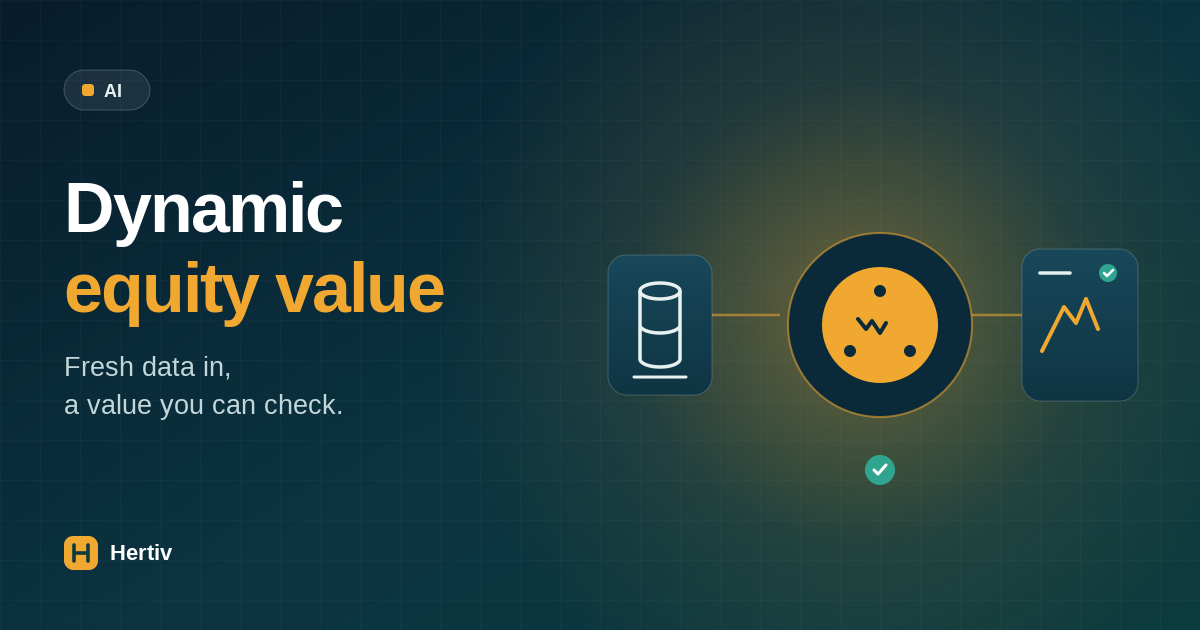
AI dynamic equity valuation updates a tokenized asset's share price as new data arrives, instead of waiting for a quarterly appraisal. Here is how it works.
On this page
Short answer
AI RWA dynamic equity valuation is a method for pricing tokenized shares in real-world assets, such as property or funds, where an AI model updates the value continuously as new market, operating and comparable-asset data arrives. It replaces fixed, infrequent appraisals with a valuation that moves with the underlying asset.
What is AI RWA dynamic equity valuation?
AI RWA dynamic equity valuation is a way of pricing equity in a real-world asset that has been tokenized, where an AI model updates the value as new data arrives instead of waiting for a scheduled appraisal. RWA stands for real-world assets: property, funds, commodities and other assets whose ownership is recorded as tokens on a blockchain.
Traditional valuation of private equity is slow. An appraiser looks at the asset every few months, applies comparable transactions and a discount rate, and produces a single number. Between appraisals the price is stale, even when the market or the asset itself has moved.
Dynamic valuation changes the timing. The model watches the data that drives value — rents, occupancy, comparable sales, interest rates and the asset's own operating numbers — and updates the equity value when the inputs move. The token price then tracks the asset more closely, which matters for holders who want to trade or borrow against it. For the tokenization side, see the RWA tokenization guide.
How does dynamic valuation work?
Dynamic valuation works by feeding live and recent data into a model that estimates what the equity is worth, then publishing the new value with the inputs that produced it. The model does not invent a price; it applies a valuation method to data that can be checked.
| Input | What the AI does | What comes out |
|---|---|---|
| Operating data | Reads rents, occupancy and costs | Updated cash flow estimate |
| Comparable sales | Finds similar assets that sold | Market price range |
| Market rates | Tracks interest and discount rates | Adjusted discount rate |
| Asset events | Flags repairs, leases and vacancies | Revised value drivers |
| Token trades | Reads recent secondary trades | Market check on the model |
The valuation method itself is familiar: discounted cash flow for income assets, or comparable sales for assets that trade. What the AI adds is speed and consistency. It applies the same method to fresh data every time, so two valuations a month apart differ because the inputs changed, not because a different person did the sums.
What data feeds the valuation?
A dynamic valuation is only as good as its inputs, and the inputs fall into three groups: the asset's own operating data, market data, and the rules that govern how the asset is valued.
Operating data comes from the asset manager: rents received, occupancy, maintenance costs, lease expiry dates and any capital spending. This data should come from systems of record, not from spreadsheets passed by email, because the model will act on whatever it is given.
Market data covers comparable transactions, interest rates and sector indices. For property, that means recent sales of similar buildings in the same area. For funds, it means the performance of comparable funds and the cost of capital. The model needs enough comparable data to be meaningful; a rare asset with no comparables is hard to value dynamically.
The third group is the valuation rules: the discount rate method, how to treat one-off costs, and the frequency of updates. These rules should be written down and agreed before the model runs, so a holder can see why the value moved. RWA tokenization covers how the asset itself is put on chain.
Where is dynamic equity valuation used?
Dynamic equity valuation is used where tokenized assets trade or are used as collateral, because both need a price that is current enough to trust.
The clearest use is secondary trading. A holder who wants to sell a token needs a price that reflects the asset today, not the last appraisal. A dynamic valuation gives buyers and sellers a reference price, which narrows the gap between what sellers ask and what buyers offer.
The second use is lending. A token used as collateral needs a value the lender can rely on. If the value is stale, the lender either lends too little or takes too much risk. A valuation that updates as the asset changes lets the lender set loan limits with more confidence.
The third use is reporting. Fund managers who tokenize equity need to show holders what their stake is worth. A dynamic valuation gives holders a current number instead of a quarterly statement, which is part of why tokenization appeals to investors in the first place.
How do you run a dynamic valuation in 5 steps?
You run a dynamic valuation by agreeing the method, connecting the data, testing the model, publishing the value with its inputs, and reviewing it on a schedule. Each step has a point where a person checks the result.
- Agree the valuation method. Pick the method for the asset type, such as discounted cash flow for income assets, and write down the discount rate rules.
- Connect the data sources. Link the asset manager's systems, market data and comparable sales, and check the feeds are complete and current.
- Test against past appraisals. Run the model on historical data and compare its values with past appraisals to see where it agrees and where it differs.
- Publish value with inputs. Each valuation should show the value, the date, the key inputs and the method, so a holder can check the reasoning.
- Review on a schedule. Have a person review the model and its outputs regularly, and re-check the method when the market changes.
The review step is what keeps the valuation honest. A model that runs without review will eventually produce a value nobody can explain, and an unexplained value is one holders will not trust.
Example (hypothetical): valuing tokenized shares in a rental building
Example (hypothetical): a fund tokenizes equity in a rental building with 40 flats. The last appraisal put the equity at 4,000,000, based on annual rent of 480,000, costs of 120,000 and a discount rate of 9%.
Three months later, rents rise: annual rent is now 504,000, costs are 126,000, and the discount rate has fallen to 8.5% as interest rates ease. The model updates the cash flow to 378,000 a year and applies the new rate, producing a revised equity value of about 4,450,000.
The change is published with the inputs: rent 504,000, costs 126,000, discount rate 8.5%, and the method used. A holder can see that the value rose because rents rose and rates fell, not because the model changed its mind.
If instead the building had lost a large tenant, the model would show the opposite: lower rent, the same costs, and a lower value. The point is the same either way. The valuation moves with the asset, and the reasons are visible.
What are the common mistakes?
The most common dynamic valuation mistakes are trusting the model without checking its inputs, hiding the method, and treating a model value as a market price.
- Bad data in, wrong value out. Stale rents or missing costs will move the valuation the wrong way.
- Hiding the method. A value with no visible inputs or method cannot be checked, so holders will not trust it.
- Treating the model value as a trade price. The model gives a reference value; the market price is what a buyer will actually pay.
- No human review. A model that runs without review will eventually produce a value nobody can explain.
- Too few comparables. A rare asset with no comparable sales is hard to value dynamically, and the model should say so.
- Updating too often. Daily updates on slow-moving data add noise, not information.
Dynamic valuation works best as a transparent reference price, not as a replacement for judgement. The model does the arithmetic; a person owns the method, the data and the decision to publish. For the ownership side, see what asset tokenization is.
Key takeaways
- Dynamic valuation updates equity value as new data arrives, instead of waiting for a quarterly appraisal
- The model applies a familiar valuation method to fresh data, so the value moves because inputs changed
- Operating data, market data and written valuation rules are the three inputs that matter
- The main uses are secondary trading, lending against tokens and holder reporting
- Every published value should show its inputs and method, so holders can check the reasoning
Frequently asked questions
What is RWA in tokenization?
RWA stands for real-world assets: property, funds, commodities and other assets whose ownership is recorded as tokens on a blockchain. Tokenizing an RWA lets the equity be held, traded or used as collateral in smaller pieces than the whole asset, which is why valuation matters to holders.
How is dynamic valuation different from an appraisal?
An appraisal is a point-in-time value produced by a person, usually every few months. Dynamic valuation applies the same kind of method continuously as new data arrives, so the value is updated when rents, rates or comparable sales move, rather than waiting for the next appraisal.
Can AI value any tokenized asset?
No. An asset needs enough operating data and comparable transactions for a model to work with. A rare asset with no comparables, or one whose income is hard to measure, is difficult to value dynamically, and the model should say so rather than produce a confident number.
Is the model value the same as the token price?
No. The model value is a reference price based on the asset's data. The token price is what a buyer will actually pay on the market, which also reflects demand, liquidity and how easy the token is to trade. The two should be close, but they are not the same thing.
Who checks a dynamic valuation?
A person should review the model, its inputs and its outputs on a schedule, and the method should be written down and agreed before the model runs. Holders should be able to see the value, the date, the key inputs and the method for every valuation that is published.
Does dynamic valuation replace auditors?
No. Auditors check the asset, the data and the controls around the valuation. A dynamic valuation model is a tool that applies a method to data; the audit checks whether the data is real, the method is sound and the controls work. The two are complementary, not substitutes.