AI Project Management: How to Run an AI Project
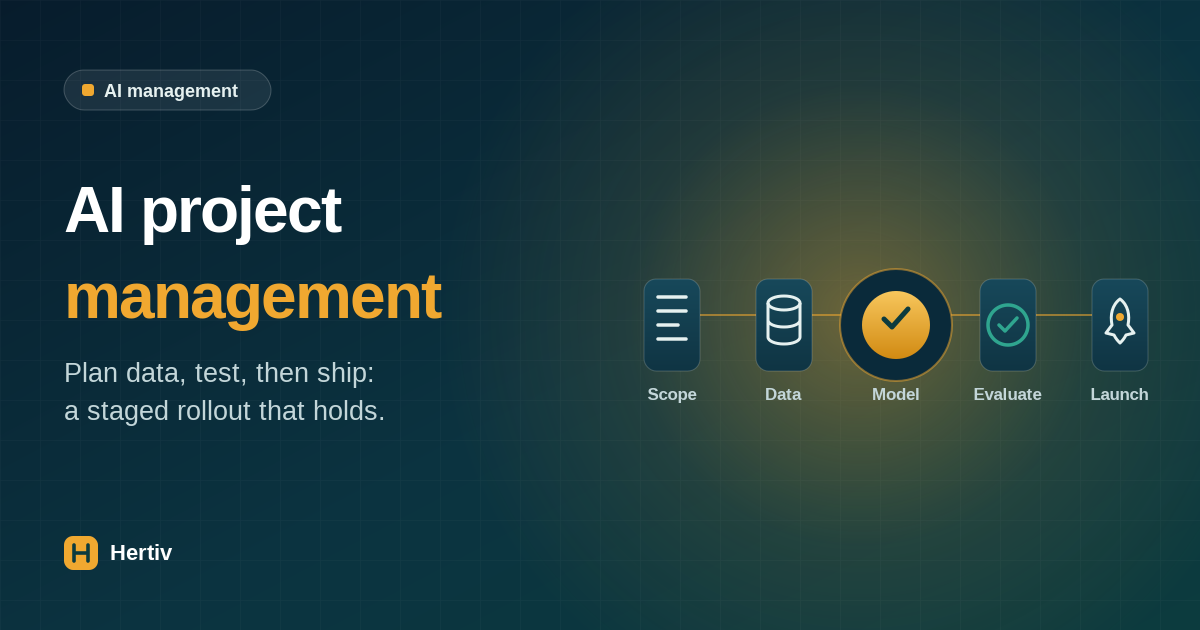
AI project management means planning data, evaluation and rollout alongside the build, so a model that works in a demo works for real users too.
On this page
Short answer
AI project management is the planning and delivery of a project that builds an AI feature: scoping the problem, getting the data ready, testing the model on cases it has not seen, and rolling it out in stages. It differs from ordinary software project management because the system's behaviour is learned from data, so results are uncertain until they are measured.
What is AI project management?
AI project management is the work of planning, running and delivering a project that builds an AI feature or product, from the first problem statement to a version users can rely on. It covers scope, data, people, evaluation and rollout, and it differs from ordinary software project management because the core behaviour of the system is learned from data rather than written as fixed rules.
That difference changes what a plan looks like. A feature with fixed rules either works or it does not, and testing can confirm it. An AI feature can work well on most inputs and fail on a few, so the plan has to include time to collect data, label examples, test on cases the team has not seen, and decide what good enough means before launch.
| Project phase | Ordinary software | With AI |
|---|---|---|
| Scope | Fixed feature list | Problem plus a quality bar |
| Build | Write and test code | Data, training and tuning |
| Testing | Pass or fail cases | Score on an evaluation set |
| Launch | Ship to everyone | Staged rollout with review |
The rest of this article walks through each part of that plan: how AI projects differ, the roles they need, the steps to run one, and how to tell whether it is on track. The failure modes a good plan avoids are covered in why AI projects fail.
How is managing an AI project different?
Managing an AI project is different because the hardest work is not writing code. It is getting data that represents the real task, agreeing how quality will be judged, and accepting that the first version will need several rounds of fixes before it is safe to ship.
Four differences shape every plan:
- Data is a deliverable. The model is only as good as the examples it learns from, so collecting, cleaning and labelling data is scheduled work, not preparation that happens off to the side.
- Output is uncertain. The same model can answer well on Tuesday and badly on a new kind of input on Wednesday, so testing means measuring a score, not ticking off cases.
- Progress is hard to see. A model can look finished in a demo and still fail on real inputs, so the team needs an evaluation set that stands in for real use.
- Costs keep running. Inference, data refresh and monitoring continue after launch, so the budget has to cover operating the system, not just building it.
These differences do not call for a new management method. They call for a normal plan with extra room for data work, evaluation and rework, and for dates that move when the score says the model is not ready. For the wider question of what makes such projects succeed, see successful AI projects.
What roles does an AI project need?
An AI project needs five roles, and on a small team one person may cover two of them. The point is that each job has an owner, because the gaps between roles are where AI projects usually stall.
- Project manager. Owns scope, dates, risks and the decision to ship or wait. Keeps the evaluation bar visible so nobody ships on a feeling.
- Domain expert. Knows what a good answer looks like in the real task and reviews outputs. Without this person, the team cannot tell good from bad.
- Data engineer. Gets data out of source systems, cleans it and keeps it flowing. Bad data quietly becomes a bad model.
- Machine learning engineer. Builds and tunes the model, runs the evaluation set and reports the score honestly, including the failures.
- Reviewer or tester. Checks outputs on fresh cases, hunts for edge cases and owns the list of things the model must never do.
On a first project, the domain expert matters most. A team can hire model help, but nobody outside the business can say whether an answer is right for its customers. If you are starting from zero, an AI readiness assessment will show which of these roles you already have and which you need to find.
How do you plan an AI project in steps?
You plan an AI project by working from the problem to the proof, not from the model to the problem. Each step produces something the next step can check, so the team finds out early whether the idea is real.
- Write the problem in one sentence. Name the user, the task and the result that counts as success. If the sentence needs three clauses, the scope is too wide.
- Collect a sample of real inputs. Gather a few hundred real cases from the actual workflow, not made-up examples, and check that you are allowed to use them.
- Label a small evaluation set. Have the domain expert mark the right answer for 100 to 200 cases and keep this set separate from training data.
- Build the simplest version first. A retrieval step or a small model often answers the question well enough to learn from, and it is cheaper to fix.
- Measure and fix the worst failures. Run the evaluation set, read the failures, and fix the data or the prompt before adding features.
- Roll out in stages. Start with a small group of users, review every output for a while, then widen the rollout only when the score holds.
This sequence keeps the project honest. If step two shows the data does not exist, or step five shows the score will not reach the bar, the team learns it in weeks, not months. An AI proof of concept follows the same shape on a smaller scale.
How do you measure progress on an AI project?
You measure progress on an AI project with a fixed evaluation set and a written quality bar, not with a percentage of tasks marked done. The score on that set is the one number that tells the team whether the model is getting better.
Set the bar before building starts. It might be that nine in ten answers are correct, that no answer invents a price, or that a human reviewer accepts the draft without edits most of the time. The exact bar depends on the task, but it must be written down so the ship decision is not argued from memory.
Track four numbers as the project runs:
- Score on the evaluation set. Run the same cases after every change, so improvements are real and not a new test set flattering the model.
- Failure types. Group the wrong answers by cause, such as missing data, a wrong source or a misunderstood question, and fix the biggest group first.
- Human review time. If reviewers spend longer fixing drafts than writing from scratch, the model is not helping yet.
- Operating cost per task. Model calls, data refresh and review time all cost money, so the cost per completed task has to stay below the value it creates.
Review these numbers in a short weekly meeting with the domain expert present. When the score stalls for two rounds, the problem is usually the data or the scope, not the model, and the plan should change rather than the deadline.
Example (hypothetical): a support agent project
Example (hypothetical): a software company gets 400 support tickets a week and wants an agent that drafts answers from its help centre. The project manager scopes it to drafting only, with a human sending every reply.
The team labels 150 past tickets as its evaluation set and agrees the bar: nine in ten drafts must be correct and usable without edits. The first version drafts answers for 240 of the 400 tickets each week, and reviewers accept 180 of those drafts as they are.
The arithmetic shows whether the project is worth continuing. Without the agent, answering 240 tickets takes about 12 minutes each, which is 48 hours a week. With the agent, reviewers spend about 4 minutes checking each draft, which is 16 hours a week. That saves 32 hours a week, even though 60 drafts still need rewriting.
The team ships the drafting version to all support staff, keeps the review step, and re-runs the evaluation set every month. The launch is not the end of the project; it is the point where real tickets start teaching the team what to fix next.
What are the common mistakes?
The most common AI project mistakes are starting with the model, skipping the evaluation set, and treating launch as the finish line. Each one is easy to avoid once the team knows to watch for it.
- Starting with the model. Picking a model before defining the problem leads to a system that answers the wrong question well.
- No evaluation set. Without fixed test cases, every demo looks good and nobody can tell whether changes help or hurt.
- Demo data instead of real data. Clean sample data hides the messy inputs the system will meet on day one.
- No domain expert on the team. Engineers cannot judge answer quality in a field they do not know.
- Shipping everything at once. A full rollout with no review step turns the first bad week into a customer problem.
- No plan for after launch. Models drift as data changes, so a project with no monitoring slowly gets worse.
Key takeaways
- AI project management adds data, evaluation and staged rollout to a normal project plan
- The model is only as good as its data, so data work is scheduled, not assumed
- A fixed evaluation set and a written quality bar are what make progress visible
- The domain expert is the most important role on a first AI project
- Roll out in stages with human review, and keep measuring after launch
Frequently asked questions
What is the first step in managing an AI project?
Write the problem in one sentence: the user, the task and the result that counts as success. Then collect real inputs from that workflow and label a small evaluation set. If the problem cannot be written in one sentence, the scope is too wide and needs cutting before any building starts.
How long does an AI project take?
A narrow first version usually takes a few weeks of data work and building, followed by several rounds of testing and fixes. The full timeline depends on data quality and how strict the quality bar is, so a team should plan for rework rather than a single build phase.
Do AI projects need a different method from software projects?
No. The same planning, roles and delivery discipline apply, with extra room for data work, evaluation and rework. What changes is that progress is measured by a score on an evaluation set, not by features marked done.
Who should own an AI project?
A project manager should own scope, dates and the ship decision, working with a domain expert who judges answer quality. The domain expert is the person who can say whether an output is right, and without one the team cannot tell good work from bad.
When is an AI project ready to launch?
When the model meets the written quality bar on the evaluation set and a staged rollout with human review is in place. Launching earlier turns the first bad week into a customer problem, so the bar and the review step should both exist before shipping.
What happens after an AI project launches?
The team keeps running the evaluation set, reviews real outputs, and watches cost per task. Models drift as data changes, so monitoring and regular re-testing are part of operating the system, not optional extras.