AI-Powered Asset Tokenization: Use Cases That Make Sense
AI makes tokenization faster and safer: it values assets, reads documents, checks compliance and matches buyers. Here are the use cases where the combination works.
On this page
Short answer
AI-powered asset tokenization uses artificial intelligence to make tokenized assets faster to value, easier to check and simpler to trade. AI reads the documents, estimates the value, screens buyers for compliance and matches supply with demand, while the blockchain records who owns each token. The combination works best where the asset is hard to value or slow to transfer today.
What is AI-powered asset tokenization?
AI-powered asset tokenization is the combination of two technologies: tokenization, which turns an asset such as a building, a fund or a shipment of goods into digital tokens on a blockchain, and AI, which handles the work around the tokens.
Tokenization alone records ownership. AI adds the judgement: reading contracts and valuations, checking that a buyer is allowed to hold the token, estimating a fair price, and flagging documents that do not match. Together they cut the manual work that makes private assets slow and expensive to trade.
The use cases that make sense share three traits: the asset is valuable but hard to divide or transfer, the paperwork is heavy, and the buyers need to be checked. Where those traits are absent, a plain database usually does the job better.
For the tokenization side alone, how tokenization works explains the mechanics of turning an asset into tokens.
How does AI change tokenization?
AI changes tokenization by automating the checks and estimates that humans do slowly. A tokenized asset needs a valuation, a set of legal documents, a compliance check on each buyer and a price for the market, and AI can assist with each of these.
| Task | What AI does | What it replaces |
|---|---|---|
| Document review | Reads contracts and flags gaps | Manual page-by-page checks |
| Valuation | Estimates value from comparables | Slow manual appraisals |
| Compliance screening | Checks buyer identity and rules | Repeated manual checks |
| Price discovery | Suggests a price from recent trades | Guesswork on illiquid assets |
| Fraud detection | Spots odd patterns in documents | Sampling a few files by hand |
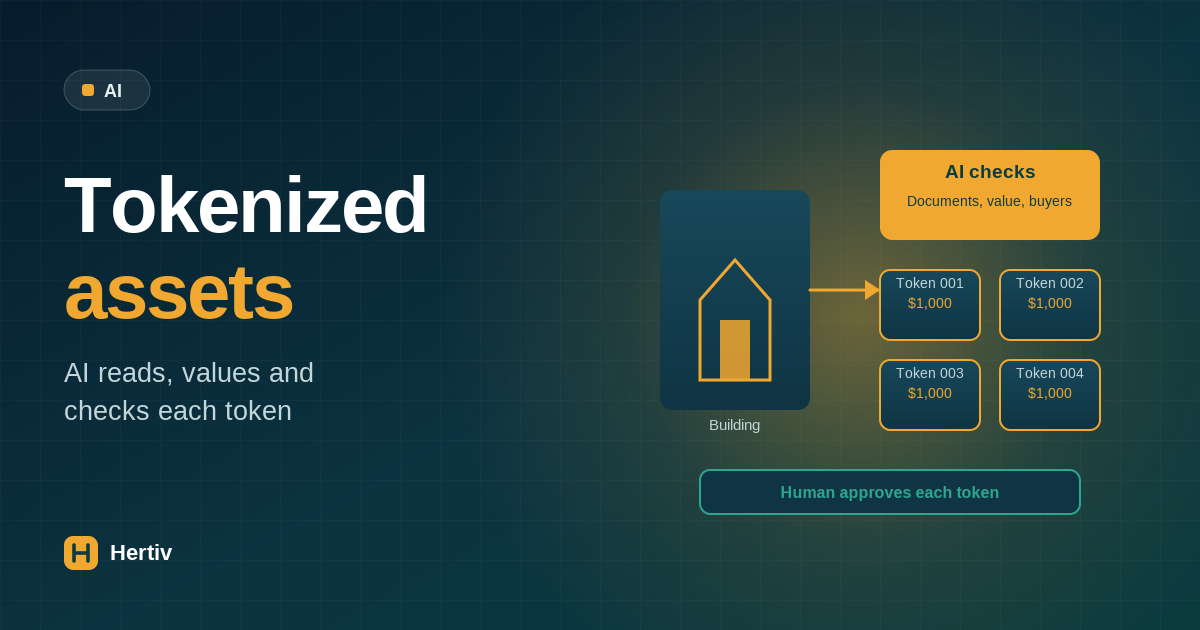
None of this removes the need for a human. The AI drafts, estimates and flags, and a person approves the valuation, the documents and the buyer. The saving is time, not responsibility.
Real estate: fractional ownership without the paperwork
Real estate is the clearest use case for AI-powered tokenization, because a building is valuable, hard to divide and slow to sell. Tokenization splits it into shares that smaller investors can buy, and AI handles the valuation and the paperwork.
The AI reads the title, the lease agreements and the valuation reports, and flags anything that does not match, such as a lease that ends before the token term or a valuation that relies on outdated comparables. It can also estimate rental income from local market data and suggest a price range for the tokens.
Buyers still need to be checked against the rules for who can invest, and the tokens still need a market to trade on. AI speeds up the checks; it does not create buyers. The how to tokenize real estate post covers the steps in more detail.
The honest limit is liquidity. A token is easier to sell than a whole building, but only if there is a market for it. Teams should plan for slow trading in the early years.
Funds and private equity: faster onboarding and reporting
Funds and private equity are a strong use case because onboarding an investor is slow: identity checks, suitability forms, tax documents and signatures, repeated for each fund. AI reads the documents, checks them against the rules and flags the gaps, so onboarding takes days instead of weeks.
Once the investor holds tokens, AI helps with reporting too. It can summarise fund performance, answer investor questions from the fund documents, and flag reporting errors before they go out. The fund manager keeps control of what is sent; the AI drafts it.
Tokenization also lets a fund offer smaller minimum investments, which widens the investor base. That only works if the rules allow it, so the legal structure must be settled before the technology is built.
For the fund angle, fund tokenization covers the service side, including the legal and custody choices.
Commodities, carbon credits and supply chains
Commodities and carbon credits suit AI-powered tokenization because each unit needs proof: where it came from, what it is, and whether the claim behind it is real. AI reads the certificates, checks them against registries and flags duplicates or mismatches.
A carbon credit, for example, needs proof that the emission was actually avoided or removed. AI can compare the project documents against satellite data and registry records, and flag credits that look double-counted. The token then carries a cleaner claim.
In supply chains, tokenization can track a shipment of goods from origin to buyer, with AI checking the documents at each handoff. This is useful where buyers pay a premium for provenance, such as certified timber or conflict-free minerals.
The limit is the data. If the underlying records are weak, AI cannot fix them; it can only show the gaps more clearly.
What are the risks and limits?
The risks of AI-powered tokenization are bad valuations, compliance mistakes, weak liquidity and the temptation to trust the AI too far. A wrong valuation becomes a wrong token price, and a missed compliance check becomes a legal problem.
- Valuation errors. An AI estimate based on poor comparables can misprice the asset.
- Compliance gaps. Rules differ by country and investor type, and the AI must be checked against the current rules.
- Weak liquidity. Tokens are easier to trade than whole assets, but only if buyers exist.
- Data quality. AI trained on incomplete documents will miss problems.
- Over-trust. A confident AI draft can hide a mistake that a careful human would catch.
Regulation is the other limit. Tokenized assets are usually securities, and the rules for issuing and trading them are strict. Get the legal advice before building the platform.
Example (hypothetical): tokenizing a small office building
Example (hypothetical): a property firm wants to tokenize a small office building valued at 2,000,000 dollars, split into 2,000 tokens of 1,000 dollars each. The manual process would take months of document review and investor checks.
The team uses AI to read the title, the tenancy agreements and the valuation report. It flags two issues: one lease ends in six months, and the valuation relies on comparables from a different district. A human reviewer fixes the valuation and notes the lease risk in the investor documents.
Onboarding is faster too: of 100 interested investors, the AI checks identity and suitability documents for 80 in a day, and 20 need a human review for missing papers. The 80 cleared investors buy 1,600 tokens, or 1,600,000 dollars of the building, in the first offering.
The arithmetic adds up: 2,000 tokens at 1,000 dollars is 2,000,000 dollars, and 1,600 tokens sold is 80 percent of the offering. The numbers are invented to show the shape of the saving, not a real result.
What are the common mistakes?
The most common mistakes in AI-powered tokenization are trusting the AI valuation, skipping the legal work, and assuming tokens will trade themselves.
- Accepting AI valuations unchecked. Every estimate needs a human reviewer who knows the asset.
- Building before the legal structure is settled. The token design follows the law, not the other way round.
- No plan for liquidity. A token with no buyers is a certificate, not a market.
- Training AI on poor documents. Messy, incomplete records produce confident mistakes.
- Ignoring the investor experience. If buying a token is harder than buying a fund share, investors will not bother.
Start with one asset type, one market and one clear buyer group. The real-world asset tokenization use cases post covers where tokenization already works without AI.
Key takeaways
- Tokenization records ownership; AI handles valuation, documents and checks.
- Real estate, funds and carbon credits are the strongest use cases today.
- AI drafts and flags; a human approves valuations, documents and buyers.
- Tokenization does not create liquidity on its own.
- Get the legal structure settled before building the platform.
Frequently asked questions
What is the difference between tokenization and AI-powered tokenization?
Tokenization turns an asset into digital tokens on a blockchain. AI-powered tokenization adds artificial intelligence to the work around the tokens: reading documents, estimating value, screening buyers and suggesting prices. The tokens are the same; the process around them is faster.
Which assets suit AI-powered tokenization best?
Assets that are valuable, hard to divide and heavy on paperwork suit it best: real estate, funds, commodities and carbon credits. Assets that are already easy to trade, such as listed shares, gain little from tokenization.
Can AI value an asset on its own?
No. AI can estimate a value from comparables and market data, but the estimate must be reviewed by a person who knows the asset. A wrong valuation becomes a wrong token price, so human review is not optional.
Is a tokenized asset a security?
Usually yes. In most markets, a token that represents ownership in an asset and offers a return is treated as a security, which means strict rules on who can issue it and who can buy it. Get legal advice for your market before launching.
How does AI help with compliance in tokenization?
AI reads investor documents, checks identity and suitability against the rules, and flags gaps for human review. This cuts onboarding from weeks to days, but the rules change often, so the checks must be reviewed against current law.
Do tokenized assets trade easily?
Not yet. Tokenized assets trade more easily than whole buildings or fund stakes, but the markets are still small. Teams should plan for slow trading in the early years and not promise liquidity they cannot guarantee.


