AI PaaS for Enterprises: What It Is and When to Use It
AI PaaS gives an enterprise managed AI services on a cloud platform: models, data tools and deployment, without running the infrastructure.
On this page
Short answer
AI PaaS, or AI platform as a service, is a cloud platform that gives an enterprise managed AI services: hosted models, data preparation tools, model training and deployment, all running on the provider's infrastructure. The enterprise builds on top of the platform instead of buying servers and running its own AI stack.
What is AI PaaS for enterprises?
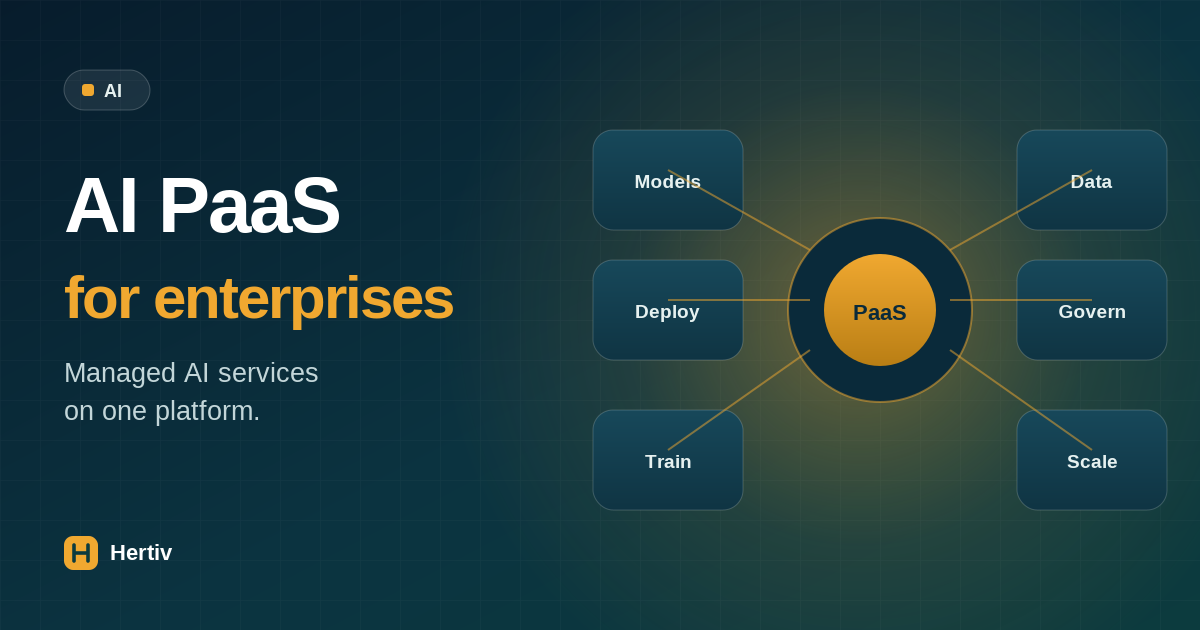
AI PaaS for enterprises is a cloud platform that provides the building blocks for AI work as a managed service. It usually includes hosted models that can be called through an API, tools for preparing and labelling data, services for training and fine-tuning models, and deployment tools that put a model behind an endpoint the company's own apps can call.
The enterprise does not buy servers, install frameworks or run the infrastructure. The provider runs the platform, patches it, scales it and keeps it available, while the enterprise focuses on its own data, its own use cases and the apps its teams use. The platform charges for what the enterprise uses, such as model calls, training time and storage.
| Layer | What the platform provides | Enterprise owns |
|---|---|---|
| Models | Hosted models behind an API | Prompts and use cases |
| Data tools | Preparation, labelling, vector stores | Its own data and access rules |
| Training | Managed training and fine-tuning | Training examples and goals |
| Deployment | Endpoints, scaling, monitoring | App logic and user access |
| Governance | Logging, access control, audits | Policies and approvals |
AI PaaS sits between using a single AI product and building everything in-house. The enterprise gets more control than a finished product, and less infrastructure work than a self-built stack.
How is AI PaaS different from SaaS and IaaS?
AI PaaS is different from SaaS because the enterprise builds its own AI features instead of buying a finished app. A SaaS product, such as a ready-made support tool, does one job out of the box. AI PaaS gives the enterprise the platform pieces, and the enterprise builds the job it needs on top of them.
AI PaaS is different from IaaS because the provider manages the AI layer, not just the servers. With IaaS, the enterprise rents machines and still installs, configures and runs the AI software itself. With AI PaaS, the provider runs the models, the data tools and the deployment services, and the enterprise only manages its own apps and data.
The middle position is the point. An enterprise that wants one finished tool should buy SaaS. An enterprise with a large AI team that wants full control should build on IaaS or its own hardware. An enterprise in between, with a few use cases and a small AI team, often fits AI PaaS best. For the cost side of building AI, see what it costs to implement AI.
When does AI PaaS make sense for an enterprise?
AI PaaS makes sense when an enterprise has several AI use cases, a small AI team, and data it must keep under its own rules. A bank with support, fraud and document use cases, for example, can run all three on one platform instead of building three separate stacks. The platform's shared logging and access control also help the enterprise meet its own audit rules.
It also makes sense when the enterprise wants to move fast. Setting up a self-run AI stack takes months of infrastructure work before the first model answers a question. On AI PaaS, a team can call a hosted model on day one and build the first pilot in weeks, then decide later whether to move any workload to its own infrastructure.
AI PaaS fits less well when the enterprise needs a model it cannot get on any platform, or when its data cannot leave its own network at all. In that case the enterprise usually builds on its own infrastructure or uses a platform that runs inside its own cloud account. The decision should follow the data rules, not the other way round.
What should enterprises check before choosing a platform?
Enterprises should check four things before choosing an AI PaaS: where the data goes, which models are available, how costs are charged, and how the platform handles access and logging. Each one affects the enterprise long after the first pilot.
Data location matters most. The enterprise should know which regions its data can sit in, whether the provider trains its own models on customer data, and how data is deleted when a project ends. If the provider's answers do not match the enterprise's own rules, no feature list will fix the gap.
Model choice and pricing come next. The platform should offer the models the enterprise needs, or let it bring its own, and the pricing should be clear per model call, per training hour and per gigabyte stored. A platform that hides its pricing behind a sales call makes budgeting hard. For how to plan a first build, see how to build an AI proof of concept.
Example (hypothetical): a bank pilots AI PaaS
Example (hypothetical): a bank with 2,000 staff wants AI help for support, document review and fraud screening. Its AI team has four people, and its data rules say customer data must stay in its own country. The team compares building its own stack with using an AI PaaS.
Building its own stack needs servers, a vector store, model hosting and monitoring. The team estimates 12 weeks of infrastructure work before the first pilot answers a question, at 4 people x 12 weeks x 40 hours = 1,920 hours.
On AI PaaS, the team calls a hosted model on day one and builds the first pilot in 4 weeks, which is 4 people x 4 weeks x 40 hours = 640 hours. The platform saves about 1,280 hours before the first pilot.
The bank checks the platform's data rules first. The platform offers a region inside the bank's country, a promise not to train on customer data, and logs for every model call. The bank runs the support pilot on the platform, measures the draft quality for a month, and only then decides whether to move the fraud workload, which has stricter rules, to its own infrastructure.
The lesson is that the platform bought the bank time, not a finished product. The team still had to build the pilots, label the data and measure the results; the platform only removed the infrastructure work in front of them.
How do enterprises start with AI PaaS, step by step?
Enterprises start with AI PaaS by picking one use case, checking the data rules, and running a small pilot with a clear measure of success. The pilot should be small enough to finish in weeks, not months, and big enough to show a real result.
- Pick one use case. Choose a workflow with clean data and a clear cost when it goes wrong, such as support drafting or document review.
- Check the data rules. Confirm where data can sit, whether the provider trains on it, and how it is deleted when the project ends.
- Set up access and logging. Give the pilot team access, turn on logging for every model call, and agree who can see the logs.
- Build the pilot. Call a hosted model, connect the team's own documents, and measure the result on 50 to 100 real examples.
- Review cost and quality. Compare the pilot's cost per case with the old way of doing the job, and decide whether to scale, change or stop.
A pilot that follows these steps gives the enterprise a real number for cost and quality, instead of a vendor demo. That number is what the next budget decision should be based on.
What are the common mistakes?
The most common mistake is treating AI PaaS as a finished product. A platform gives the enterprise building blocks, not a working app. The enterprise still has to build the use case, prepare its data, test the model and measure the result. A team that expects the platform to do the work will be disappointed.
Another mistake is skipping the data check. An enterprise that loads customer data onto a platform without checking where it sits or whether the provider trains on it can break its own rules in a way that is hard to undo. The data check comes before the first upload, not after it.
Teams also forget the cost of model calls. A pilot that costs little can grow expensive when it scales to thousands of cases a day, because each call costs tokens. Measure the cost per case in the pilot, and set a budget alert before scaling. For how to keep model costs down, see LLM API cost per month.
Key takeaways
- AI PaaS is a managed platform for building AI features, not a finished app.
- It sits between SaaS and building everything in-house.
- Check data location and training rules before the first upload.
- Start with one pilot and measure cost per case.
- A platform removes infrastructure work, not the work of building the use case.
Frequently asked questions
What does AI PaaS stand for?
AI PaaS stands for AI platform as a service. It is a cloud platform that provides managed AI services, such as hosted models, data tools and deployment, so an enterprise can build AI features without running its own AI infrastructure.
How is AI PaaS different from using ChatGPT?
ChatGPT is a finished product for chatting with a model. AI PaaS is a platform for building your own features, such as a support assistant that reads your own documents. The platform gives the building blocks; the enterprise builds the feature.
Can an enterprise keep its data private on AI PaaS?
It depends on the platform. The enterprise should check where data is stored, whether the provider trains its models on customer data, and how data is deleted. Some platforms offer regions and controls that match strict enterprise rules.
What does AI PaaS cost?
The cost usually depends on model calls, training time and storage. Each question to a model costs tokens, and each document set costs indexing and storage. The enterprise should measure the cost per case in a pilot before scaling.
Does AI PaaS work for small companies?
Small companies can use it, but a single finished SaaS tool is often cheaper and faster for one use case. AI PaaS fits best when a company has several use cases and wants to build on one shared platform.
Can an enterprise leave an AI PaaS later?
Leaving is possible but takes work, because the apps and data pipelines are built on the platform's services. A team that keeps its prompts, data and evaluation sets in its own repository can move more easily than one that keeps them inside the platform.


