AI Medical Scribe: What It Does During a Patient Visit
An AI medical scribe listens during a visit and drafts the clinical note. Learn what it captures, what the clinician must still do, and how to roll one out.
On this page
Short answer
An AI medical scribe is software that listens to a patient visit and drafts the clinical note from the conversation. It separates the clinician's words from the patient's, picks out the history, examination findings and plan, and produces a structured draft for the clinician to review, edit and sign. The clinician stays responsible for the note; the scribe only does the writing.
What is an AI medical scribe?
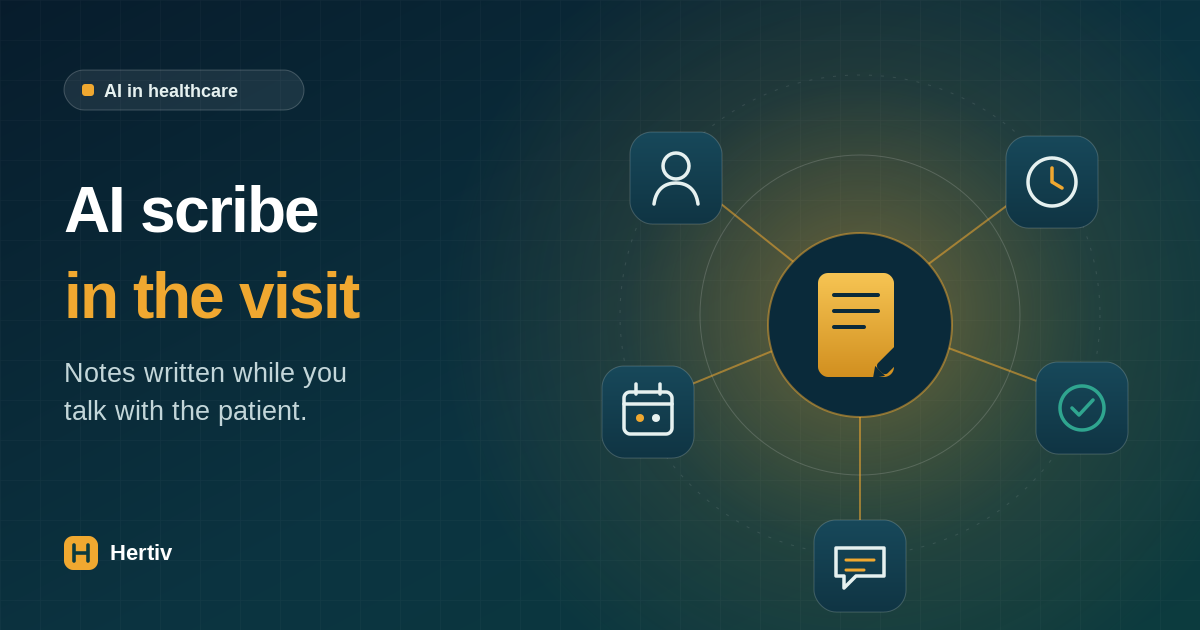
An AI medical scribe is software that listens during a patient visit and drafts the clinical note from the conversation. Unlike dictation, where the clinician speaks a summary after the patient has left, a scribe works from the visit itself: it hears the questions, the answers and the discussion, and turns them into a note in the structure the record system expects.
The scribe is not a doctor and it does not make clinical decisions. It does not diagnose, choose treatment or decide what the patient needs. Its job is documentation: capturing what was said and decided, and presenting it in a form the clinician can check quickly. The clinician reviews the draft, fixes anything wrong, and signs it. Until that signature, the note is not finished.
| Tool | What it does | Who checks the output |
|---|---|---|
| AI medical scribe | Drafts the note from the live visit | The clinician, before signing |
| AI medical transcription | Turns dictation into text | The clinician or an editor |
| AI virtual medical assistant | Handles messages, scheduling and admin | The care team, per task |
| Human scribe | Writes the note during the visit | The clinician, before signing |
Virtual assistants cover a wider set of jobs than scribes do. AI virtual medical assistants explains how clinics use them for messages, scheduling and admin work alongside documentation.
How does an AI medical scribe listen and write the note?
An AI medical scribe works in four steps: listen, separate, draft and review. First, it records the visit through a microphone or the room system, with the patient's consent. Next, it separates the speakers, so the clinician's questions and the patient's answers are labelled correctly.
Then it uses a language model to turn the conversation into a structured note, with sections such as history, examination, assessment and plan. Finally, the clinician reads the draft, corrects it and signs it.
Speaker separation is the step that most often fails. In a busy room, with family members present or two people talking at once, the software can attribute a statement to the wrong person. That matters when a symptom described by the patient ends up recorded as something the clinician observed. Reviewers should check who said what, not just whether the words are right.
The draft is shaped by templates tied to the specialty. A paediatric visit and a cardiology visit produce different notes, because the headings and the details that matter are different. A good scribe tool lets the clinic adjust those templates, so the draft matches how the team already writes. Without that, clinicians spend the time they saved on reformatting.
What does the clinician still have to do?
The clinician still has to do the clinical work: listen, examine, decide and take responsibility for the note. The scribe removes the typing, not the thinking. After the visit, the clinician reads the draft, checks the history against what the patient actually said, confirms the plan matches what was agreed, and signs. That review is where the clinician's judgement lives.
Review also catches the scribe's most common errors. The software can miss a negative, such as recording that a patient has no chest pain when the patient said they do, or it can invent a detail to fill a gap in the conversation.
These errors are rare but they are exactly the ones that change a record. A clinician who skims the draft will miss them, so review needs to be a real read, not a glance.
Some clinicians find review slower than expected at first, because they are reading someone else's wording instead of their own. That usually improves as the templates are tuned and the clinician learns what the tool gets wrong. If review stays slow after a few weeks, the tool is not fitted to that clinician's way of working, and the team should adjust the templates or the workflow before expanding.
Where does an AI medical scribe fit best?
An AI medical scribe fits best where visits follow a pattern and the note is long. Primary care, paediatrics, orthopaedics and other clinics with many similar visits see the most benefit, because the scribe handles the repetitive structure and the clinician only checks the details that differ. Visits with a lot of conversation and a standard note shape are the sweet spot.
It fits less well where the visit is unusual or sensitive. A first consultation with a complex history, a difficult conversation about a serious diagnosis, or a visit with several family members talking at once will produce a draft that needs heavy editing. In those cases, the clinician may save little time, and the risk of a misattributed statement is higher.
Specialties with their own vocabulary also need more setup. The scribe has to recognise the terms the specialty uses, and the templates have to match the note shape that specialty expects. A pilot in one specialty will show whether the tool handles that vocabulary well, and the team can add terms and adjust templates before rolling it out more widely.
How do you roll out an AI medical scribe?
You roll out an AI medical scribe the same way you roll out any clinical tool: with consent, a small pilot and a clear review rule. Patients need to know the visit is being recorded and why, and the clinic needs to know where recordings go and how long they are kept. That conversation should happen before the first pilot visit, not after.
- Agree the consent script. Decide what patients are told, how they can opt out, and what happens to the recording if they do.
- Pick one specialty and a few clinicians. Choose a team with repetitive visits and a willingness to give honest feedback.
- Set up secure recording. Check where audio is stored, who can access it, how long it is kept, and which data rules apply.
- Tune the templates. Match the draft to the note shape the specialty already uses, so review is a check, not a rewrite.
- Run the pilot for a few weeks. Track review time, the kinds of errors that appear, and whether clinicians actually save time.
- Expand only if review is faster than typing. If it is not, fix the templates or the workflow first.
Consent and privacy are not paperwork to rush past. Recordings of a patient visit are sensitive health information, and the clinic is responsible for them. For guidance on protecting that data, see data security and compliance.
Example (hypothetical): a clinic counts the hours
Example (hypothetical): a primary care clinic has 5 clinicians, each seeing 24 patients a day and spending 2 hours a day writing notes after clinic. That is 10 hours of note-writing a day across the team. The clinic pilots an AI scribe with 2 of the clinicians for a month.
After the pilot, each of the 2 clinicians spends 45 minutes a day reviewing drafts instead of 2 hours writing, saving 1 hour 15 minutes each, or 2 hours 30 minutes a day between them.
The arithmetic is simple: 2 clinicians times 75 minutes saved equals 150 minutes a day, which is 12 hours 30 minutes across a 5-day week. Review is slower on complex visits, about 60 minutes, and faster on routine ones, about 30 minutes.
The clinic expands to all 5 clinicians. If the same saving holds, that is 6 hours 15 minutes a day, or just over 31 hours a week, freed for patient care or finishing on time. The decision is based on the pilot's own numbers, and the clinic keeps measuring after the rollout to check the saving holds.
What are the common mistakes?
The most common mistakes are skipping consent, treating the draft as finished, and judging the tool on one specialty. Each is easy to avoid once you plan for it.
- Recording without clear consent. Patients must know the visit is recorded and be able to opt out. A consent script agreed in advance avoids awkward moments.
- Signing without reading. A fluent draft can hide a wrong negative or a misattributed statement. Review is a real read, not a glance.
- Judging the tool on the wrong visits. A scribe tested on complex first consultations will look bad. Pilot it on the repetitive visits it is built for.
- Ignoring speaker errors. Check who said what, not just whether the words are right. A symptom attributed to the wrong person changes the record.
- Skipping template tuning. A draft in the wrong shape costs as much time to fix as typing it did.
- Forgetting the audio. Recordings need secure storage, limited access and a retention rule. Agree all three before the pilot.
Clinics that plan their first AI tools carefully tend to avoid these traps. Building an AI healthcare scheduling assistant shows the same pilot-first thinking applied to a different clinic tool.
Key takeaways
- An AI medical scribe drafts the note from the live visit; the clinician reviews, edits and signs it.
- Speaker separation matters most: a statement attributed to the wrong person changes the record.
- The scribe removes typing, not thinking. Review is where the clinician's judgement lives.
- Scribes fit repetitive, standard-shaped visits best and complex or sensitive visits worst.
- Patient consent and secure recording storage are part of the setup, not an afterthought.
- Judge a scribe by review time in a pilot, not by a vendor promise.
Frequently asked questions
What is an AI medical scribe?
An AI medical scribe is software that listens to a patient visit and drafts the clinical note from the conversation. It separates the speakers, structures the history, examination and plan, and produces a draft the clinician reviews, edits and signs.
Does an AI medical scribe replace the clinician's note-writing?
It replaces the typing, not the clinical work. The clinician still listens, examines and decides, then reads the draft, checks it against what actually happened in the visit, and signs it. The note is not finished until the clinician has reviewed it.
What is the difference between an AI medical scribe and AI medical transcription?
Transcription turns dictation into text, usually recorded after the visit. A scribe listens during the visit itself, separates the speakers and drafts a structured note from the conversation. Scribes usually use transcription as one step inside a larger workflow.
Do patients need to consent to an AI medical scribe?
Yes. Patients should know the visit is being recorded, why, and how they can opt out. The clinic should also know where recordings are stored, who can access them and how long they are kept.
Can an AI medical scribe make mistakes?
Yes. It can miss a negative, attribute a statement to the wrong speaker, or invent a detail to fill a gap. These errors are rare but they change the record, which is why the clinician must read the draft properly before signing.
Which clinics benefit most from an AI medical scribe?
Clinics with many similar, repetitive visits, such as primary care and paediatrics, usually benefit most, because the note shape is predictable and the draft needs only small fixes. Complex or sensitive visits need heavier editing and save less time.