AI Loan Underwriting: How Lenders Decide Faster
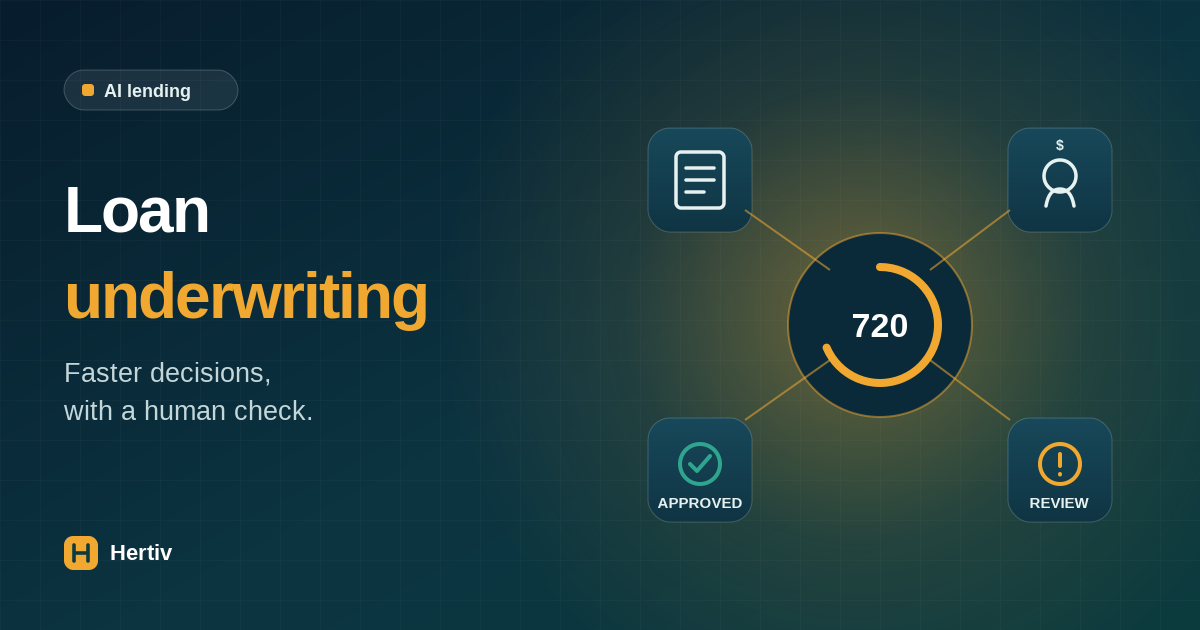
AI loan underwriting reads income, credit history and debt, then scores each application so lenders approve clear cases fast and send the rest to a human reviewer.
On this page
Short answer
AI loan underwriting uses software models to assess a loan application against the lender's credit policy, checking income, credit history, debt load and identity. Clear applications are approved quickly, borderline cases go to a human underwriter, and hard-rule failures are declined with the reasons recorded.
What is AI loan underwriting?
AI loan underwriting is the use of software models to assess a loan application and recommend whether to approve it, decline it, or send it to a human reviewer. It reads the same facts a human underwriter reads, such as income, debts and credit history, and applies the lender's rules to them in a consistent way.
It does not replace the lender's credit policy. The policy still sets the limits, such as the maximum debt-to-income ratio or the minimum credit score, and the model applies those limits to each application. What changes is speed and consistency: every application is checked against the same rules, in the same order, with the same evidence recorded.
Most lenders use it as a first pass rather than a final decision. Clear applications are approved quickly, borderline ones go to a person, and applications that break a hard rule are declined with a reason. That split is what makes the system useful, because it focuses human time on the cases where judgement actually matters.
What does the AI check before it decides?
The AI checks the facts that predict whether a borrower will repay, and it checks them in the same order for every application. The table below shows the five checks most lenders rely on and what each one is meant to catch.
| Check | What it looks at | Why it matters |
|---|---|---|
| Income | Pay slips, bank statements, tax records | Confirms the borrower can afford the payments |
| Credit history | Past loans, cards, missed payments | Shows how the borrower handled debt before |
| Debt load | Existing loans against monthly income | Flags borrowers already stretched thin |
| Employment | Job type, tenure, employer checks | Tests whether the income is stable |
| Identity and fraud | Documents, device and application signals | Catches stolen identities and false details |
No single check decides the outcome on its own. A strong income can offset a thin credit file, and a clean history can offset a short employment record. The model weighs the checks together, which is why lenders describe the result as a score with reasons rather than a simple yes or no.
How does an AI underwriting decision run?
An AI underwriting decision runs as a fixed sequence, so the same application always gets the same treatment. The sequence below is the one most lenders follow, from the moment an application arrives to the moment a decision is recorded.
- Collect the application. The borrower submits income, employment and identity details through the lender's form or app.
- Verify the documents. The system checks pay slips and identity documents against the lender's sources, and flags anything that does not match.
- Pull the credit file. The lender requests the borrower's credit report and scores it against the policy limits.
- Score the application. The model combines income, debts, history and employment into a score, and lists the reasons behind it.
- Route the decision. Clear approvals go through, borderline cases go to a human underwriter, and hard-rule failures are declined with a reason.
- Record everything. Every input, score and reason is logged, so the decision can be explained and reviewed later.
The whole run usually takes minutes for a straightforward application, compared with days for a fully manual review. That speed is the main reason lenders adopt it, but the audit trail matters just as much: when a borrower asks why they were declined, the lender can point to the specific facts and rules behind the decision.
What data does the system need?
The system needs the borrower's application details, their credit file, and proof of income and identity. Those three sources cover most of what a decision depends on, and a lender that cannot collect them cleanly will struggle to automate underwriting at all.
Application details come from the form the borrower fills in: the amount requested, the purpose, income, outgoings and employment. The credit file comes from a credit bureau and shows past borrowing, repayment behaviour and any defaults. Proof of income and identity comes from pay slips, bank statements and identity documents, which the system checks for consistency with the application.
Some lenders add extra data, such as bank transaction history with the borrower's consent, which can help people with thin credit files. Others use property or vehicle records for secured loans. What matters is that every data source is named in the policy, collected with consent where the law requires it, and checked for accuracy before it feeds a decision.
For lenders, the practical lesson is to fix data quality first. A model fed with stale income figures or mismatched identity records will produce confident-looking scores that are wrong, and the errors will show up as bad loans or unfair declines. See AI credit scoring use cases for how the scoring step fits into the wider lending process.
Where does a human still decide?
A human still decides the borderline cases, the unusual ones, and any case where the borrower disputes the outcome. AI underwriting is built around that boundary: the model handles the clear cases, and people handle the ones that need judgement.
Borderline cases are the most common handoff. An application that sits just below a score threshold, or where two checks disagree, is exactly the kind of case where a person can weigh context the model cannot see, such as a recent job change that explains a short employment record.
Unusual cases are the second handoff. Self-employed income, foreign documents, or a borrower with no credit file at all are hard to score, because the model has little comparable history to work from. A human underwriter can ask for extra evidence and make a call the model would only guess at.
Disputes are the third. When a borrower challenges a decline, a person must be able to explain the reasons, check whether the underlying data was wrong, and change the decision if it was. No lender should let a model have the last word on a disputed application.
Example (hypothetical): a lender reviews 200 applications
Example (hypothetical): a small lender receives 200 personal loan applications in a week. By hand, each review takes about 30 minutes, so the team would need 200 times 30 minutes, which is 6,000 minutes or 100 hours, to work through the whole pile.
With AI underwriting, the model clears 120 applications straight through and flags 80 for human review. Reviewers spend 20 minutes on each flagged case, which is 80 times 20 minutes, or 1,600 minutes, about 27 hours. The team saves roughly 73 hours in the week.
Of the 80 flagged cases, reviewers approve 50 after checking the extra evidence and decline 30. Added to the 120 cleared by the model, that is 170 approvals and 30 declines, which adds up to the 200 applications received. The point of the example is not the exact split, but the shape of it: the model does the routine volume, and people spend their time on the 80 cases where their judgement changes the outcome.
What are the common mistakes?
The most common AI loan underwriting mistakes are trusting the score without checking the data, letting the model decide cases it was never built for, and failing to explain declines to borrowers.
- Skipping data checks. A score built on stale income or a mismatched identity record is wrong no matter how good the model is.
- Automating the wrong cases. Thin credit files, self-employed income and foreign documents need a human; forcing them through the model produces guesses, not decisions.
- No appeal path. If a borrower cannot challenge a decline and get a person to look at it, the lender has built a black box, not a process.
- Ignoring bias in the training data. If past decisions favoured one group of borrowers, the model will copy that pattern unless the lender tests for it.
- Forgetting the fraud check. Income and identity fraud are the fastest way to lose money, so the fraud signals must run before the score, not after it.
Fraud checks deserve their own attention in any lending build. See AI mortgage underwriting fraud detection for how the fraud layer works in a related lending product.
For the general patterns behind those checks, see fraud detection using machine learning.
Key takeaways
- AI underwriting applies the lender's credit policy consistently to every application
- It checks income, credit history, debt load, employment and identity before scoring
- Clear cases are approved fast while borderline and unusual cases go to a human
- Every decision must be logged with its reasons so declines can be explained
- Data quality matters more than model choice: stale income or mismatched identity breaks the score
Frequently asked questions
What is AI loan underwriting?
AI loan underwriting is software that assesses a loan application against a lender's credit policy, using income, credit history, debt and identity checks. It recommends approval, decline or human review, and records the reasons behind each decision.
Does AI approve loans on its own?
In most setups it approves only clear cases that pass every rule. Borderline applications, unusual income patterns and any disputed decision go to a human underwriter, who makes the final call.
What data does AI underwriting use?
It uses the borrower's application details, their credit file from a bureau, and proof of income and identity such as pay slips and bank statements. Some lenders add bank transaction history with the borrower's consent.
Is AI underwriting fair to borrowers with thin credit files?
It can struggle with thin files because there is little history to score. Lenders usually route those cases to a human, who can weigh extra evidence such as bank statements or rental payments.
How is AI loan underwriting different from credit scoring?
Credit scoring is one input: a number that summarises past borrowing behaviour. Underwriting is the full decision, which combines the score with income, debt, employment, identity and fraud checks against the lender's policy.
What happens if a borrower disagrees with a decline?
The borrower should be able to ask for a review. A human underwriter checks whether the underlying data was wrong or incomplete, and can change the decision if the facts support it.